
Energy & Sustainability
How do you measure and verify smart building energy savings?
How to measure and verify energy savings using IPMVP options, adjusted baselines and a complete M&V plan.
Put meters where their data will change a decision, starting from the questions the owner needs answered.
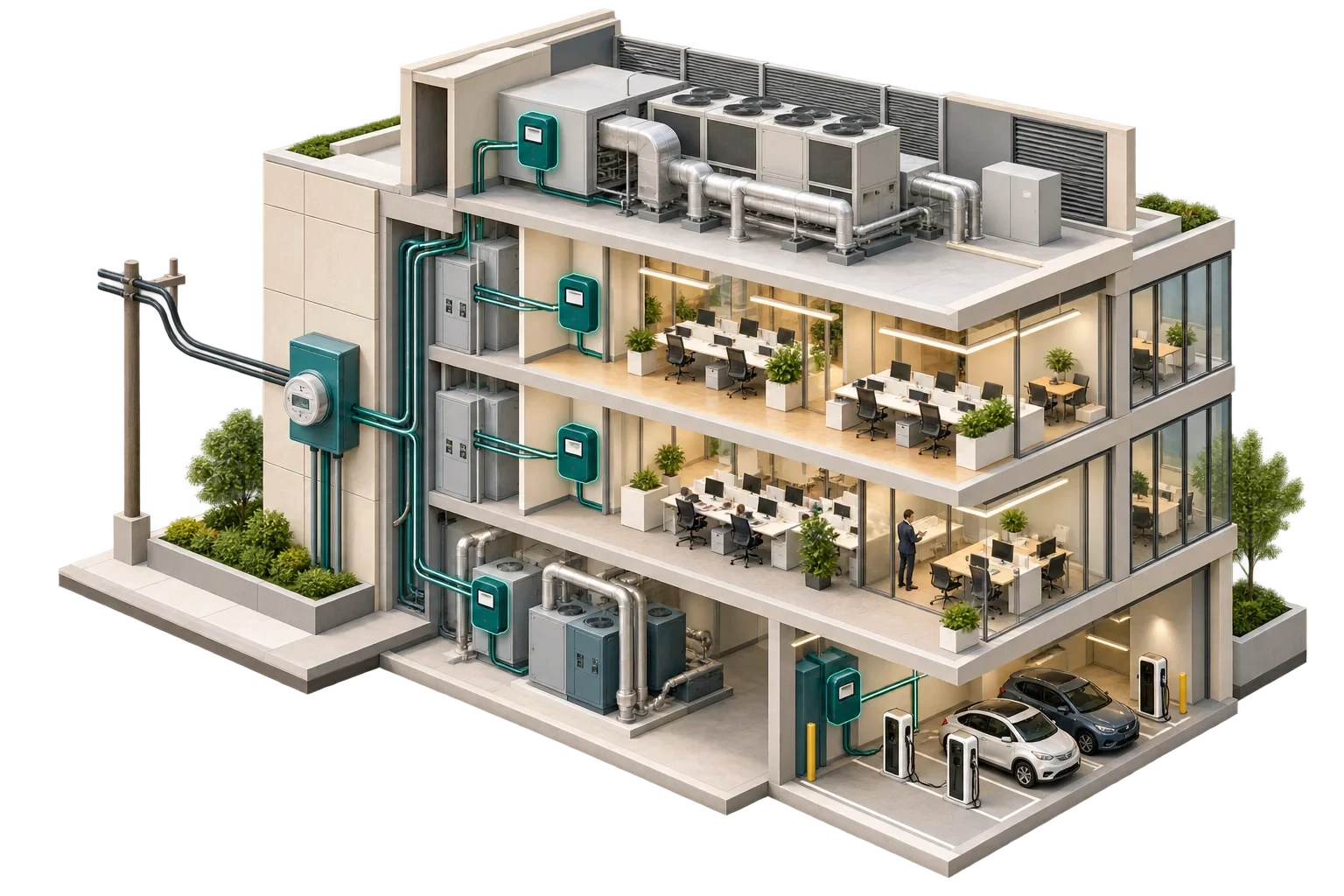
Submetering is the measurement of energy use inside a building, below the utility's main meter: by floor, by tenant, by system or by individual item of plant. It shows where consumption occurs, allows costs to be allocated and tells you whether an intervention worked. Where meters belong is less obvious than it sounds. They should go where their data will change a decision, not everywhere a meter can physically be fitted, so a good metering plan starts with the questions the owner needs answered and works back to the meters that can answer them.
The US Federal Energy Management Program (FEMP) makes the same argument in its operations and maintenance guide. The critical first step for any metering programme, it says, is to establish the objective, because how savings are achieved depends on how the data will be used. Typical uses include allocating costs among tenants, verifying bills, managing demand and diagnosing energy use, and each needs different data. Splitting electricity costs between tenants, for instance, requires at least kWh and kW data for the parts of the building each tenant occupies. A meter chosen without its use in mind can record a perfectly accurate number that answers none of these questions.
The same guide sets out a hierarchy that trades diagnostic detail against cost:
| Level | Example | What it can tell you |
|---|---|---|
| Whole building | Main incoming meter with 15-minute interval data | Trends and anomalies; "frames the question" |
| Panel / sub-panel | Lighting panel, motor control centre | Hours of operation; validation of a project |
| Circuit | A specific circuit within a panel | Specific loads; power-quality issues |
| End use | One chiller, one air handling unit | Detailed performance of one system |
A sensible default is good interval data at the top and targeted meters lower down where questions remain: on major plant, at tenant boundaries and on systems with known problems. Interval data from the main meter alone often exposes out-of-hours consumption and peaks worth investigating, which is a reason to get that layer right before buying anything else. Cheaper circuit-level submetering platforms have widened the options lower down; FEMP's 2024 guide to grid-interactive buildings lists tenant billing, measurement and verification, equipment-level benchmarking and automated fault detection among their uses.
That sounds trivial, but it is where schemes most often fail without anyone noticing. A meter records whatever is wired or piped through it, so a circuit that also feeds unrelated loads produces data that cannot answer the question the meter was bought for. Check the distribution arrangement before installing anything. Then record the hierarchy and what each meter serves, because totals that cannot be reconciled without double counting will not be trusted; the tender list below sets out the full record.
Accuracy and interval must also match the use. Meters used to bill tenants may be subject to legal and contractual requirements that operational monitoring is not, and those should be confirmed with the appropriate advisers. Every meter needs safe access, reliable communications and a routine that catches failed, frozen or implausible readings. Commissioning should follow the whole path from the physical meter to the number on the screen, including polarity, scaling and units, because an error anywhere along that chain is invisible to anyone who looks only at the dashboard.
A metering programme works best installed in phases. The first priority is reliable interval data from the main incoming meters, together with meters on the largest plant. The second is the tenant and cost-allocation boundaries, where money depends on the readings. Diagnostic meters come last, placed where the first two phases have raised questions they cannot answer. Justifying each phase by what the earlier data revealed keeps spending tied to evidence, not to a wish for completeness.
A meter that is installed but never integrated produces numbers nobody uses. The tender should treat metering as part of the building's data system and ask for:
Pagin Consulting starts every metering plan, new or inherited, from one short list: the decisions the data has to support, each checked against the distribution drawings. The number of meters follows from that list, and none should be bought until it exists.
This article connects to our work on Sustainability.
We can discuss how this subject fits the project brief.
Contact Pagin Consulting