
Energy & Sustainability
What is building energy submetering and where should meters be installed?
What submetering is, where meters should go and how to specify, phase and commission a metering programme.
Combine flow monitoring with local sensing, and design the response before the alarm.
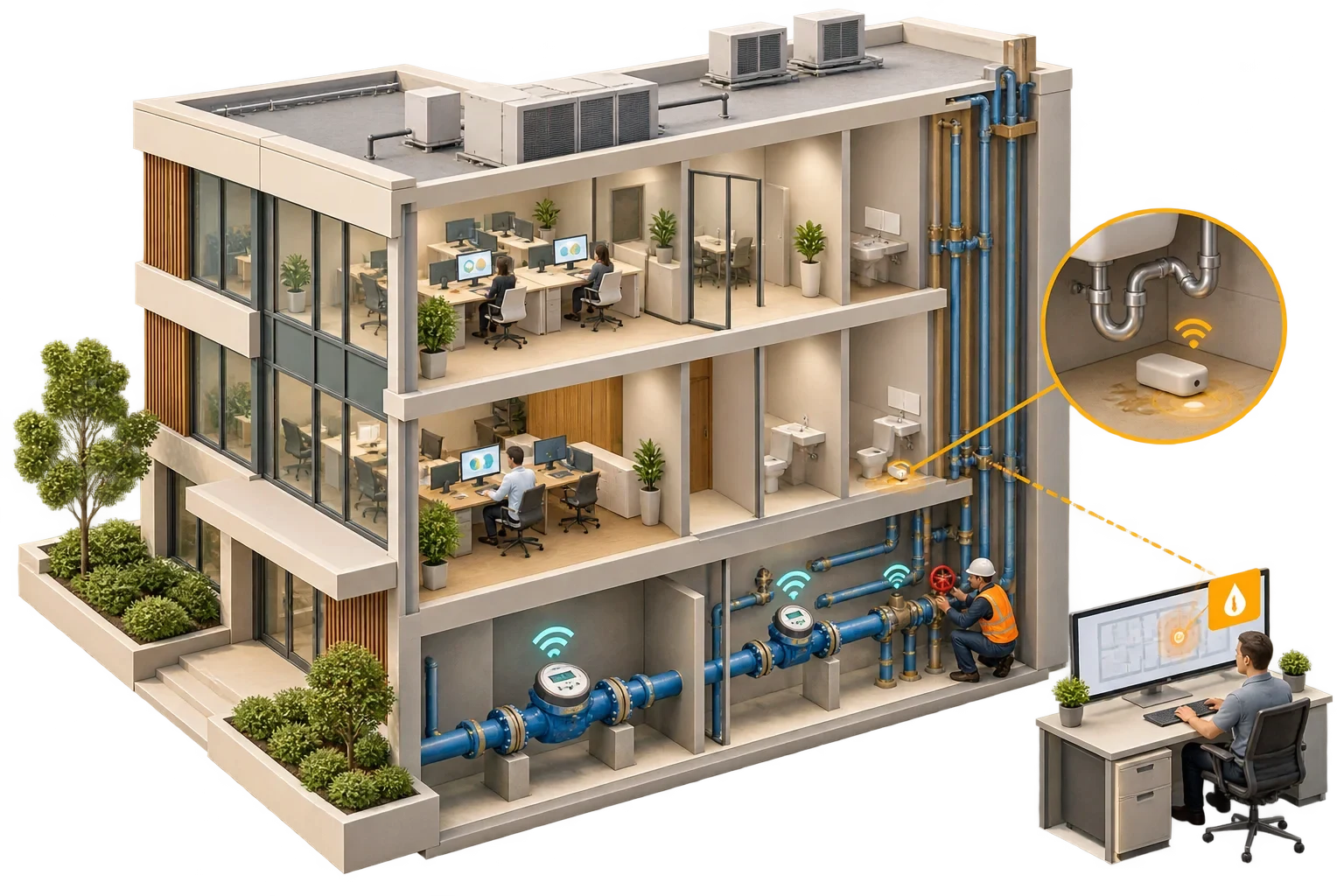
A leak that would once have surfaced on the next quarterly bill can now show up within hours. Smart water meters record consumption at short intervals and send the data automatically, so unusual patterns, such as flow that never drops to zero overnight, become visible almost as they begin. Leak detection systems add local sensing: water sensors under vulnerable equipment, or acoustic devices on pipework. The strongest designs combine the two and link them to a defined response, because an alert is of little value if nobody knows where to look or who can authorise isolating the supply.
Scroll horizontally to read the full table.
| Method | How it works | Good at | Limits |
|---|---|---|---|
| Flow monitoring from interval meters | Compares flow against expected patterns and thresholds | Continuous leaks, out-of-hours use, gradual increases | Locating the leak; telling a leak from legitimate use |
| Local water sensors | Detect water where it should not be | Fast detection of escapes at specific risks: plant rooms, server rooms, under tanks | Only covers where sensors are placed |
| Acoustic detection | Listens for the sound of escaping water in pipes | Finding leaks in buried or hidden pipework | Needs specialist equipment and interpretation |
Neither metering nor local sensing covers every scenario on its own. Where budgets are limited, priorities help: Pacific Northwest National Laboratory's water-metering guidance for US federal agencies sets out a process for deciding which buildings to meter first, centred on water-intensive building types.
Guidance from the US Federal Energy Management Program on distribution-system leaks offers two simple screening methods that translate well to buildings and campuses. The first compares verifiable uses, both submetered and estimated unmetered, with total supply; if they account for less than 90% of supply, a full audit is warranted. The second watches the minimum flow during unoccupied periods, typically around 3 or 4 a.m. FEMP's guidance is that a significant increase over time can be assumed to be leak-related and calls for a full audit. FEMP also recommends zone meters with flow-rate thresholds that flag possible leaks when exceeded, and notes that permanent leak-monitoring systems should be combined with techniques that pinpoint where the leak is.
FEMP's O&M guide lists leak detection among the standard applications of advanced metering: continuous monitoring of water use or pressure, with meters able to report by exception when a fault is detected.
Detection is only useful if it leads somewhere. For each detection zone, the response plan should record which isolation valves serve it and whether they can be closed remotely; who receives the alert, in and out of hours, and how it escalates; and which normal uses can look like a leak, such as cleaning, irrigation, overnight processes or tank refilling, with a note of how to tell them apart.
Automatic shut-off valves deserve particular caution. They can limit damage, but interrupting the supply has consequences, because sprinkler and fire systems, cooling plant, process water and sanitary facilities may all depend on it. The effects of both a genuine and a false activation need assessing with the relevant designers, fire-safety specialists and the operator, and essential systems need their own arrangements.
The system also has to be kept honest. Sensors, communications and valves should be tested on a schedule, and the monitoring itself monitored: a dashboard still showing yesterday's normal reading because a meter has stopped reporting is no evidence that nothing is wrong.
Picture the property's worst plausible leak: where it would start, who would notice and how long it would take to stop. Shortening that time takes water metering, leak detection, integration and a clear escalation route, specified as one system, not bought as four separate purchases.
This article connects to our work on Sustainability.
We can discuss how this subject fits the project brief.
Contact Pagin Consulting