
Operations & Productivity
How can smart buildings reduce facilities management costs?
Which facilities management cost lines smart building capabilities can change, and how to build and measure the cost case.
Remote monitoring saves visits only when the operating model and the maintenance contract change too.
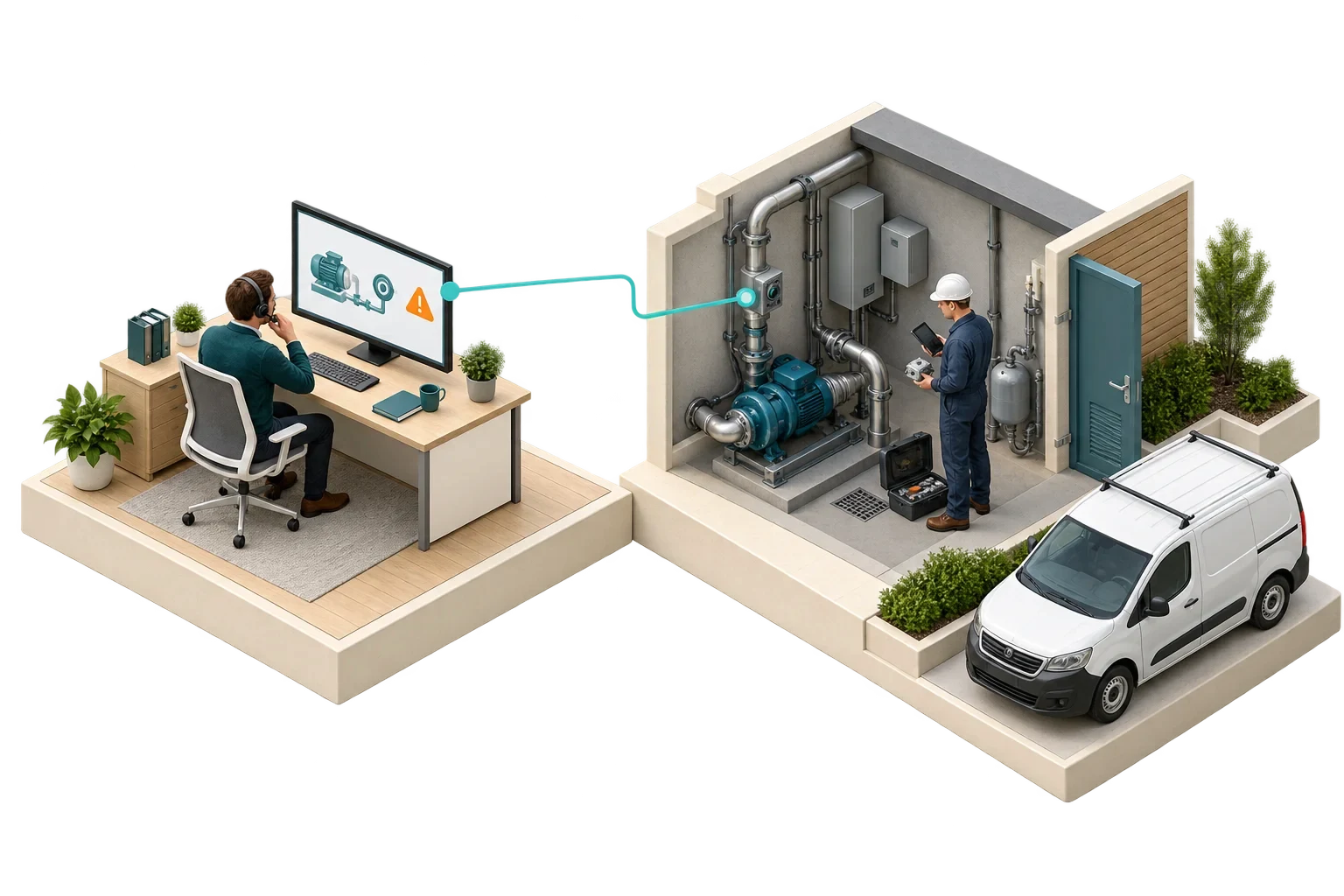
Every maintenance manager knows the call-out that achieves nothing: an engineer drives across town at night, opens the plant room and finds the alarm has already cleared. Remote monitoring removes a good share of those trips. It lets a qualified person see what is happening, diagnose the likely cause, and either fix the problem remotely or send the right person with the right parts first time. It also screens out visits that should never have happened, such as alarms that cleared on their own, faults already in hand and routine checks that would only have confirmed normal readings.
What it cannot do is replace physical repairs, inspections that require attendance or the judgement of someone standing next to the equipment. The savings arrive when the remote service is run as an operating model, with a defined triage process, clear authority and secure access, and when maintenance contracts are changed so that remote resolution is expected, recorded and rewarded.
| Can usually be done remotely | Usually still needs a visit |
|---|---|
| Confirm whether an alarm is genuine and still active | Replacing failed components |
| Review trends to identify a likely cause | Mechanical adjustment, cleaning, lubrication |
| Reset a tripped controller or restart a sequence, where safe and authorised | Statutory inspections and testing |
| Adjust setpoints or schedules within agreed limits | Investigating noises, smells, leaks or visible damage |
| Check that a repair has held over following days | Work requiring isolation or permits |
| Prepare the attending engineer with diagnosis and parts list | Faults where remote data is missing or contradictory |
The left-hand column is where avoided and better-prepared visits come from. The right-hand column is why remote monitoring supports maintenance teams and does not replace them.
Nuisance call-outs are the obvious target. When an alarm is verified remotely before anyone is dispatched, many of the cases where the condition has already cleared are caught at the desk. Diagnostic visits are the next: the trip made only to find out what is wrong, followed by a second trip with the right parts. Remote diagnosis can often fold the two into one.
Some faults clear with a controlled reset, and if the reset is safe, within the remote operator's authority and the underlying cause is recorded, the visit can be avoided altogether. The caveat matters, though. A reset that hides a recurring fault saves nothing, so recurrence has to be tracked. The routine round of walking the plant to note temperatures, pressures and meter readings can largely go too, replaced by monitored data, which leaves site time for work that needs hands.
The first decision is what to monitor, and the answer is not everything at once. The first candidates are assets whose failure is costly or uncomfortable and whose data gives useful warning: central plant, domestic hot water, critical ventilation, lifts where the supplier offers monitoring, and leak detection.
For each alarm type, a triage procedure then sets out what the remote operator checks, what they may do remotely, and when and to whom they dispatch, including the information the attending engineer must receive. Alongside it sits a definition of authority. Which remote actions are permitted (viewing only, acknowledging alarms, resets, setpoint changes within limits) and who may perform each? Remote commands to plant are control actions and should be authorised and logged like any other change.
Remote monitoring also means remote access to building systems, and NIST's guide to OT security (SP 800-82) sets the baseline: access only where justified and limited to what is needed, multi-factor authentication considered, activity monitored and access removed when no longer required. A service that has to watch continuously can keep its read-only monitoring connection separate from any session that can change settings, and make the latter available only on demand, as CISA and the FBI advise for integrators.
Every alarm handled remotely should end with a recorded outcome: resolved remotely, dispatched, no fault found or duplicate. Those records are the evidence of whether the service works.
Where a maintenance contract pays per visit or per call-out, remote resolution cuts the contractor's income, and the incentive works against the owner. Introducing remote monitoring is therefore a reason to revisit the commercial model. The options include a fixed monitoring fee with call-outs only after recorded remote triage, service levels for remote response times, and reporting on remote resolutions, repeat faults and first-time fix rates. The contract should also say who owns the monitoring data and the triage records, and how access ends when the contract does.
A small set of measures, tracked before and after with the same definitions throughout, tells you most of what you need: call-outs per building per month, split between in-hours and out-of-hours; the proportion of alarms resolved remotely; the first-time fix rate for dispatched visits; repeat faults within a defined period; and the time from alarm to acknowledgement.
Not every change in those figures belongs to monitoring. Weather, equipment age and changes in use also affect fault rates. And fewer call-outs combined with more repeat faults is a warning sign.
Choose the first assets by the consequence of their failure, not by how easy they are to connect, and write the triage and authority rules, the access arrangements and the revised maintenance contract together. Any one of them on its own leaves maintenance much as it was.
This article connects to our work on Our services.
We can discuss how this subject fits the project brief.
Contact Pagin Consulting