
Energy & Sustainability
How much energy can smart building controls save?
What published controls savings figures mean and how to build a credible estimate for one building without double counting.
Agree the M&V method before implementation, report energy before money, and decide who calculates the result.
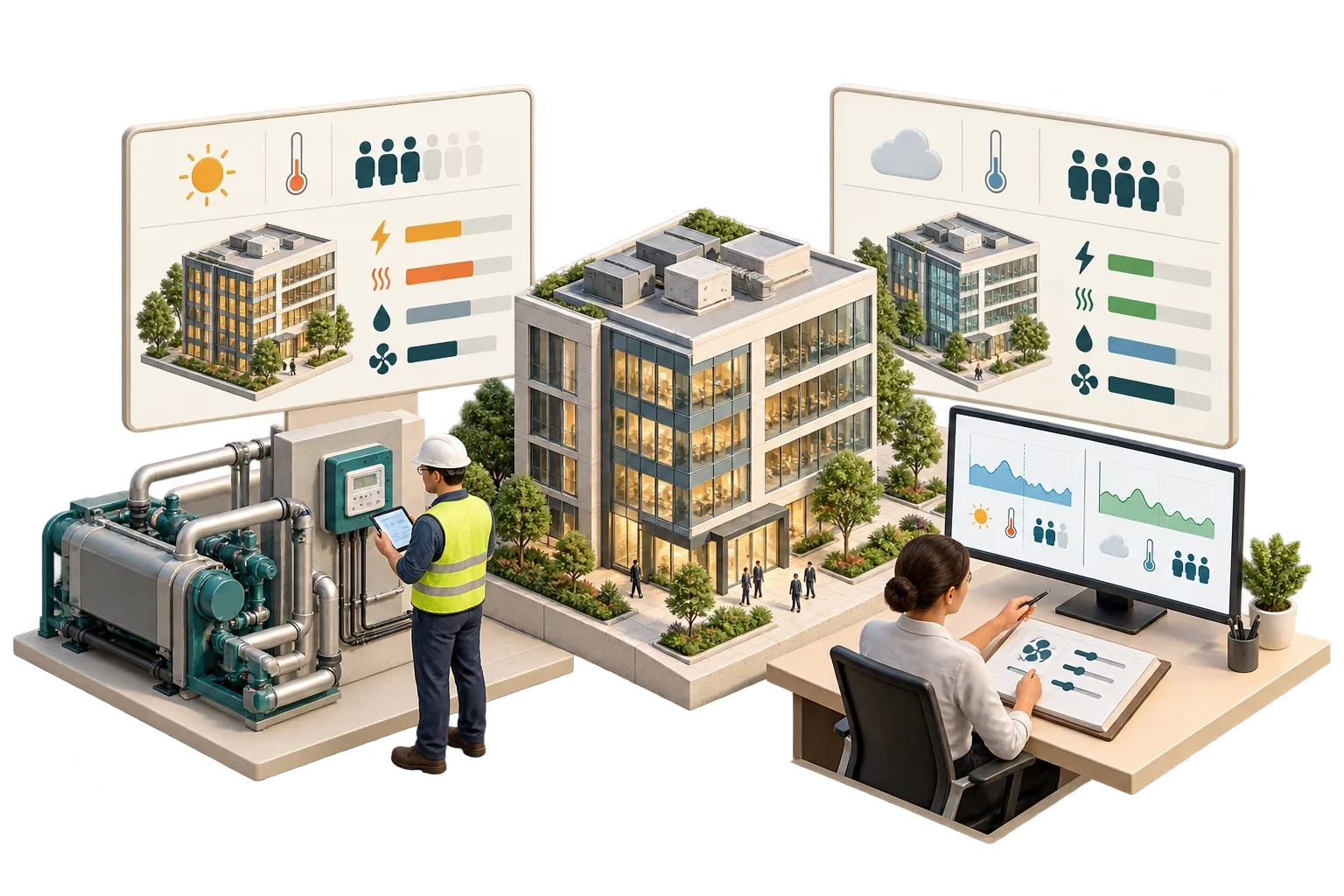
A saving is energy that was not used, which means it can never be read off a meter. The Efficiency Valuation Organization (EVO), which maintains the International Performance Measurement and Verification Protocol (IPMVP), puts it this way: savings are determined by comparing measured consumption before and after a measure, making suitable adjustments for changes in conditions. That means estimating what the building would have used without the intervention, under the conditions that actually occurred, and comparing it with what it did use. The method has to be agreed before implementation, while baseline data can still be collected.
IPMVP is a largely non-prescriptive framework, in which each project designs its approach in an M&V plan. It describes four options, which differ mainly in the measurement boundary:
| Option | Boundary | Typical use |
|---|---|---|
| A or B — Retrofit isolation | The affected equipment | Verifying savings from specific equipment, by measuring its energy or key variables |
| C — Whole facility | The whole building's meters | Several measures with interactive effects; managing total performance |
| D — Calibrated simulation | Part or all of the facility | Baseline or reporting data unreliable or unavailable, such as new buildings |
For smart building projects that change controls across many systems, Option C is often the natural fit, because IPMVP associates it with multiple measures that have interactive effects. It does, however, need savings large enough to stand out from the normal variation in whole-building consumption. For a single measure, such as pump speed control, Option A or B drawn around that equipment gives a clearer answer.
The variables that materially affect energy use, such as weather (heating and cooling degree days), occupancy, opening hours and production or service levels, need recording, because they become the adjustments in the baseline model. One-off changes, such as a new tenant, an extension or a change of use, need a defined treatment too, decided before they happen.
Savings should be reported in energy units first and converted to money only as a second step, using an agreed tariff method. A lower bill caused by a tariff change is not an energy saving, and a reduction in demand charges may need separate analysis. The report should include the uncertainty of the result and the cost of the M&V itself, which should be proportionate to the size of the saving and the commercial decision it supports.
New controls are installed. The reporting period is colder, with 2,400 degree days, and measured use is 108 MWh.
The colder weather hid more than half of the saving in the simple comparison. Even so, the 12 MWh remains an estimate that depends on the model, the boundary and the data, and a full M&V plan would state its uncertainty.
IPMVP leaves the detail to each project's plan. To head off later disputes, the plan should state at least:
The plan belongs in the project scope, not in a later side agreement, and the meters and data retention it relies on must actually exist before the baseline period starts.
If the result determines a payment, a bonus or a guarantee, the party that benefits should not be the only one calculating it. The contract should say who performs the calculation, who checks it, what access the checker has to the data and the model, and how a disagreement is resolved. Independent review costs money, so its depth should match the value at stake.
Savings are far easier to prove when the evidence is agreed before anyone promises them, and easiest of all while the baseline is still being recorded.
This article connects to our work on Sustainability.
We can discuss how this subject fits the project brief.
Contact Pagin Consulting