
Energy & Sustainability
How does fault detection and diagnostics reduce building energy waste?
How fault detection and diagnostics finds energy waste, what the evidence shows and why the resolution process matters most.
Keep control in the BMS unless an energy platform's authority is deliberately designed and commissioned.
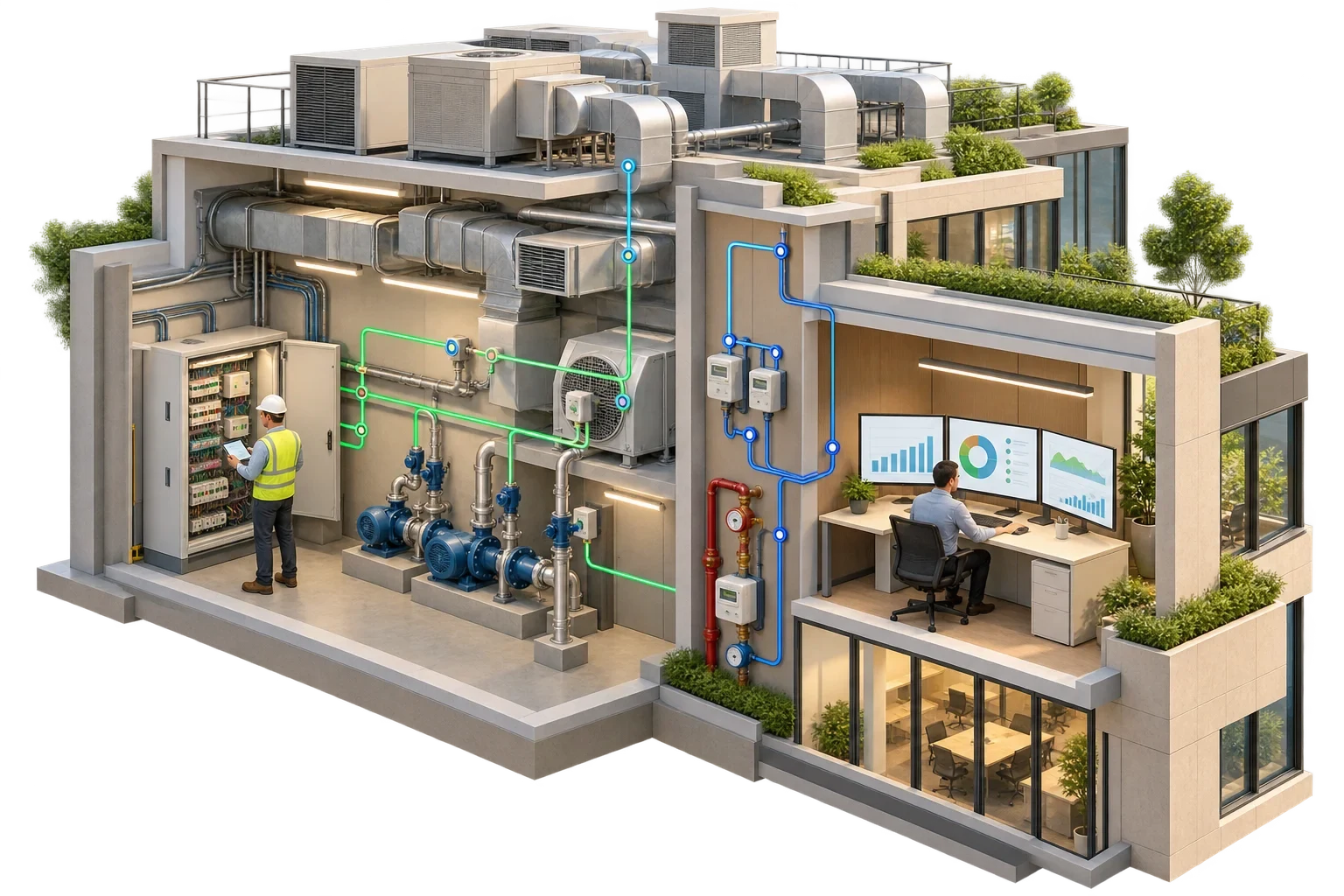
Both deal with energy, which is why they are so easily confused. A building management system (BMS) runs building services in real time: it schedules plant, holds set points and raises alarms for heating, ventilation, cooling and often lighting. An energy management system, or energy management and information system (EMIS), exists to understand and improve energy performance: it collects meter data, analyses consumption, compares buildings and tracks whether improvements worked.
In the market, products overlap and the labels are used loosely. An owner should therefore specify the functions it needs, and not assume that either label guarantees metering, analysis or effective control.
The US Federal Energy Management Program's guide to grid-interactive efficient buildings describes an advanced building automation system as one integrated into the building and able to automatically control and manage multiple energy systems, with remote control and management. It describes an energy management information system as a general label for software or systems that monitor, analyse and control building energy use and system performance.
Both definitions, notice, include control. In practice the BMS is where control logic runs and where operators act on plant, while the EMIS is where energy data is turned into evidence and priorities.
| BMS | EMIS | |
|---|---|---|
| Main users | Operators, controls engineers | Energy managers, sustainability and finance teams |
| Main question | Is the plant running correctly right now? | Where is energy being used and wasted, and is it improving? |
| Data | Points, setpoints, alarms, short-term trends | Interval meter data, long histories, weather, tariffs, floor areas |
| Typical outputs | Control actions, alarms, plant graphics | Consumption profiles, benchmarks, savings reports, cost allocation |
| Scope | Usually one building or site | Often a portfolio |
The data requirements differ more than people expect. A plant control point may lack the accuracy, boundary or history an energy assessment needs, while a fiscal meter may not reveal which system used the energy.
In the EU, the recast Energy Performance of Buildings Directive (Directive (EU) 2024/1275) requires Member States to ensure that, where technically and economically feasible, non-residential buildings have building automation and control systems if their heating, air-conditioning or combined ventilation systems have an effective rated output above 290 kW (by 31 December 2024) or above 70 kW (by 31 December 2029). Those systems must be capable of continuously monitoring, logging, analysing and allowing for adjusting energy use, and of benchmarking the building's energy efficiency, detecting losses in efficiency of technical building systems and informing whoever manages the facility about opportunities for improvement. Functions traditionally associated with energy management are, in other words, now expected of automation systems in larger non-residential buildings. The Directive was due to be transposed into national law by 29 May 2026, and national rules determine exactly how it applies, so each property needs checking against them.
Whichever products are chosen, the specification has to define meter coverage and the relationship between each meter and what it serves, the resolution and retention of interval data, tariffs where cost analysis is needed, and the route by which an energy finding becomes an operational action, including who may approve changes.
Schedules and set points should never be maintained in two applications that can contradict each other. If the energy platform is allowed to issue commands, its authority, limits and failure behaviour need explicit design and commissioning. The simpler alternative is to keep control in the BMS and let the EMIS recommend.
Pagin Consulting writes specifications from a deliberately plain list: the energy decisions your team makes most often, and the system each one depends on today. The list shows where the BMS, the EMIS or another platform should hold each function, and it stops the specification from buying the same function twice.
This article connects to our work on Sustainability.
We can discuss how this subject fits the project brief.
Contact Pagin Consulting