
Energy & Sustainability
What is the Smart Readiness Indicator for buildings?
What the EU Smart Readiness Indicator assesses, its optional legal status and how to use it as a planning tool.
Compliance depends on national rules and demonstrated capability, not on whether a BMS is installed.
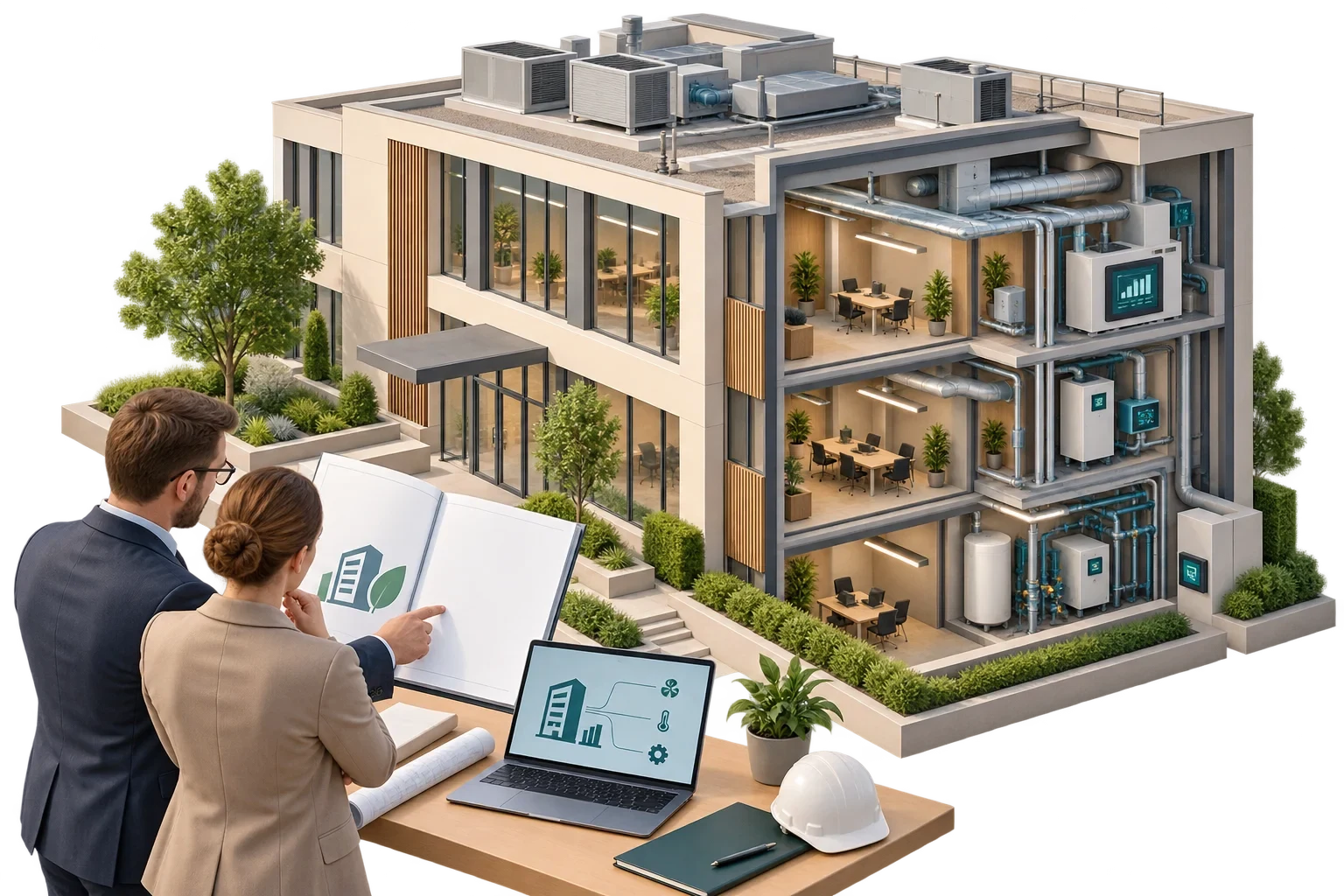
The EU's recast Energy Performance of Buildings Directive, Directive (EU) 2024/1275, makes building automation and control a defined requirement for many non-residential buildings and sets out what those systems must be capable of. A directive, however, does not apply directly to buildings. Each EU country turns it into national law, so owners need to understand the EU framework and then confirm the national rules that apply to each property. Compliance depends on the building, its systems and the national implementation. Having a BMS installed does not settle it either way.
The European Commission's summary gives the key dates. The recast directive entered into force on 28 May 2024, and the general deadline for transposing it into national law was 29 May 2026. In June 2025 the Commission adopted a support package with guidance for EU countries on implementing the recast directive. Whether, when and how a particular country has transposed the relevant provisions has to be checked country by country; the passing of the EU deadline shows neither that a national rule is in force nor what it says.
Article 13(9) requires EU countries to lay down requirements so that, where technically and economically feasible, larger non-residential buildings are equipped with building automation and control systems, by the end of 2024 or the end of 2029 depending on the rated output of their heating, air-conditioning and ventilation systems (over 290 kW and over 70 kW respectively).
Article 13(10) states that these systems must be capable of:
| Capability | In practice, look for |
|---|---|
| Continuously monitoring, logging, analysing and allowing for adjusting energy use | Metering integrated with the automation system; retained histories; ability to act on findings |
| Benchmarking energy efficiency, detecting losses in efficiency of technical building systems, and informing the person responsible about improvement opportunities | Comparison over time; fault detection; notification to a named role |
| Communicating with connected technical building systems and being interoperable across proprietary technologies, devices and manufacturers | Documented open interfaces between systems |
| Monitoring indoor environmental quality (by 29 May 2026) | Measurement of parameters such as temperature, humidity and ventilation |
The thresholds refer to the effective rated output of the specified systems, not to floor area, and national guidance explains how to count it. Ireland's guidance on its regulations under the previous directive, for instance, applies the threshold to each system individually and sums units that operate jointly; other countries may differ.
A proper review compares the installed automation with each capability in turn. Which energy flows are metered and integrated? How long is data retained? Is anyone told when efficiency falls? Which interfaces are open and documented, and is indoor environmental quality monitored at all? Along the way, look for functions that exist in the product but were never configured or commissioned. A product name or a controls cabinet is not evidence of compliance. Industry bodies have published checklists that translate the requirements into evidence, and they can help structure a review, but national rules decide.
Feasibility provisions, exemptions and inspection regimes are matters of national law, to be confirmed with appropriate local legal and engineering advisers.
Owners with several buildings need a repeatable method that works the same way in every building. A workable sequence runs as follows:
The evidence gathered at the third step is useful whatever the legal outcome. It shows what the existing automation can really do, and it is the starting point for any upgrade specification.
The directive's list of capabilities describes automation an operator would want anyway. That is why a simple triage, with each building's heating, cooling and ventilation outputs set against the thresholds and the national rules checked for those that cross them, can pay for itself whatever the compliance answer turns out to be.
This article connects to our work on Sustainability.
We can discuss how this subject fits the project brief.
Contact Pagin Consulting