
Smart Districts & Cities
How can a smart district coordinate energy, mobility and utilities?
How a district can coordinate energy, mobility and utility systems through visible dependencies and agreed decision rights.
Set priorities and limits in a control philosophy before choosing optimisation software.
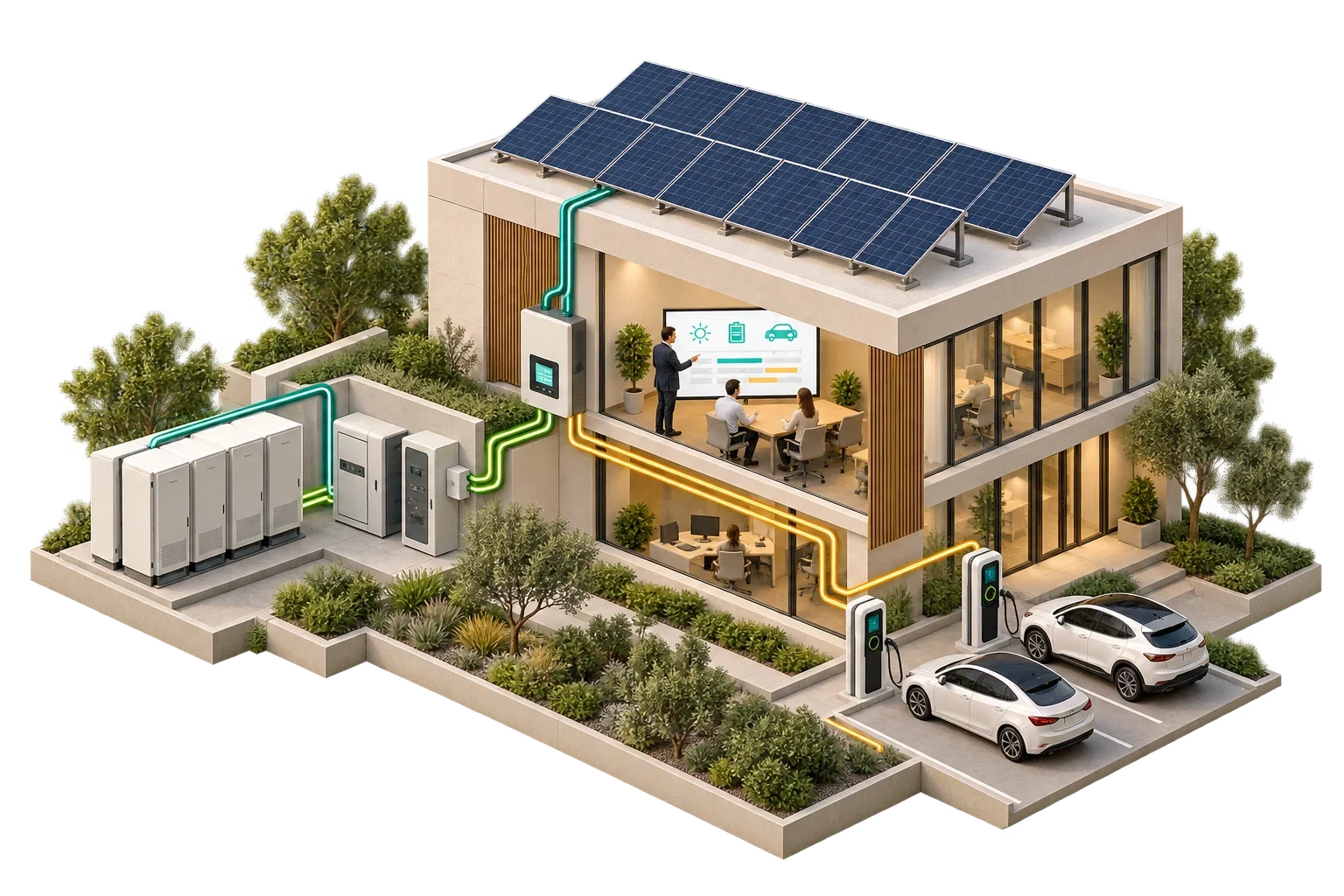
Solar panels, a battery and a row of electric-vehicle charge points can work together to cut peak demand, use more of the building's own generation or keep essential loads running. They cannot do all three at once, because those goals compete for the same battery capacity and the same charging hours. Coordination therefore starts with an agreed energy-management strategy: what the building is trying to achieve, in what order of priority and within which limits. Only then does it make sense to choose the software that carries the strategy out.
Coordination inside a single building is the subject here. Sharing energy across several buildings or a district raises further questions of shared connections and governance.
In the EU, the recast Energy Performance of Buildings Directive requires new buildings to be designed to optimise their solar potential and obliges member states to ensure suitable solar installations on many new and some existing non-residential buildings, where technically and economically feasible. It also requires the recharging points it mandates to be capable of smart and, where appropriate, bidirectional recharging. More buildings will therefore have all three assets, and with them the problem of making them cooperate.
The US Federal Energy Management Program's guide to grid-interactive efficient buildings lists the benefits owners pursue: avoiding demand charges and peak-period prices, reducing bills or earning payments from utilities, resilience to grid outages, decarbonisation and better energy management. It describes four demand-management strategies: efficiency, load shedding, load shifting and modulation. The owner's job is to pick the objectives that matter for this building and put them in order. A battery held full for resilience cannot also be emptied every afternoon to shave peaks, and the software needs to be told which matters more.
Optimisation works inside constraints, and those need recording before anyone discusses algorithms:
Ordinary grid-connected operation and backup supply are different things. A battery and a solar array do not automatically keep a building running in a power cut. Operating safely without the grid requires appropriate electrical design, protection and approvals by qualified electrical engineers.
A workable design separates the system that plans from the devices that protect themselves:
| Layer | Role |
|---|---|
| Supervisory energy management | Sets targets — charge plan, battery schedule — from forecasts and tariffs |
| Local controllers (inverter, battery management, charge points) | Enforce safety and equipment limits regardless of commands |
| BMS | Shares building loads and may shift flexible loads such as pre-cooling |
| Metering | Provides the measurements every decision depends on |
The interfaces between these layers should be documented, along with what happens when communication fails; normally each device falls back to a safe, standalone mode. The economics deserve the same rigour. Costs should be evaluated against the actual tariff and operating profile, including battery degradation, round-trip losses and users' charging needs, because not every shifted kilowatt-hour is worth the same.
The software can enforce a policy but cannot set one. Someone has to decide whether visitors' vehicles are charged on the same terms as staff, whether any vehicles take priority, how much battery capacity is held back for resilience and whose budget pays for charging. These are questions to settle with the people affected before the system is configured, and to revisit once there is operating data to judge them by.
Those answers should then be proved on site. Witness tests should include an attempt to exceed the import limit, a communications failure, a manual override and a day on which the charging requirement cannot be met, and each should behave as the control philosophy says it will.
Write down what should happen on a dull winter afternoon with a full car park. If the agreed priorities already answer that, choosing a platform becomes a matter of finding one that can carry them out. If they do not, no platform will settle the argument for you.
This article connects to our work on Sustainability.
We can discuss how this subject fits the project brief.
Contact Pagin Consulting