
Energy & Sustainability
How can buildings coordinate solar panels, batteries and EV charging?
How a building can coordinate solar, batteries and EV charging through ranked objectives, constraints and layered authority.
Agree who may decide what, within which limits, before automating anything across systems with different owners.
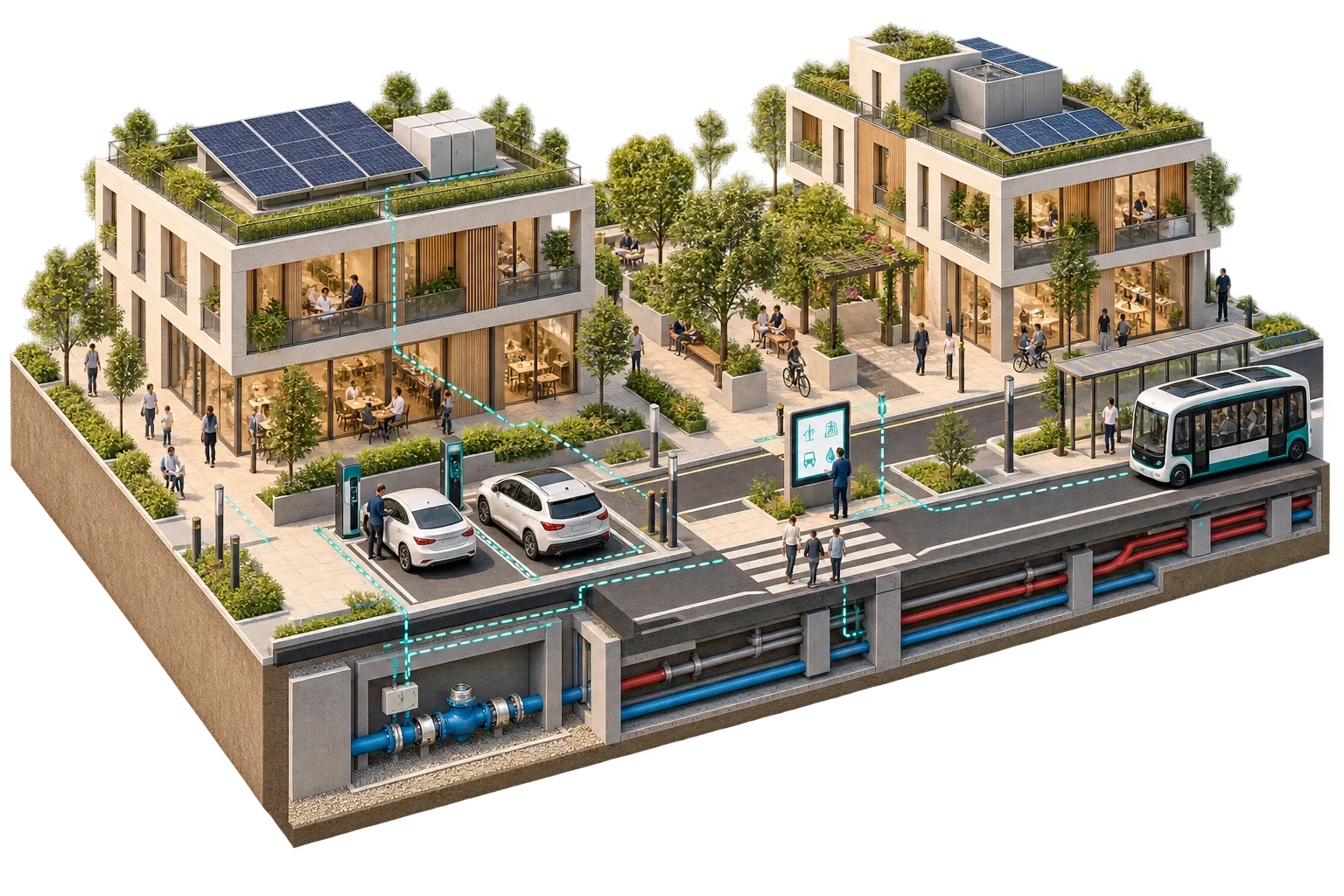
In a district, systems that were designed separately end up leaning on each other. Electric-vehicle charging adds to site electrical demand. A shared heat network serves buildings with different operating hours. Deliveries and servicing compete for access and public space, and water and drainage infrastructure is shared by everyone.
Coordinating them starts with making those dependencies visible and agreeing in advance who may decide what, within which limits. Done well, coordination makes better use of capacity and flattens peaks. It cannot create capacity that is not physically there, and it only works if every asset owner accepts the role their asset is being asked to play.
So the digital opportunity has to be assessed together with the physical constraints and the commercial arrangements, and a single coordinated service should be piloted before anyone builds a cross-sector platform.
The first step is a list of the places where one system's operation affects another.
| Interaction | Example | Typical constraint |
|---|---|---|
| EV charging and site electricity | Charging peaks coincide with building demand | Grid connection capacity, tariff, user service expectations |
| Heat network and buildings | Return temperatures from buildings affect network efficiency | Building controls, heat interface units, metering |
| On-site generation and storage | Solar output exceeds daytime demand on some plots | Metering arrangements, network rules, who owns the asset |
| Servicing and public realm | Delivery vehicles and waste collection compete for access | Loading bays, time windows, safety |
| Water and drainage | Storm events stress shared drainage | Attenuation capacity, monitoring, maintenance |
District heating shows how tight these couplings can be. The European Commission's Smart Cities Marketplace describes how networks have evolved towards lower-temperature schemes that reduce distribution losses and make renewable sources easier to use, with intelligent management supporting their operation. But a lower-temperature network depends on the connected buildings' controls and heat interface units working as designed. The UK government's Heat Network Optimisation Guide (2023) treats high return temperatures as a symptom of uncontrolled flow in the system, and lower return temperatures as a condition for low heat losses. Buildings that send water back hotter than intended erode the efficiency the network was planned to achieve.
Every asset that might take part in coordination needs a short profile. It should name the owner and operator, and quantify the flexibility available: how much load can be shifted, for how long and how often. It should also record the service obligation that limits that flexibility, whether residents' comfort commitments, a laboratory's environmental conditions or a commuter's need for a charged car in the morning. And it should say who can request a change, who can refuse it, and what the asset falls back to if the coordination signal is lost.
The profiles will differ enormously. A care home may have very little tolerance for comfort changes, while an office's EV car park overnight may have a great deal of flexibility.
Coordination can be advisory, with operators receiving information and deciding for themselves, or automated within agreed limits. A district is usually better served by starting advisory and introducing automation only where the limits and responsibilities are well understood.
Automated services need a fuller specification. It must set out what information each party provides and how often, and the decision horizon, whether day-ahead scheduling, hour-ahead or real time. It must define the limits within which a central request is executed automatically, how conflicts are resolved and how a participant opts out when local conditions demand it. Above all, results should be verified at the meter.
The US Department of Energy's Grid-interactive Efficient Buildings work frames buildings as flexible energy resources, combining efficiency and demand flexibility with smart controls and communication. The same thinking applies at district scale, with the added need for agreements between owners.
Shared energy services involve metering, billing, network connection agreements and, in some cases, energy supply regulation that depends on the country and the parties involved. In the EU, the recast Energy Performance of Buildings Directive (Directive (EU) 2024/1275) requires member states to ensure that the recharging points it mandates in buildings are capable of smart recharging and, where appropriate, bidirectional recharging. National rules and the network operator's requirements determine what is permissible. These are design inputs, to be settled early with the relevant specialists; left until after installation, they become problems.
The first coordinated service should have a clear owner, measurable performance and a real constraint to manage; EV charging within a connection limit is a natural candidate. It is the cheapest way to learn how the agreements, data and controls behave in practice before extending the approach to other sectors.
None of that can start without the asset profiles. Write them for the three or four assets most likely to take part, and the gaps will show what has to be agreed. Pagin Consulting's part is the digital side, the interfaces and data requirements, working alongside the specialists who own the physical systems.
This article connects to our work on Masterplan design.
We can discuss how this subject fits the project brief.
Contact Pagin Consulting