
Smart Districts & Cities
What is a smart district?
What makes a district smart, which services it shares across buildings and who usually owns them.
Choose the project boundary and its governance before choosing technology.
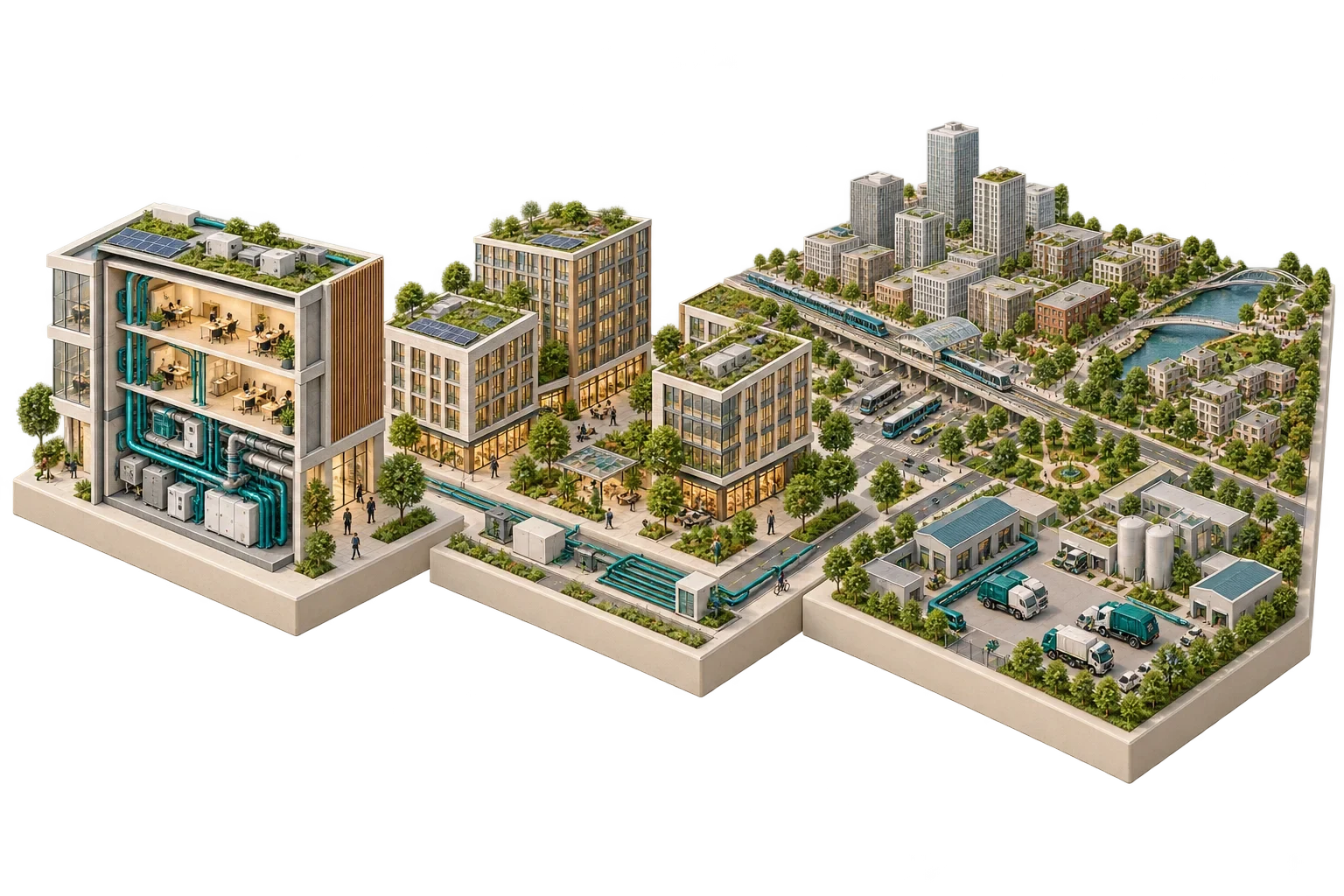
The difference is mostly one of scale and governance. A smart building is a single asset whose owner or operator controls most of its systems and contracts. A smart district is a defined group of buildings and spaces that share some infrastructure and services under an agreed operating model. A smart city is a public-service undertaking across a whole urban area, accountable to residents and involving many public bodies, utilities and private partners. The larger the boundary, the smaller the share of the problem that is technical, and the larger the share that is about who decides.
Scroll horizontally to read the full table.
| Smart building | Smart district | Smart city | |
|---|---|---|---|
| Typical scope | One building or campus under one operator | Several plots, shared spaces and utilities | Entire municipality or metropolitan area |
| Decision makers | Owner, operator, tenants | Developer, estate manager, utilities, occupiers | Elected bodies, departments, agencies, utilities, communities |
| Typical goals | Comfort, energy, operating cost, tenant service | Shared infrastructure, estate operations, phasing, area reporting | Public services, sustainability, resilience, quality of life |
| Accountability | Contracts and leases | Estate agreements and service charges | Public law, budgets and democratic scrutiny |
| Data | Detailed equipment and space data | Aggregated or event-level data from buildings | Aggregated indicators, open data, public-service records |
| Typical funding | Owner capital and operating budgets | Developer capital, service charges, energy contracts | Public budgets, grants, concessions, partnerships |
The International Telecommunication Union's definition of a smart sustainable city, set out in Recommendation ITU-T Y.4900, is framed around outcomes: quality of life, efficient urban operations and services, competitiveness, and meeting the needs of present and future generations. That is a useful test at every scale.
It is tempting to take a successful building application, enlarge it and call it a city platform. It rarely works, because three things change as the boundary widens: who is entitled to the data, who can act, and who pays.
Data entitlement changes first. A building operator may legitimately use detailed equipment readings; a district manager needs capacity and service status; a city team usually needs aggregated indicators and trends. Each level should receive information suited to its role, with clear definitions and restrictions, and personal data needs a lawful basis at every level.
Authority changes too. Within a building, the operator can change a schedule unaided. In a district, a request to reduce demand has to be agreed with each building operator, and in a city an action may need policy approval and public communication. Interoperability helps information flow, but it cannot settle disagreements about authority or purpose.
And so does funding. A building improvement is justified by its owner's business case. District services are often recovered through service charges or energy contracts, while city services compete for public budgets and have to demonstrate public value.
The levels work best as a hierarchy of agreed interfaces, not as one central system. The US National Institute of Standards and Technology's IoT-Enabled Smart City (IES-City) Framework takes the same approach. It sets out a consensus set of common architectural features and stops short of prescribing a single platform.
Many problems at district and city scale trace back to an unclear boundary, so the boundary should be on paper while the technology is still undecided. A useful boundary statement names the geography, the organisations, and the services and decisions in scope. It separates the outcomes each party can deliver alone from those that depend on cooperation, and states what information each party must share and with whom. Above all, it says what each building or service must keep doing if the shared layer becomes unavailable.
For most developers and owners, the practical aim is buildings and districts that work well on their own and connect sensibly to wider urban services, without central dependencies the project cannot control.
This article connects to our work on Masterplan design.
We can discuss how this subject fits the project brief.
Contact Pagin Consulting