
Smart Buildings
What is the difference between a smart building and a building management system?
How a building management system differs from a smart building, what a BMS can already do, and when an extra platform is justified.
How to turn connected technology into a building that is easier to operate—and what to decide before investing.
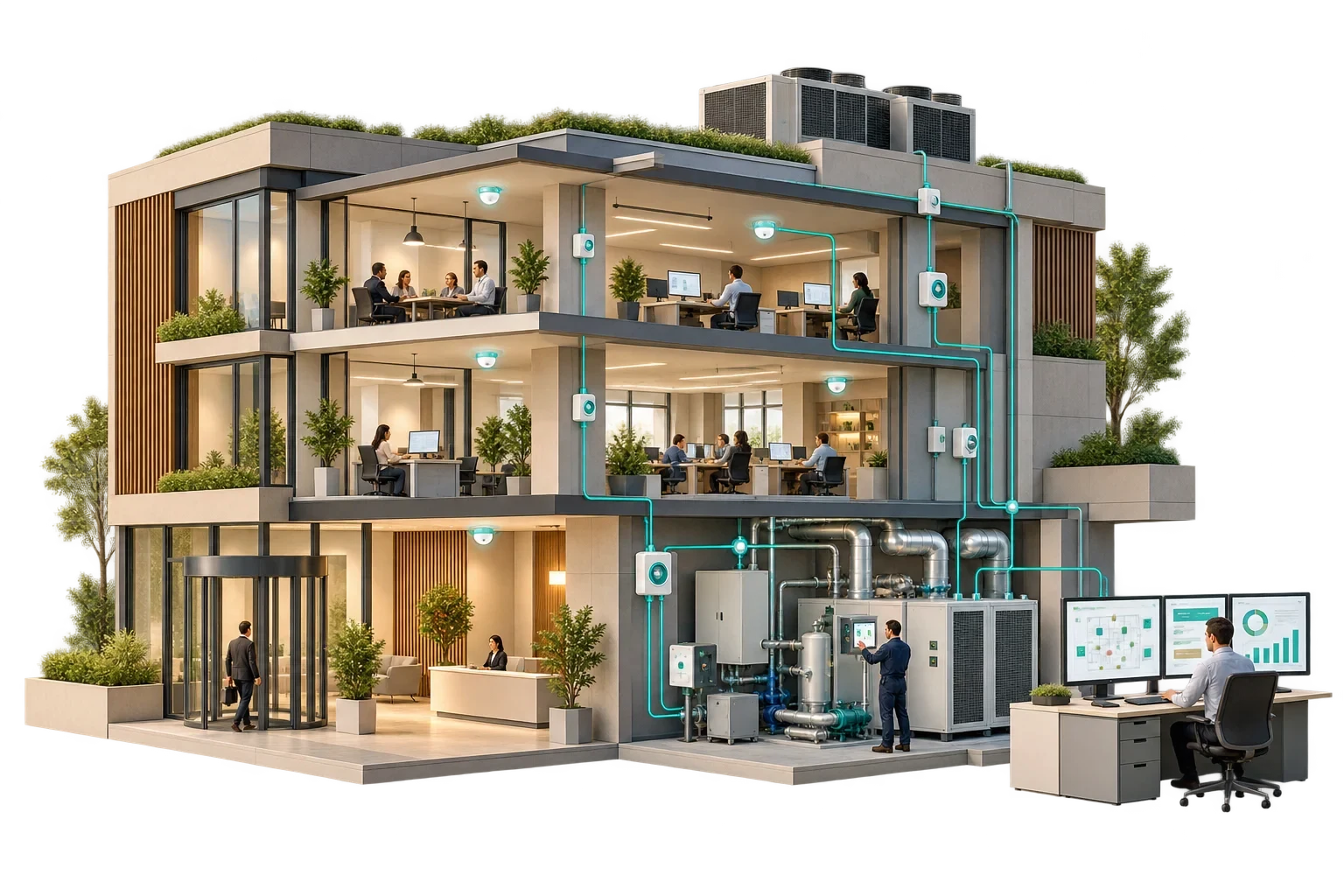
A smart building is one whose systems are connected and whose information is reliable enough to change how the asset is run. The connections are not the point; what they make possible is. Services can follow actual demand, faults surface before they become complaints, and operators get an honest picture of performance. So the useful place to begin is the owner's operating priorities; the technology catalogue can wait. A building becomes smarter only when its systems work together towards an outcome somebody has defined.
Three owners can ask for a smart building and mean three different things. A university may want teaching rooms conditioned according to whether anyone is actually in them. An office landlord may want equipment faults identified before the same tenant complains for the third time. A developer may want future tenants to plug in their own services without ripping out base-building infrastructure. Choosing one platform for all three before anyone has examined how the buildings will be run is a reliable way to commit budget before the value is clear.
It helps to write each objective as an operational statement: who needs to know what, what should happen next, and how anyone will know it worked. "Make the building intelligent" answers none of those questions. "Give the duty engineer a prioritised list of persistent temperature faults, each linked to the right piece of equipment" answers all three.
Building controls coordinate equipment to keep conditions comfortable and indoor air healthy while managing energy use and cost. The US Department of Energy (DOE) traces how controls moved from thermostats and pneumatic actuators to digital, networked systems, and how networking made remote monitoring and control possible. It also notes that energy management and control systems can provide automated fault diagnostics. A smart building organises that capability around a simple chain of five steps:
The chain should be specified and tested end to end, because each link can fail on its own. A sensor whose data nobody is responsible for acting on gives the owner nothing except another device to maintain. A command that was "successfully sent" does not prove that a valve moved or that a room reached the required temperature. Acceptance testing should demonstrate the intended result at the point where it matters to the operator.
Behind the chain sit five layers, each with a question the owner should answer before buying anything.
| Part | Purpose | Question for the owner |
|---|---|---|
| Field devices and existing systems | Measure conditions and operate equipment. | Are the measurements accurate enough for the intended action? |
| Connectivity | Carry data between authorised systems. | Who maintains the network and diagnoses a lost connection? |
| Integration and data structure | Associate information with identifiable assets and spaces. | Can the next supplier understand and reuse it? |
| Applications and workflows | Turn information into decisions or tasks. | Who will act on the output during an ordinary working day? |
| Operations and support | Keep the solution reliable after handover. | Who owns updates, faults, training and recurring costs? |
Of these, the meaning of the data is the one most often neglected. A temperature value is far more useful when its location, unit, timestamp and relationship to equipment are known. DOE's work on control platforms describes the role of semantic models, such as ASHRAE's proposed Standard 223P, in describing equipment and the relationships between equipment, spaces, sensors and actuators. With such a model in place, controls and analytics software can discover a building's systems and configure itself to them, reducing the need for expensive manual point mapping on site.
Before adding another layer of software, look hard at the building management system (BMS) already installed. Its monitoring and control functions may meet several of the owner's priorities on their own. The wider brief then needs to cover only the outcomes that depend on other systems, and to say who is responsible for those connections. Scope should follow the gap the review uncovers.
The simplest test is to ask the existing supplier to demonstrate the required functions and data access. If the BMS already does the job, any additional platform needs a justification of its own. If the information has to serve several applications or suppliers, the question becomes how it will stay accessible when one product is replaced.
Not necessarily. AI and digital twins should earn their place in the brief like anything else. The first question is whether a clear control rule or a better operating procedure would solve the problem. More sophisticated analytics are justified when the decision genuinely requires them, the input data is usable and the team can verify the result, and the effort of maintaining that capability belongs in the investment case from the start.
NIST's guide to operational technology security (SP 800-82) names building automation systems among the systems it covers and stresses their performance, reliability and safety requirements. Cybersecurity decisions in a smart building therefore have to account for physical operation, not just the protection of information.
For every proposed connection, ask what happens when a sensor fails, an integration stops or an external service goes offline. Which functions carry on locally? Which alarms appear, and who restores service? Essential protection and life-safety responsibilities should be stated explicitly. However attractive the interface, it cannot make up for an unclear response to failure.
Energy savings depend on where the building starts: its occupancy, its equipment and how well its systems are commissioned and maintained. Improvement can only be judged against a baseline that accounts for changes in weather, occupancy and operating hours. The International Performance Measurement and Verification Protocol (IPMVP) sets out this approach: savings cannot be measured directly, so consumption before and after a measure is compared, with suitable adjustments for changed conditions.
In an existing building, the most revealing first step is a conversation with the people who field the complaints, handle the alarms and pay the bills, followed by a system survey and a check that representative data can actually be reached. The findings point to a focused pilot with an accountable owner and clear acceptance checks, and expansion should wait until the pilot has proved useful and its support needs are understood. Before the pilot starts, the owner should be able to confirm that:
The most useful first document fits on one page: your three most persistent operating problems, who deals with each of them today, and which systems hold the information they rely on. Every later decision about technology can be tested against it.
This article connects to our work on Building design.
We can discuss how this subject fits the project brief.
Contact Pagin Consulting