
Smart Buildings
Can an existing building be converted into a smart building?
How existing buildings gain smart capabilities by reusing, integrating or replacing systems, and how to phase the work around occupation.
Assess purpose, people, processes, data, infrastructure and commercial readiness per use case, not just the equipment.
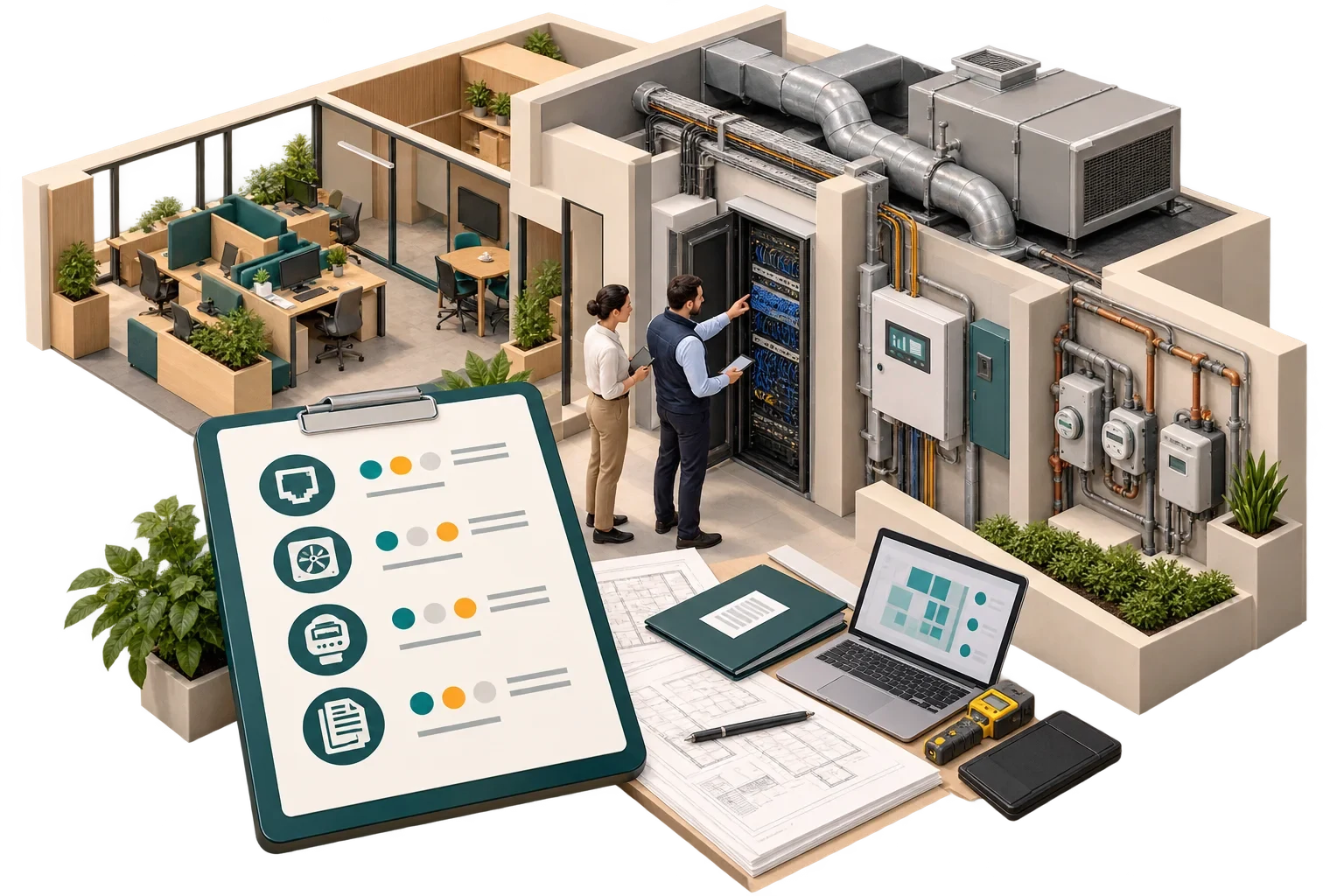
Readiness checks often ask about hardware. Are the controllers supported? Is there a network? Can data be extracted? Those questions matter, but smart building projects can fail for reasons no hardware survey would find: nobody is responsible for acting on the alerts, the maintenance contract does not cover the new devices, the credentials are held by a former contractor, or the project began because the technology was available and nobody had identified a problem to solve.
A proper readiness assessment therefore looks at six areas. It asks whether there is a clear purpose and an owner for the outcome; whether the operating team has the capacity and processes to act on new information; whether the technical foundations can support the use cases; whether the asset information is good enough to build on; whether contracts and licences allow access to systems and data; and whether security and governance are in place. Each area is rated on evidence, the weakest become prerequisites, and the assessment ends in a decision, "proceed", "proceed after these prerequisites" or "not yet", with the reasons written down.
A technical survey of the existing systems remains essential for any retrofit. But the RIBA Smart Building Overlay to the Plan of Work makes the case for a wider view from the very start of a project. Its Stage 0 questions include whether lifecycle opportunities affect commercial viability, whether there is an appetite for digital innovation, and whether a smart building aligns with existing business and estate strategies. It also points to lessons learnt from existing operational assets as a valuable source of answers.
| Area | Questions to answer | Evidence to look for |
|---|---|---|
| Purpose and ownership | Which problem or opportunity is this for? Who owns the outcome and the budget? | A named sponsor; a short statement of outcomes; agreed measures |
| People and process | Who will act on new information? Is there time, skill and a process to do so? | Staffing, current workload, existing procedures for alarms and work orders |
| Technical foundations | Can existing systems supply the data and control the use cases need? Is there a suitable network? | Survey results: supportability, interfaces, network segmentation, capacity |
| Information | Are asset registers, drawings, point names and documentation accurate enough? | Sample checks of records against site; naming consistency |
| Commercial and contractual | Does the owner hold credentials, licences and configuration backups? Do contracts allow third-party access and integration? | Licence records; contract clauses; supplier confirmations |
| Security and governance | Who is responsible for building system security? How is remote access controlled? Who decides on data use? | Policies, access lists, an agreed responsibility between IT and facilities |
A simple three-level scale works, provided every rating is backed by evidence. An area is ready if it supports the intended use cases now. It is ready with prerequisites if specific, achievable actions are needed first, such as recovering credentials, correcting point names or agreeing an alarm process. It is not ready if the gap is fundamental, such as no owner for the outcome, or unsupported systems that cannot be secured, in which case a decision is needed before anything is invested.
The ratings should never be averaged. A strong technical score does not compensate for having nobody to act on the results, and the overall result is governed by the weakest area the use case depends on.
A building can be ready for one use case and not for another. An office with good metering and a reliable building management system may be ready for energy analytics but not for occupancy-based ventilation, if it has no occupancy data and its air-handling controls cannot vary ventilation by zone. The assessment is most useful when it is aimed at the two or three use cases actually under consideration.
The EU Smart Readiness Indicator (SRI) rates a building's capability to use smart technologies across nine technical domains, such as heating, ventilation, lighting and monitoring and control, and is a useful structured lens on technical capability. It does not assess organisational readiness, contracts or the quality of asset information, so it works alongside the six areas above and does not replace them.
The output is deliberately short: a one-page summary of ratings by area for each use case, with the evidence behind them; a list of prerequisites with owners and target dates; the decision itself; and the use cases recommended for a first phase, along with those deferred. Its value lies in making gaps visible before money is committed, and a short document does that best.
Take the two or three use cases you are most likely to fund and run each through all six areas, technical survey included, writing down the prerequisites that still stand between you and a go-ahead. An assessment that ends in a score and no decision has not done its job.
This article connects to our work on Our services.
We can discuss how this subject fits the project brief.
Contact Pagin Consulting