
Smart Districts & Cities
What is the difference between a smart building, smart district and smart city?
How buildings, districts and cities differ in scope, decision makers, data and funding, and how the three levels connect.
Plan shared infrastructure, interfaces and responsibilities as a district brief before individual plots are designed.
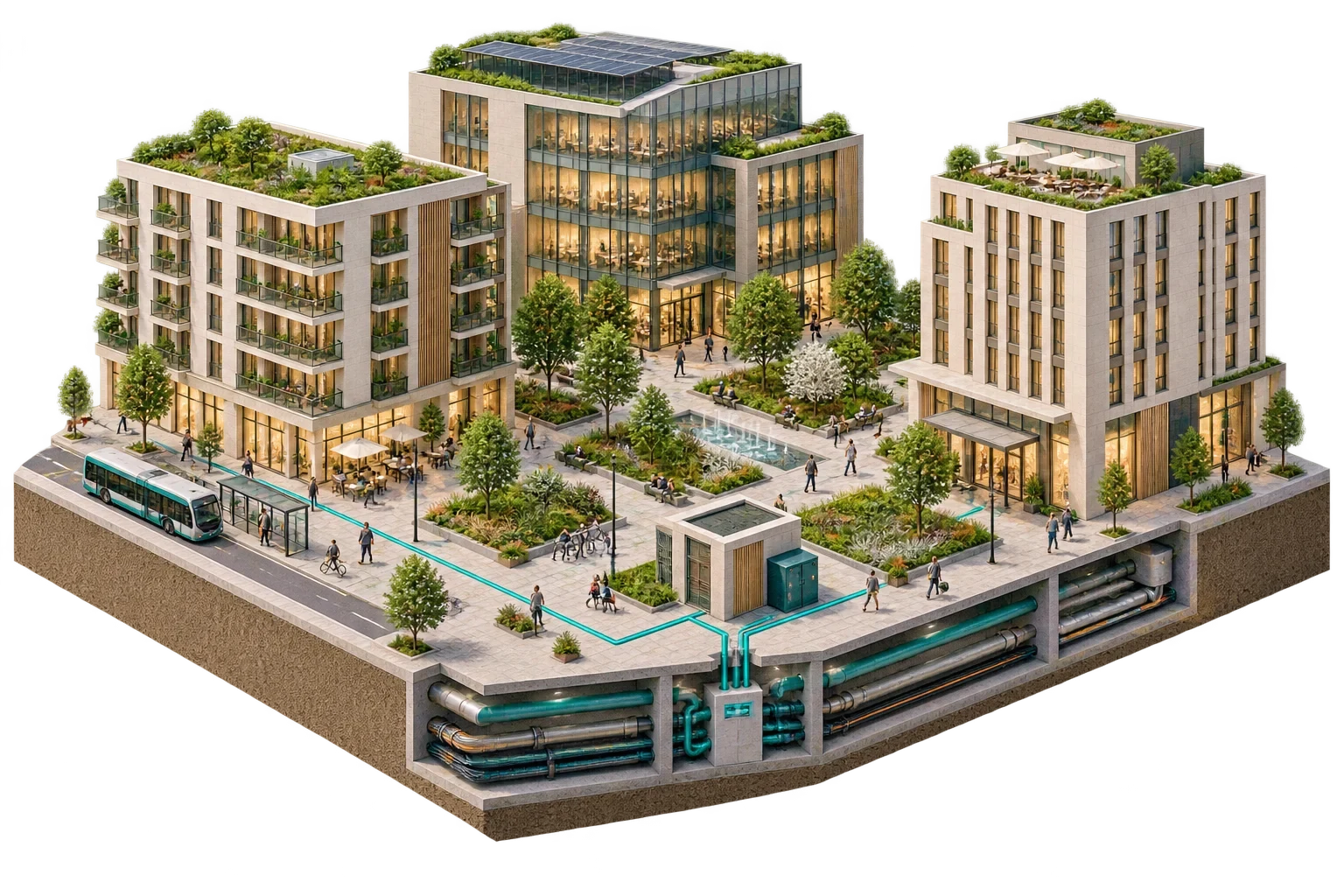
A smart district is a defined area, such as a mixed-use development, business park, campus, regeneration quarter or estate, in which several buildings and the spaces between them share some infrastructure, information and services, and are run under an agreed operating model. Sensors are not what make it smart. What does is the ability to handle shared needs that no single building can manage efficiently alone: utilities serving several plots, common security and logistics, upkeep of the public realm, mobility, and a consistent picture of how the area is performing.
That makes the defining question organisational before it is technical. Who owns each shared service, who pays for it, and who has the authority to act when something goes wrong?
| Shared service | Examples | Who usually owns it |
|---|---|---|
| Utilities and energy | District heating or cooling, shared electrical connection, on-site generation, metering | Energy services company, developer, utility |
| Digital infrastructure | Ducts, fibre, telecoms rooms, mobile coverage, public Wi-Fi | Developer, estate manager, neutral-host operator |
| Estate operations | Security, cleaning, landscaping, waste, deliveries | Estate management company |
| Mobility | Car parks, cycle storage, electric-vehicle charging, servicing access | Estate, operator or concessionaire |
| Information | Shared asset register, service status, district reporting | Estate manager or district operator |
Not every district needs all of these, and not every shared service needs a central platform. A business park with one owner and a shared security team has a very different brief from a regeneration quarter with dozens of freeholders and a public landlord.
Each building in a district keeps its own systems and its own operator. The district layer adds only what genuinely crosses property boundaries, and that starts with physical infrastructure. Ducts, routes and plant space are very hard to add once streets and plots are built, so they have to be planned first.
On top of that sit agreed interfaces, through which buildings share specific information with the district, such as meter readings, alarm summaries or access events, without opening up their internal systems. Each building must also keep operating safely if district services are unavailable. And governance has to set out who can see what, who can request what, and how costs are shared.
Interoperability across those boundaries is not automatic. The US National Institute of Standards and Technology notes that many smart city ICT deployments are custom systems that are neither interoperable nor portable, which is why its IoT-Enabled Smart City Framework sets out common architectural features. In a district, that argues for agreeing interfaces and data structures before each plot procures its own systems.
Governance deserves particular emphasis. A district operator should not automatically receive each tenant's detailed data just because an interface makes it technically possible. Share what serves an agreed purpose, and nothing more.
The case is strongest where several buildings can share energy infrastructure. A heat network is the obvious instance: the European Commission's Smart Cities Marketplace notes that networks have evolved from early high-temperature steam systems towards lower-temperature schemes that reduce distribution losses and make it easier to use renewable heat sources. It is also strong where a single estate team runs security, logistics or maintenance across several plots, where a development will be delivered in phases over many years and later plots need clear rules for connecting, and where an owner or public authority wants consistent reporting across the whole area.
The case is weaker when buildings are independently owned and operated with little shared infrastructure. Then a light set of common standards may be all that is needed.
The first task is to list the decisions and services that genuinely cross property boundaries, because those, and only those, are the district's business. Next comes a map of the parties: developer, future estate manager, utilities, occupiers and public authority, with a note of which appointments have not yet been made. Common infrastructure should then be planned at the same time as the spatial and utility masterplans.
With that in place, the operating model can be written: who owns each service, how costs are recovered, what the data-sharing rules are and what happens when a party changes. The district can then start with a few accountable services and an agreed way of checking how they perform.
For a developer or estate owner at the planning stage, the right first document is often a short district digital brief setting out shared infrastructure, interfaces and responsibilities. Pagin Consulting writes such briefs in coordination with the spatial and utility masterplanners.
This article connects to our work on Masterplan design.
We can discuss how this subject fits the project brief.
Contact Pagin Consulting