
Digital Twins & BIM
What is BIM and how is it different from a 3D model?
What BIM is, how it differs from a 3D model and how to judge a BIM deliverable by what it supports.
The relationship between BIM and a digital twin needs a clear project brief. Here is how we recommend deciding what your asset needs.
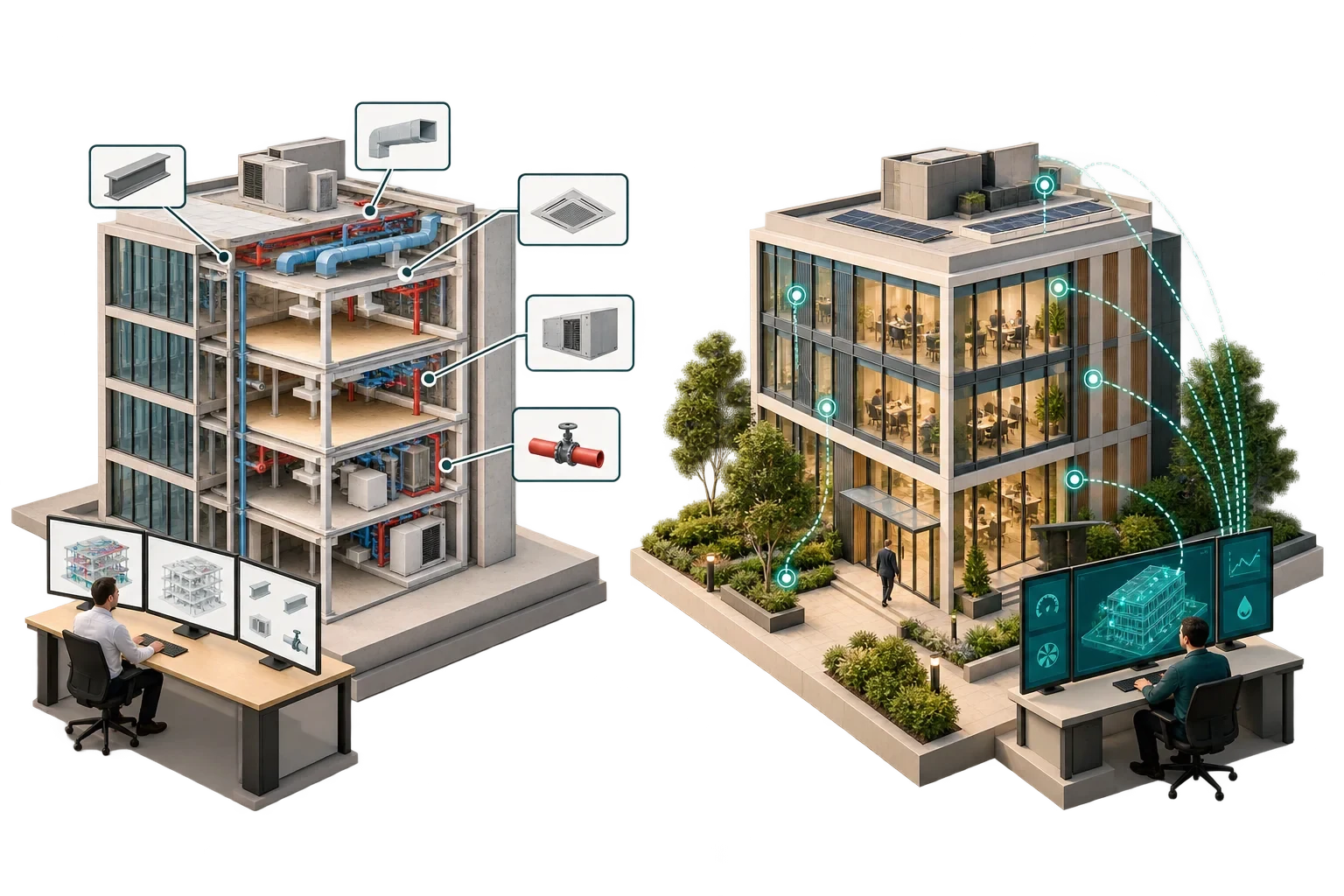
A supplier shows a three-dimensional model of your building, its rooms shaded from blue to red by live temperature readings, and calls it a digital twin. It may be a useful dashboard, but it does not tell you whether you need BIM, a twin or neither. The short answer is that BIM is the managed body of information about a building, from design through to operation, while a digital twin connects part of that information to live data from the building to help someone make a specific operating decision. Settle which decision matters first, and the right purchase follows.
The IMI Framework (formerly the UK BIM Framework) treats BIM under the ISO 19650 series as information management across design, construction, operation and maintenance. Geometry is only part of that information, and BIM does not stop at handover: the asset information the operator receives is part of it, and has to be kept current.
What makes that information useful in operation is fit, not detail. A technician who has to find a fire damper and its access hatch gains little from a precise model if the damper's tag, location and maintenance record are wrong. Asking for every property the software can hold has the opposite cost: more to produce, more to check, and little that anyone uses.
The RIBA Smart Building Overlay to the Plan of Work points out that there is no official definition of a digital twin. For its own purposes it separates an asset twin, a digital representation of the building and its systems usually based on the asset information model, from a performance twin built on the data the building generates. That distinction is a good starting point for a brief.
Each project still has to say what it means by the term: which equipment and spaces are represented, which live data stays connected, and which decision the system supports. Without that, owner and supplier end up assessing different deliverables. Measured against such a brief, the coloured model in the opening paragraph is quickly placed. It displays readings, but it predicts nothing, raises no work order and does not on its own make a business case.
| BIM information | Operational digital twin | |
|---|---|---|
| Purpose | Information to design, build and maintain the asset | Support for one specific operating decision |
| Content | Models, asset data, documents, managed exchanges | Selected asset data, live readings and, where needed, an analytical model |
| Updated through | Project and asset-information processes | Live data feeds and controlled changes to the model |
| Is 3D needed? | Where an information requirement calls for it | Not always; systems and relationships may matter more |
| Owner's test | Does it meet the information requirements? | Does it improve the decision, with fresh and accurate enough data? |
| Maintained by | Information producers, then the asset-information owner | Named owners for each data connection, the model and the application |
An operational twin of the same unit adds the live picture. It shows the supply-air temperature climbing from 14 °C to 17 °C after 2 pm while the cooling valve stays fully open, and it marks the gap between that and the behaviour expected for the day's weather. The engineer sees the pattern in context instead of trawling through trend logs. The twin still cannot say why. Someone has to go up to the roof and establish whether the coil is fouled, the valve actuator has failed or the chilled water is arriving too warm.
If the engineer cannot find the right unit and its manuals, better asset information comes first. A twin starts to earn its cost when the team has recurring problems to investigate and the time to act on what it shows.
Keep the first step small: one operating question, the assets it involves and an honest check of the information that already exists. Equipment tags must match across the model, the controls and the maintenance system: a model whose objects cannot be matched to real equipment has little operational value, however detailed it is. Connect only the readings the first use case needs, test a few representative cases with the operations team, and name who maintains the mappings when equipment changes.
IFC, the open exchange schema published as ISO 16739-1, can carry model data between applications, so ask suppliers which model view definition their software supports. An IFC file is still a file. It is not a live connection, an analytics service or a guarantee that every property your use case needs will survive the exchange.
As often as the decision requires, and no more. A monthly performance review and an operational alarm need very different data services. Ask suppliers to state the sampling interval, the transfer delay, how stale data is flagged and how long history is kept; "real time" is not an acceptance criterion without a stated tolerance.
Letting the twin control equipment is a separate decision. For a first investigation tool, recommendations reviewed by an engineer may well be enough. If the system is to write commands, its authority, limits, approval steps, rollback and responsibilities have to be defined explicitly. Calling something a twin grants it no permission to control anything.
For many use cases, yes. The test is whether verified equipment registers, surveys, system relationships and operational data can support the first use case. A detailed whole-building model may be justified where spatial information is essential to the decision, but establish that before rebuilding the model becomes the programme's first major cost.
The most useful document to take into a meeting with platform suppliers is a single page: the first use case, the asset information it needs and the system connections it depends on. Proposals can then be judged against it, and modelling that supports no decision drops out. Pagin Consulting drafts that page with owners.
This article connects to our work on Digital twin.
We can discuss how this subject fits the project brief.
Contact Pagin Consulting