
Digital Twins & BIM
What is BIM and how is it different from a 3D model?
What BIM is, how it differs from a 3D model and how to judge a BIM deliverable by what it supports.
Start with one system and one operator task, and decide who maintains the twin before it is built.
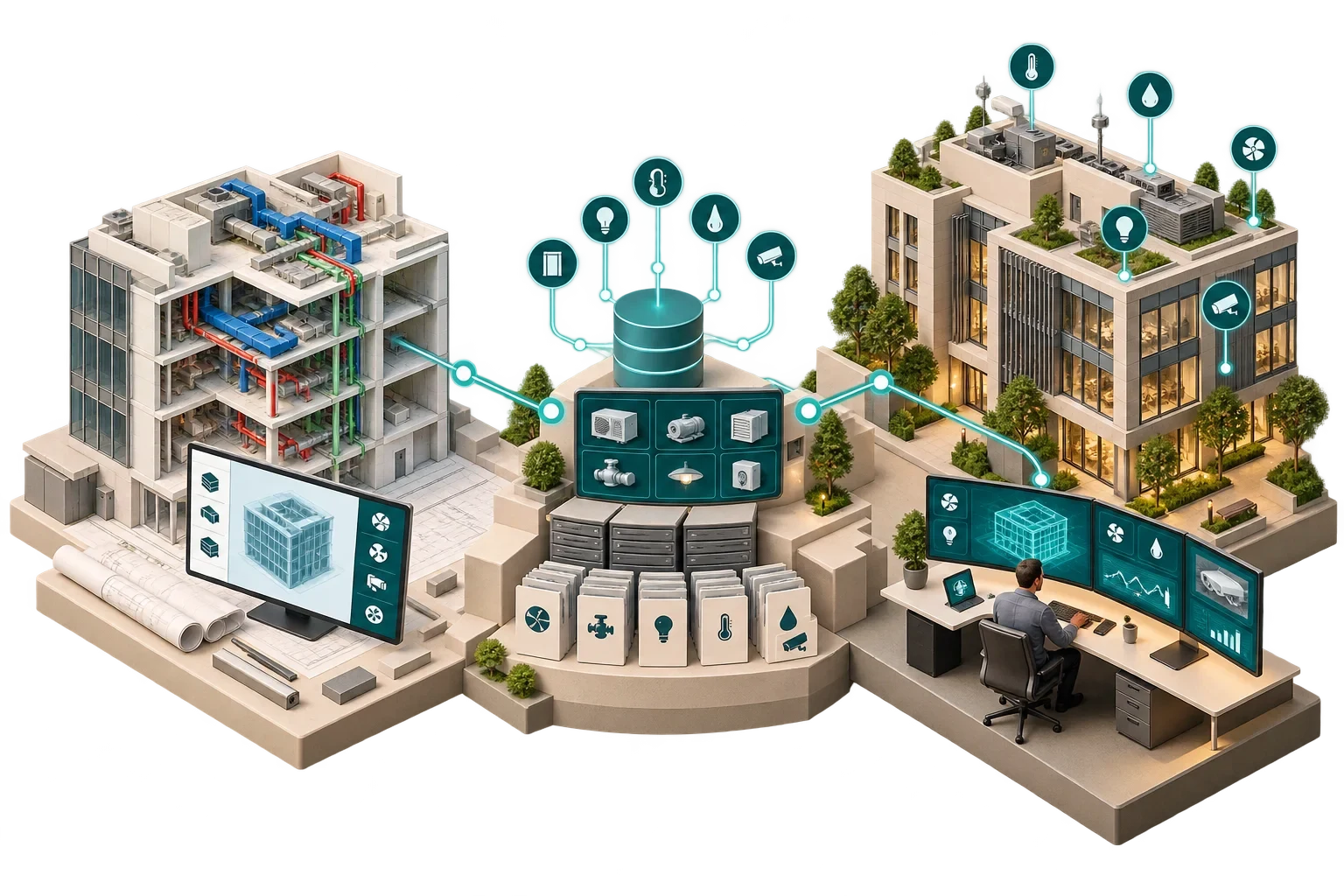
Attaching live readings to model objects produces something that looks like a digital twin. Whether it works as one depends on less visible work. The operating decision the twin must support has to be agreed; the model has to be checked against the installed building for that scope; asset identities have to be reliable; the operational data has to be mapped to those identities; any analysis has to be validated separately from the data connections; and a process has to exist that keeps everything current after handover. That last step is often missing from the plan, and without an owner for it the twin begins to part company with reality on the day it is delivered.
Choose a single system and a single operator task, such as investigating comfort complaints in the areas served by a chilled-water system. That choice fixes which assets, spaces, relationships and data points matter, and keeps the first phase affordable.
Design and construction models are produced for delivery, not operation, so for the chosen scope they need testing against reality. Do the assets in the model match what was installed, by make, model, location and serial number? Are system relationships recorded, so that you can see which pump serves which circuit and which unit serves which space? Are identifiers unique and consistent with the labels on site? Are maintenance documents linked to the right assets?
The gaps should be recorded. A model becomes an authoritative operational reference only once they have been resolved for the scope that matters.
Not everything belongs in the twin itself. Each kind of information should have an authoritative home:
| Information | Usually authoritative in |
|---|---|
| Asset identity, type, location | Asset register (CAFM or CMMS), seeded from the BIM handover |
| Geometry and spatial context | Asset information model |
| Live and historical readings | BMS and meters, via a data layer |
| Work orders and maintenance history | CMMS |
| Approved documents | Common data environment or document system |
The twin links these sources by identifier. Copying every field into it would only create reconciliation work.
Each BMS point and meter must be mapped to the right asset and space, with units, timestamps and quality indicators. IFC, the open BIM exchange schema (ISO 16739-1:2024), covers information for operation and maintenance, but BMS points and their links to equipment are often absent from a handover model and have to be added. An operational ontology such as Brick can hold those relationships in a documented, reusable form.
The mapping should be proved on a handful of assets with known locations and connections. Switch something, and confirm that the right object in the twin changes.
Connectivity and analysis are separate claims and need separate evidence. If the twin compares actual with expected behaviour, that logic must be tested against known events and across different operating conditions, and the limits of its validity recorded.
Equipment is replaced, spaces are re-planned, controllers are upgraded. For each kind of change, someone must update the relevant records in a defined order and verify the result. ISO 19650-3:2020, which ISO has put under revision, sets out information management for the operational phase of assets; the practical consequence is that the asset information model has to be maintained as a living record, and the twin depends on it.
A connected twin crosses several appointments, and problems gather at the joins between them. Each piece of work needs an owner, written into the relevant contract:
| Task | Usually best placed | Watch for |
|---|---|---|
| Model accuracy against the installation, for the chosen scope | Main contractor, checked by the owner's information manager | "As-built" models that were never compared with site |
| Identifier convention and site labels | Owner sets the rule; contractors apply it | Labels and model names that use different schemes |
| Points list and point naming | Controls contractor | Names that change during commissioning and are not reissued |
| Point-to-asset mapping | Systems integrator or twin supplier, checked by the controls contractor | Mapping held only inside the twin supplier's software |
| Analytical rules and their validation | Twin supplier, with the operator | Rules tuned only on design assumptions |
| Updates after handover | Owner's facilities or information manager | No budget or procedure for keeping records current |
Some decisions belong to the owner alone, and are best taken before anyone is appointed:
The handover itself should include:
Pagin Consulting is most useful at the information-requirements stage, before modelling begins. That is when the link between the BIM deliverable and building operation can still be secured cheaply, with identifiers, point mappings and the acceptance tests that prove them.
This article connects to our work on Digital twin.
We can discuss how this subject fits the project brief.
Contact Pagin Consulting