
Digital Twins & BIM
How do you turn a BIM model into an operational digital twin?
A six-step route from a BIM deliverable to an operational twin, with responsibilities allocated across appointments.
Specify BIM as information management with operational requirements, not as a model to look at.
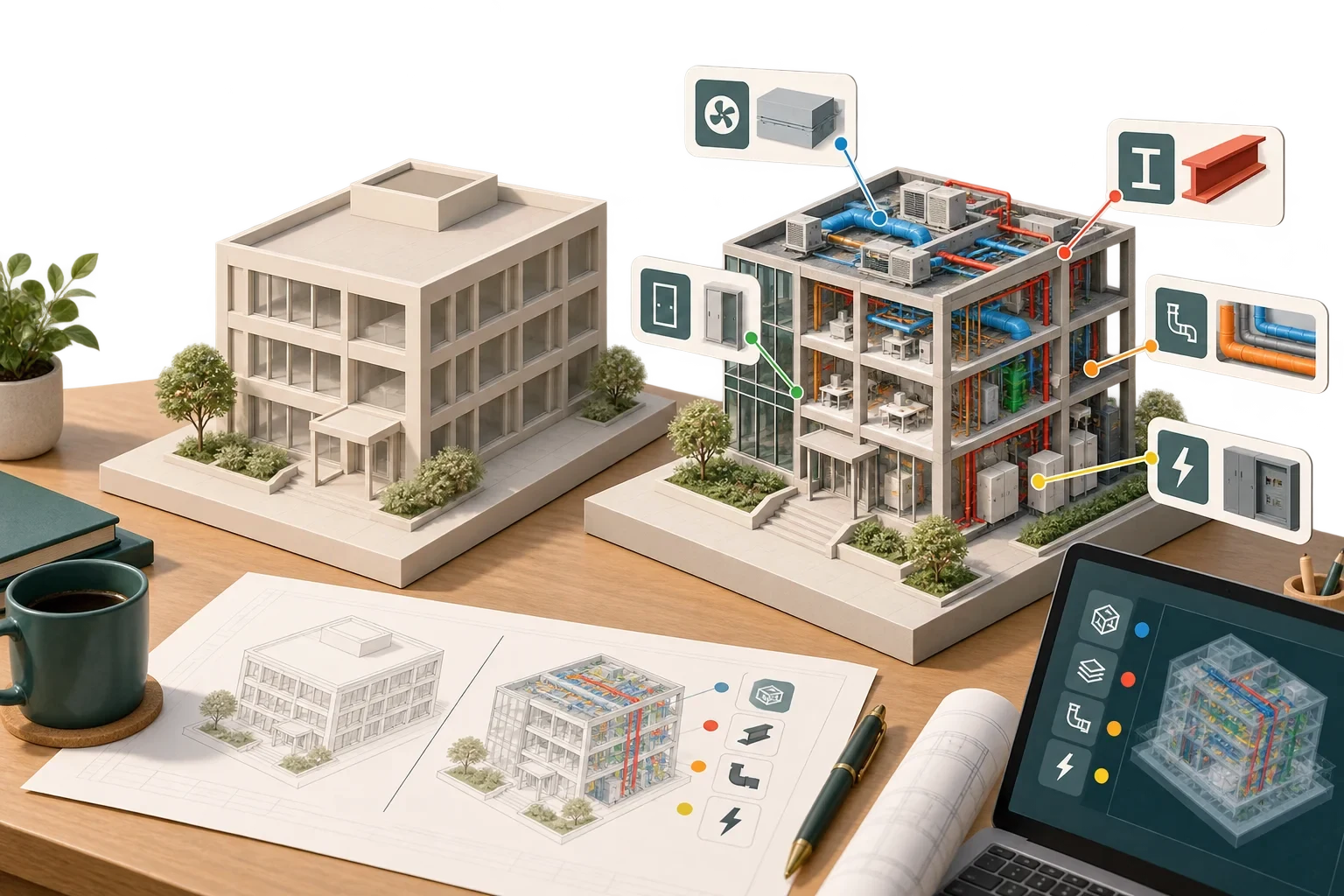
A 3D model shows what a building looks like and whether its parts fit together. Building information modelling (BIM) is something broader: a way of producing and managing information about a built asset, whether a building, a bridge or a campus, across its whole life, from planning and design through construction and operation to eventual disposal. A 3D model may be part of that information. BIM also covers the structured data attached to objects (what an item is, its properties, what it connects to), the documents that go with them and, just as importantly, the processes that decide who produces which information, when it is checked and how it is exchanged.
The IMI Framework (formerly the UK BIM Framework), the UK's national approach to information management published by BSI and nima, frames BIM under the ISO 19650 series as better specification and delivery of information about the design, construction, operation and maintenance of assets. The emphasis falls on the right information, not the most impressive model.
| A 3D model | BIM | |
|---|---|---|
| What it is | Geometry: shapes, sizes, positions | Information management across the asset's life, which may include models, data and documents |
| Main question answered | "What does it look like, and does it fit?" | "What is it, what does it do, who is responsible, and where is the approved information?" |
| Content | Surfaces and solids | Objects with identity, type, properties, relationships; linked documents |
| Process | Whoever builds it | Defined roles, information requirements, checking and approval, a common data environment |
| Life after handover | Often none | Asset information maintained during operation |
The distinction matters most to the people who run the building. A model can be visually detailed and still useless to an operator if it lacks reliable equipment identifiers, maintenance documents and the relationships between equipment and the spaces it serves.
The ISO 19650 series sets out information management using BIM. Part 1 covers concepts and principles for exchanging, recording, versioning and organising information across the life cycle; Part 3 covers the operational phase of assets. ISO is revising both and lists draft replacements in development. The open exchange format most associated with BIM is IFC (Industry Foundation Classes), published as ISO 16739-1.
"We need a BIM model" is not a requirement. A useful brief starts from the decisions the information must support at each stage, such as design coordination, cost, construction sequencing, and operation and maintenance. From those follows the information each decision needs, in geometry, data and documents, and no more. The brief should also say who produces and checks that information and when, and how it will be exchanged: in which format, and how the receiving system will use it.
Specifying every conceivable property without saying who will use it creates cost and noise. Every party should ask only for information it will actually use.
ICT and smart building systems, including networks, BMS controllers, sensors, access control and meters, are often modelled late or poorly because they sit between disciplines. Yet these are the systems whose identity and connections an operator most needs to know. Agreeing their information requirements early, alongside the mechanical and electrical services, avoids a handover in which the most operationally important equipment is the least documented.
Check whether your project information requirements name the ICT and smart-system assets the operator will need, with the properties each task depends on. If they do not, add them while the model is still to be built.
This article connects to our work on Digital twin.
We can discuss how this subject fits the project brief.
Contact Pagin Consulting