
Digital Twins & BIM
What is IFC and why does it matter for building data exchange?
What IFC covers, how MVDs and IDS make exchanges specific and why early tests with the receiving application matter.
Agree identifiers and operational relationships in the information requirements, before models are built.
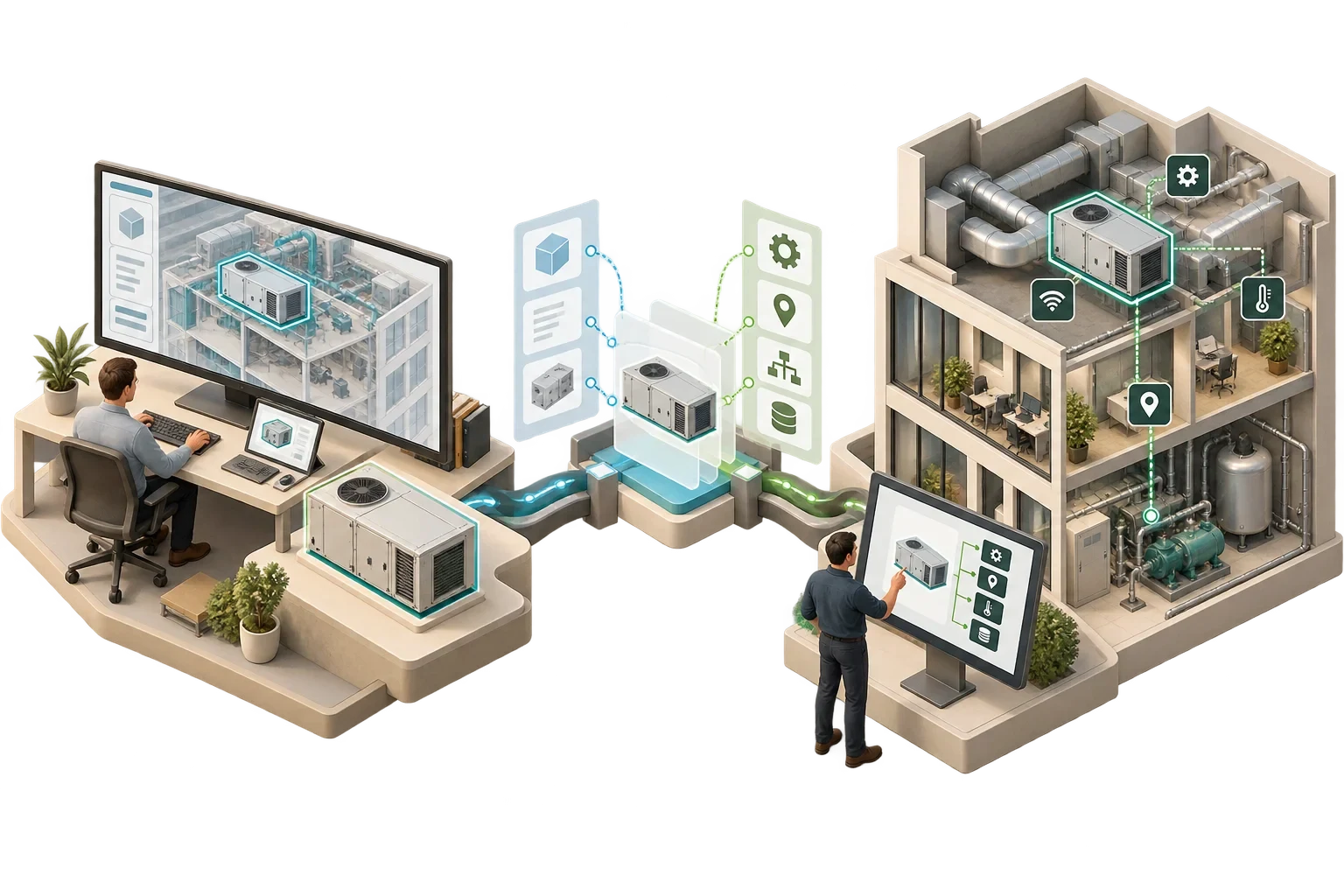
They describe the same building for different purposes. BIM (building information modelling) and IFC (Industry Foundation Classes, the open data schema for exchanging BIM information) describe a building as designed and constructed: its spaces, systems, components and their properties. Operational ontologies such as Brick, Project Haystack or RealEstateCore describe the context applications need to interpret live and historical data, such as which sensor belongs to which equipment and which equipment serves which space. Both know about rooms and air-handling units, but they were built for different jobs.
That overlap is both an opportunity and a trap. Connected through shared identities, the two let the effort spent on project information carry on working after handover. The trap is assuming that a design model automatically describes the building as it actually operates.
IFC, published as ISO 16739-1, covers life-cycle phases up to and including operation and maintenance, according to ISO's abstract. It can therefore carry a great deal of what operations need: equipment identity, type, location, system membership and selected properties. What a particular export actually contains depends on the modelling brief and on the model view definition, the subset of the schema, that the software implements.
Handover models vary, but the typical picture is uneven:
| Needed for operations | Typically in the IFC handover? |
|---|---|
| Equipment identity, type, location | Often, if specified and checked |
| System membership (this AHU is part of that system) | Sometimes; depends on the modelling brief |
| Which unit serves which space (air or water flow) | Sometimes, and often incomplete |
| BMS points and their link to equipment | Rarely |
| Controller and network references | Rarely |
| Changes after handover | No — the model reflects a moment in time |
An IFC export is a useful starting point, then, though it seldom maps BMS points to equipment.
The single most valuable decision is to agree one identifier per asset and per space, and to use it in the model, the asset register, the BMS and the operational ontology alike. Everything else depends on it.
With that in place, whatever is reliable in the model, such as identity, type, location and system, can be reused once it has been checked against the installed condition. The operational relationships the model lacks, such as feeds, serves and has point, are then added in the operational ontology and linked to the same identifiers. Every transformation and source should be recorded, so that any fact can be traced back to the model, a survey or a commissioning record. The mapping is then tested the way an operator will use it: raise a test alarm on a handful of points from different systems and floors, and check that each leads straight to the right asset, room and manual.
The model and the operational ontology will fall out of step unless someone keeps them aligned. When a unit is replaced, it may need a new asset identity while keeping the same functional relationships to its system and spaces. Who updates which record, in what order, and how the change is verified all need defining while the building is new, long before the first unit is replaced.
Written into the appointing party's exchange information requirements before design modelling begins, the asset identifiers and operational relationships cost little to agree; afterwards, the same context has to be reconstructed by survey. Pagin Consulting sets out those identifiers and exchanges for owners.
This article connects to our work on Our services.
We can discuss how this subject fits the project brief.
Contact Pagin Consulting