
Digital Twins & BIM
Can you create a digital twin for an existing building without BIM?
How to build an operational twin for an existing building without BIM, starting from a verified record of one system.
Invest in a twin only for an important, recurring decision, with a written gate before expansion.
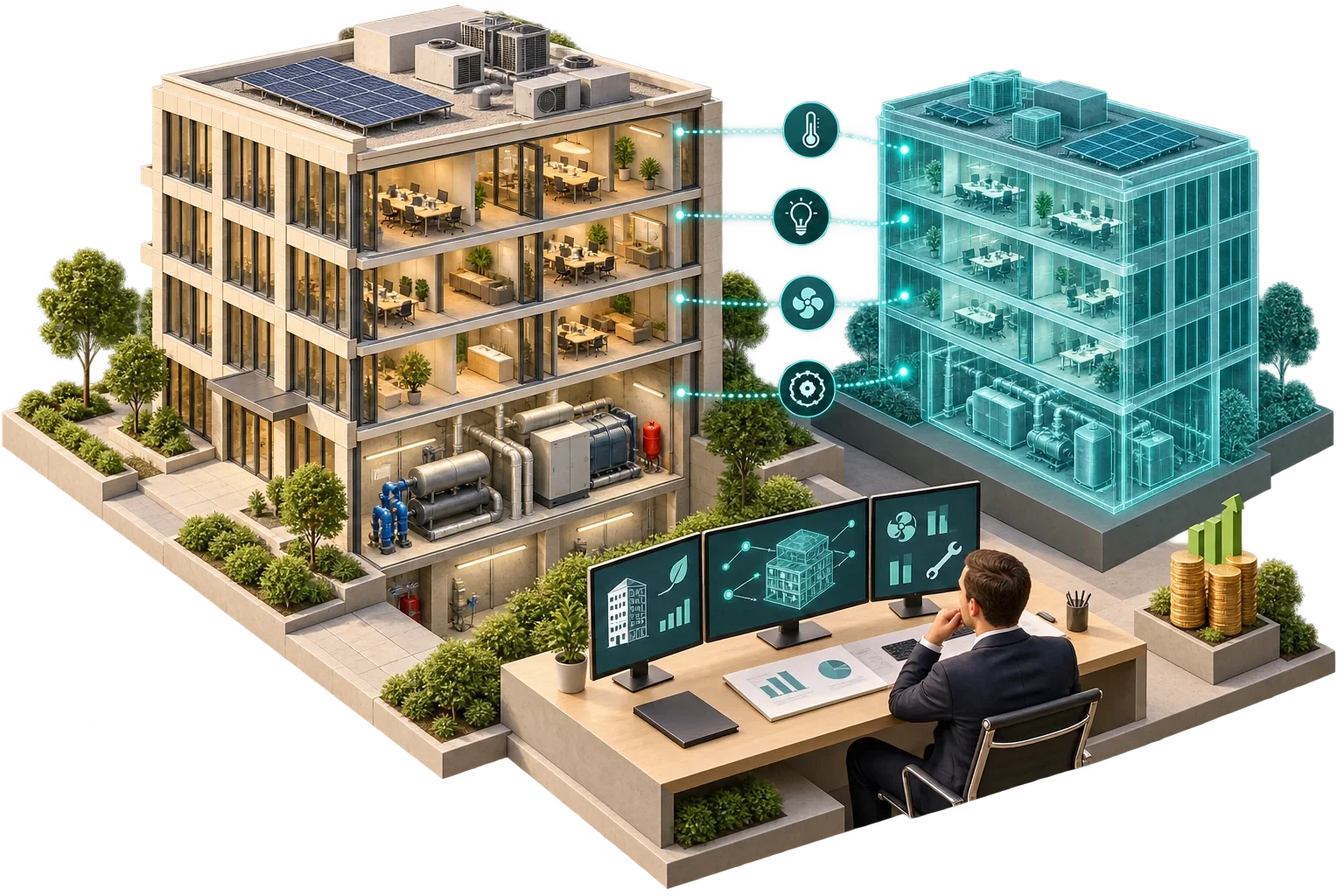
A 3D viewer, an operational model linked to live data and a validated simulation that predicts behaviour are all sold as "digital twins". They are different deliverables with very different costs, which is why the term needs pinning down before money is committed.
In general terms, a building digital twin is a digital representation of a specific building, or part of one, kept connected to information about its real condition and behaviour so that people can understand, analyse or decide something about it. NIST's 2025 report on digital-twin security and trust (NIST IR 8356) notes that there is still no agreed-upon definition. The Digital Twin Consortium's description, which that report quotes, captures the essentials: a virtual representation of real-world entities and processes, synchronised at a specified frequency and fidelity.
Those last words carry the weight. A twin is defined by what it represents, how often and how accurately it is updated, and what it is for. It is worth investing in when the decision it supports is important and recurring, when the information behind it can be kept current, and when simpler tools, such as better asset records, a monitoring dashboard or an engineering study, cannot meet the need.
| Capability | What it does | Typical use |
|---|---|---|
| Visual record | Shows geometry and linked documents | Navigation, induction, space planning |
| Connected operational view | Links assets and spaces to live and historical data | Investigating faults, comfort, energy |
| Analytical model | Compares actual behaviour with expected behaviour | Fault detection, performance checks |
| Predictive or scenario model | Simulates behaviour under changed conditions | Testing control strategies, retrofit options |
Whichever capability you need, the specification should set out its physical scope, the data connections and their update frequency, the form of representation and the intended users. Suppliers should demonstrate it on your information; a showcase project proves very little.
Frequency of use matters as much as capability. A model consulted once for an investment study has a very different maintenance requirement from one used daily by operators.
The costs go well beyond the licence: surveys and asset verification, information preparation, integration, model development, validation, training and, most often underestimated, the ongoing updates and support that keep the twin truthful.
Benefits need more discipline still. A twin does not save energy or prevent failures by existing; people acting on its outputs do. A credible case states which decisions improve, who makes them and how the improvement will be measured, and it separates what can be evidenced from what remains a hypothesis. Energy savings, maintenance savings and avoided disruption should each be estimated and later verified on their own; merged into one headline figure, they cannot be checked.
The honest first question is what the real obstacle is. If staff cannot find manuals or identify equipment, the answer is better asset records and better links between them. If nobody can see what the plant is doing, a monitoring and trending tool may be enough. If a one-off question needs answering, an engineering study may cost less than a permanent model. A connected or analytical twin starts to justify itself when operators need to understand how interconnected systems behave, and that question keeps coming back.
That museum's gate is the habit to copy. Agree in writing what a pilot must demonstrate before expansion, how it will be measured and what would cause the project to stop. It protects the owner from a twin that grows because it is impressive, not because it is useful.
One question sorts most twin proposals: which single operating decision will this improve, and what must the first stage prove before it is allowed to grow? A supplier who needs more than a paragraph to answer has not yet understood the building.
This article connects to our work on Digital twin.
We can discuss how this subject fits the project brief.
Contact Pagin Consulting