
Digital Twins & BIM
What is a building digital twin and when is it worth investing in?
What a building digital twin is, the capability levels on offer and how to decide whether one is worth the investment.
A verified record of equipment, spaces and relationships matters more than detailed geometry for most operational questions.
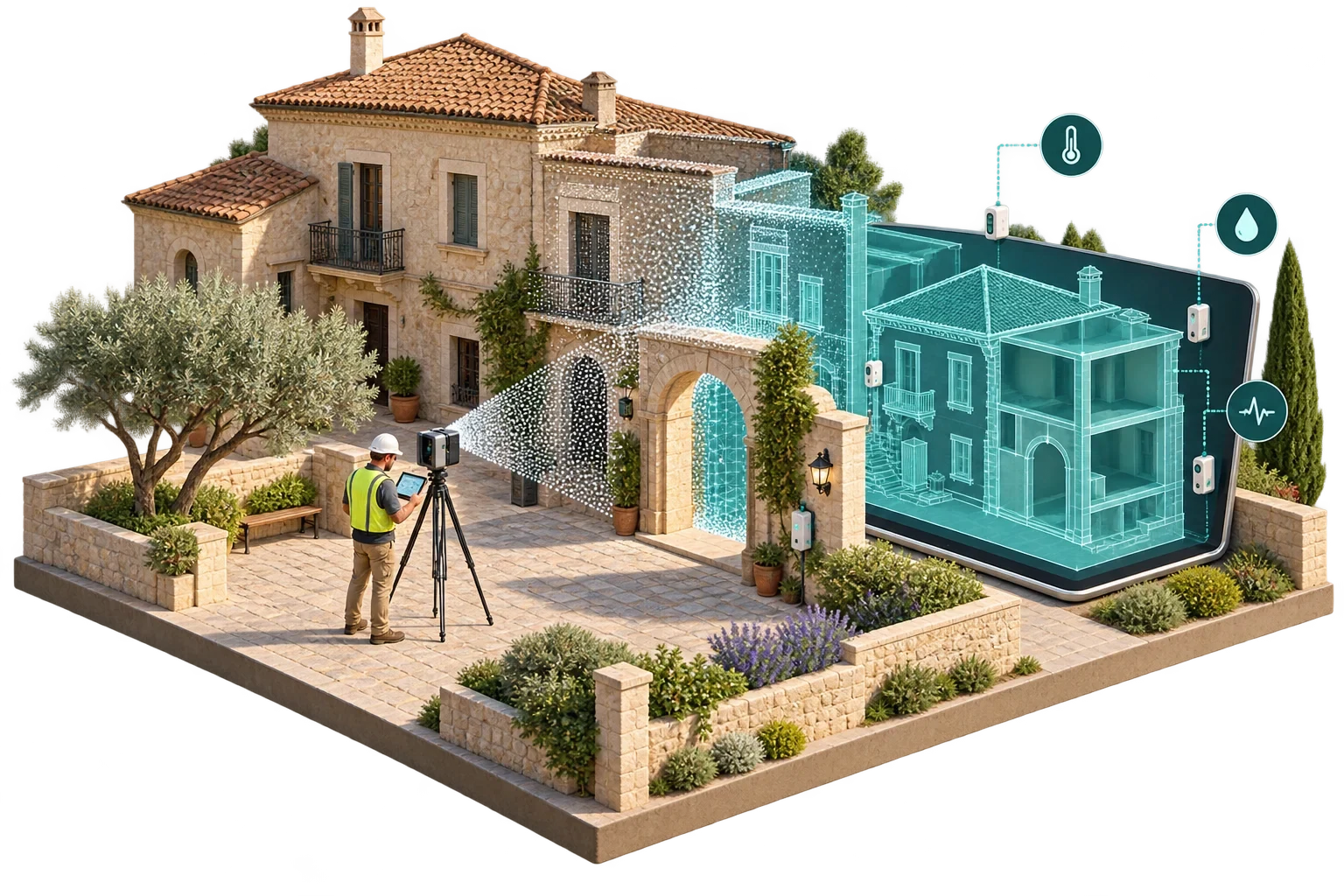
Yes. A useful operational digital twin can be built for a defined part of an existing building without first reconstructing a detailed whole-building BIM model. What a twin needs depends on the decision it supports, and for most operational questions a verified record of the relevant equipment, the spaces it serves, how it is connected and the data it produces matters far more than detailed geometry. Commissioning a full 3D model as the first step often consumes the budget that verification and integration needed.
The real difficulty in an existing building lies elsewhere. Its records are often incomplete and partly wrong, and the work is in assembling a foundation that can be trusted.
At its simplest, a digital twin is a digital representation of something real. For an existing building, the practical question is what to represent, and how faithfully. In an existing building it helps to think in layers:
| Layer | Usually needed for operational use cases? | Typical sources |
|---|---|---|
| Asset identity and type | Yes | Asset register, nameplates, site survey |
| Location (building, floor, room) | Yes | Floor plans, survey |
| Relationships (serves, feeds, part of) | Yes, for anything diagnostic | Schematics, BMS graphics, tracing on site |
| Live and historical data | Yes | BMS, meters, sensors via a data layer |
| Documents | Often | O&M manuals, maintenance records |
| Detailed 3D geometry | Only for spatial tasks | Measured survey, scan, or new model |
Spatial tasks, such as planning a plant replacement route, coordinating a fit-out or visualising complex risers, can justify geometry. Diagnostic and energy tasks usually do not, at least at first.
Drawings, schematics, asset registers and BMS point lists in an older building describe what someone intended or recorded at some point in the past. For the chosen scope, the work is to gather everything available, from drawings and schematics to BMS graphics, point lists, the asset register and maintenance history, and then to test it on site by confirming equipment, nameplates, labels and locations and tracing the key connections. Where sources disagree, the team reconciles them and records which version was confirmed.
The final step is recording uncertainty, and it is frequently left out. Each relationship should be marked as verified, inferred or unknown, so that users know what they can rely on.
Each asset needs a stable identifier, ideally matching a physical label, used consistently in the asset register, the maintenance system and the data layer. BMS points and meters are then mapped to those assets and spaces; an ontology such as Brick can hold the relationships in a documented, reusable form. A limited, verified scope makes a stronger foundation than a comprehensive model assembled from conflicting records.
None of this depends on BIM having been used to deliver the building. ISO 19650-3, which covers information management in the operational phase, applies to all types of assets.
A survey for an existing-building twin is an information-gathering contract, and its brief should be as precise as any construction package. It should cover:
A laser scan or other measured survey captures geometry quickly and accurately, and it is worth commissioning for spatial tasks: a congested plant room, a riser, a replacement route for large equipment. What it does not record is what an asset is, who maintains it or what it serves. Those still come from the asset survey, so a scan supplements that work; it does not replace it.
Someone has to update the representation when equipment is replaced, circuits are altered or spaces change use, and someone has to verify those updates. Without that arrangement, the survey team's work begins to decay as soon as they leave site.
Invest progressively: one system and one decision at the outset, with a measure of whether the twin improves that decision; a wider scope follows only once it does, and geometry only where a task needs it. Pagin Consulting would begin with that first stage, and in particular with how the survey will test what the old records claim.
This article connects to our work on Digital twin.
We can discuss how this subject fits the project brief.
Contact Pagin Consulting