
Operations & Productivity
How can a hotel integrate PMS, guest room controls and maintenance systems?
How a hotel connects its PMS, guest-room controls and maintenance system through an agreed interface schedule and tests.
Most hotels need a small core done well; everything else should earn its place against a real operating need.
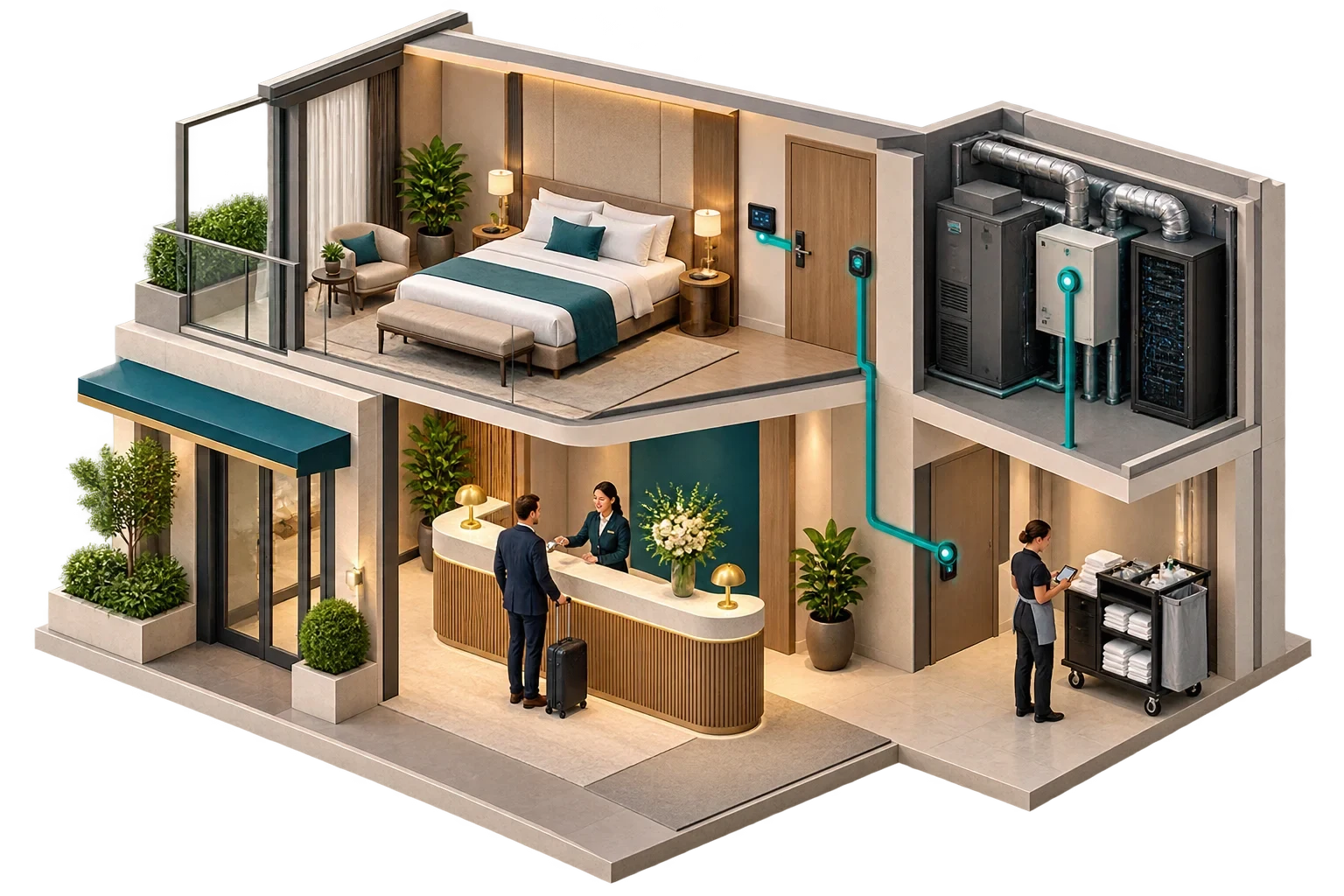
A guest rarely notices a hotel's building systems until one of them lets them down: a room that is stuffy on arrival, Wi-Fi that drops during a video call, a broken fan-coil reported twice before anyone comes. What a hotel needs is a small core done well.
That core means dependable guest and staff connectivity, guest-room controls that respond sensibly to room status, a building management system (BMS) that runs central plant efficiently, energy metering that shows where consumption goes, and a maintenance system that hears about faults from the equipment before the guests report them. Beyond that core, the right systems depend on the property's service model, size, staffing and plant. A 40-room urban hotel and a 400-room resort should not be given the same brief.
The most reliable brief is written from the guest journey and the daily work of the operating team, and chooses systems that make those tasks easier. Technology that adds a workflow nobody owns is a cost and nothing more.
| System | What it does | Who mainly uses it |
|---|---|---|
| Property-management system (PMS) | Reservations, check-in status, room status, billing | Front office, housekeeping |
| Guest-room management system (GRMS) | In-room HVAC, lighting, curtains, do-not-disturb, occupancy | Guests, engineering |
| Building management system (BMS) | Central plant, air handling, public-area HVAC, alarms | Engineering |
| Door locks and access control | Room keys, back-of-house access, audit trail | Front office, security |
| Guest and staff networks | Wi-Fi, wired networks, streaming services | Guests, all staff |
| Energy and water metering | Consumption by area, plant and outlet | Engineering, finance, sustainability |
| Maintenance management (CMMS) | Work orders, planned maintenance, asset history | Engineering |
| Fire, life-safety and security | Detection, alarm, CCTV, intruder systems | Security, engineering |
Fire and life-safety systems follow their own regulations and certified designs. Smart-building integration should only read from them, or act on them through interfaces the responsible fire engineer has explicitly approved.
The grouping that follows is a starting point, to be tested against each property.
Almost every hotel needs reliable guest Wi-Fi and a separate, managed network for building systems. It needs guest-room controls with a sensible unoccupied mode and clear in-room controls, a BMS covering central plant with alarms that actually reach someone, and main meters plus key submeters (for kitchens, laundry, pool and guest-room floors, for instance) so that consumption can be attributed. And it needs a maintenance system in which faults are logged against identifiable rooms and assets.
Of these, the BMS deserves the first look. The US Department of Energy states that high-performance control sequences can deliver around 30% annual HVAC energy savings on average across commercial building types.
Other systems earn their place only in the right circumstances. Linking PMS room status to the GRMS pays off where rooms sit unoccupied for long periods, and much less in a small property that is consistently full. Automated alarm-to-work-order integration is worth most where the engineering team is stretched or covers several sites. Mobile keys and digital check-in depend on the guest profile and the front-office model, and spa, pool and kitchen monitoring depends on whether those facilities exist and how much energy they use.
A third group is optional and should only be bought with a clear owner: guest apps that duplicate the in-room controls, advanced analytics and digital twins before the basic data is reliable, and in-room voice assistants and similar features, which also raise privacy questions to settle with the data protection lead.
Room conditioning is often where a hotel gains or loses most. A PMS "checked-in" status is not the same as a guest being in the room, since a guest may be out all day. Nor does "checked-out" mean the room is empty; housekeeping or a late departure may still be there. The operator needs to agree how booking status, occupancy detection, door events and staff overrides combine, and what happens when the signals conflict or the PMS interface is lost. The room must stay comfortable and safe in every case, and arriving guests should never walk into a room that has been allowed to drift too far.
The guest-facing controls should be simple. An interface that confuses guests generates calls to reception and erodes the benefit of the whole system, which is why acceptance testing should include representative guest and housekeeping tasks.
A small urban hotel should stay lean. Robust connectivity, good room controls, metering and a simple maintenance tool usually cover most of its needs, and the few integrations it has should be well supported. A large full-service hotel has more systems, more departments and more to gain from connecting PMS, GRMS, BMS and maintenance, but it also has a greater need for someone who clearly owns integration. A resort's distributed buildings, outdoor areas and heavy pool, spa and kitchen loads make metering, network coverage and remote monitoring more important. And in a branded or managed property, brand standards may prescribe particular systems or vendors, so owner, operator and brand need to settle early which decisions belong to whom.
The hotel briefs Pagin Consulting writes are built on one separation: essential, conditional and optional, judged for the particular property. Made early, that separation stops a hotel paying twice for overlapping room-control, building-management and platform functions.
This article connects to our work on Fit-out design.
We can discuss how this subject fits the project brief.
Contact Pagin Consulting