
Operations & Productivity
How can a hotel integrate PMS, guest room controls and maintenance systems?
How a hotel connects its PMS, guest-room controls and maintenance system through an agreed interface schedule and tests.
Plan the retrofit around revenue and guests first and the technology second.
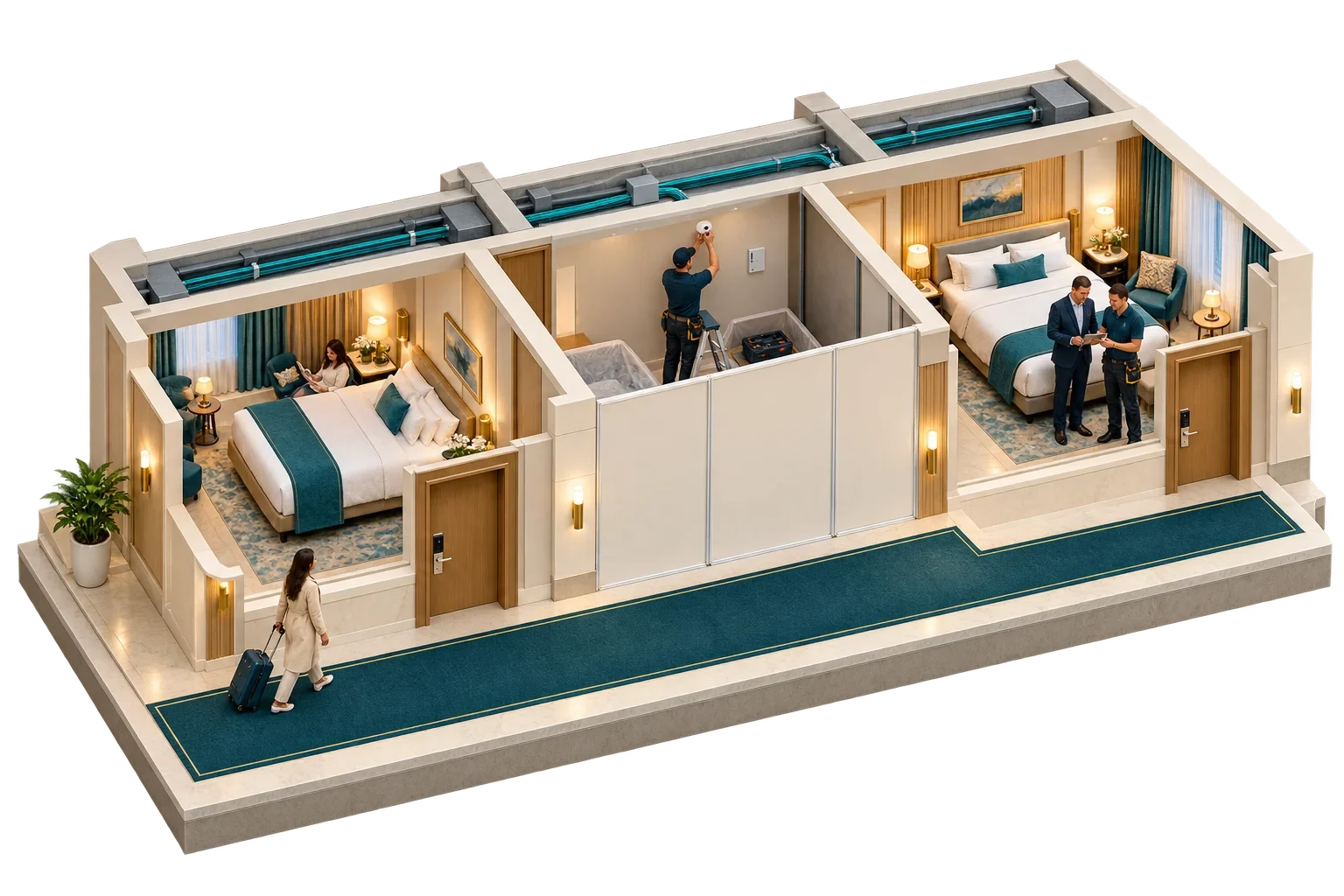
In a hotel, the rooms are the product. Every one taken out of order is revenue lost, every noisy afternoon risks a poor review, and the systems being replaced have to keep running because the hotel cannot pause service while they change. So a retrofit in an occupied hotel is planned around revenue and guests first and the technology second.
In practice that means working in small, sellable blocks of rooms agreed with revenue management, keeping each room's downtime short and predictable, testing every room before it returns to sale, scheduling network and system cutovers for low-occupancy periods with a rehearsed fallback, and controlling contractor access on guest floors. The method is best proved on a fully tested sample of rooms, which fixes the sequence and the timings, before the rollout settles into a repeatable daily or weekly cycle with a clear handback check for every room.
In an office, a retrofit can often be scheduled out of hours across a whole floor. In a hotel, operations run around the clock and guests are always in the building. Contractors work in corridors where people are sleeping, and the guest room management system, the property management system and the building management system all have to keep working throughout.
The plan has to be agreed with the general manager, revenue management, front office, housekeeping, engineering and security before the programme is fixed, because each holds a piece of it. Revenue management decides which rooms can come out of inventory, when and for how long, working around events, peak seasons and group bookings. Front office and housekeeping need to know each day which rooms are out of order and when they will return, through the normal room status process. Engineering owns the plant and building systems and must approve shutdowns and isolations. Security manages contractor access to guest floors and back-of-house areas.
The work is broken into blocks small enough to return to sale quickly, such as a group of rooms on one floor or a single riser stack. Each block follows the same sequence: rooms taken out of order, work carried out, rooms tested, rooms cleaned and inspected, rooms returned. Timing each step in the first blocks shows where the sequence needs adjusting.
Work that does not require entering guest rooms, such as riser cabling, corridor network equipment and plant room controllers, should be finished before the in-room work starts. That shortens the time each room spends out of order.
No room should go back on sale until it has passed a short functional check, written in advance and recorded. A typical check confirms that:
Changing a central server, network or interface affects the whole hotel at once. Cutovers belong in low-occupancy periods, with engineering and the suppliers on site, and they should be rehearsed. The fallback plan needs to say how to revert, how long that takes, and how rooms will be conditioned manually if the new system is not working, and the guest room controllers should be confirmed to have a safe default mode if they lose contact with the central system.
NIST's guide to OT security (SP 800-82) notes that changes to operational technology typically need careful testing and planned outages, often scheduled days or weeks ahead. In a hotel, that discipline protects the guests along with the systems.
Access control for contractors should be agreed between the hotel's security team and the contractor: identification, escorts where required, which areas and times are permitted, and how keys or access credentials are issued and returned. Workers should not enter occupied rooms. Access to building systems needs the same care, with a list of authorised individuals whose access is removed when the work ends. Naming authorised personnel in the service agreement and applying least privilege, as CISA and the FBI advise for integrators, suits both remote and on-site access during a hotel retrofit.
Health and safety, fire safety and surveys for hazardous materials before drilling or opening ceilings are matters for the hotel's appointed specialists and for the contractor's own duties under applicable law, and the technology programme has to allow time for them. Where the work affects fire detection, alarm or smoke control, for instance by covering detectors in a work area, the hotel's fire safety procedures and the fire engineer's advice apply.
Work in guest areas should be confined to agreed hours, noisy tasks scheduled away from occupied neighbouring rooms where possible, and front office staff briefed on what to say if guests ask. The new in-room controls should be simple, with a short guide for guests and a briefing for staff, because calls to the front desk about unfamiliar controls are often the first complaint.
At the end of the programme, every room should have passed its handback check, all temporary access should have been removed, documentation should reflect what was installed room by room, and engineering staff should have been trained. Watch room faults and guest comments closely for the first weeks of normal operation.
Phasing is where an occupied retrofit is won or lost, so the block sequence, the room handback check and the cutover plans need agreeing with the operations and revenue teams before any work starts on site. Pagin Consulting plans that phasing and coordinates the suppliers to it, aiming for a retrofit few guests ever notice.
This article connects to our work on Fit-out design.
We can discuss operational systems and energy opportunities.
Contact Pagin Consulting