
Smart Buildings
What smart building systems does a hotel actually need?
Which hotel systems are core, conditional or optional, and how to avoid paying twice for overlapping room-control and platform functions.
Make comfort an acceptance criterion and agree who may change what before tuning anything.
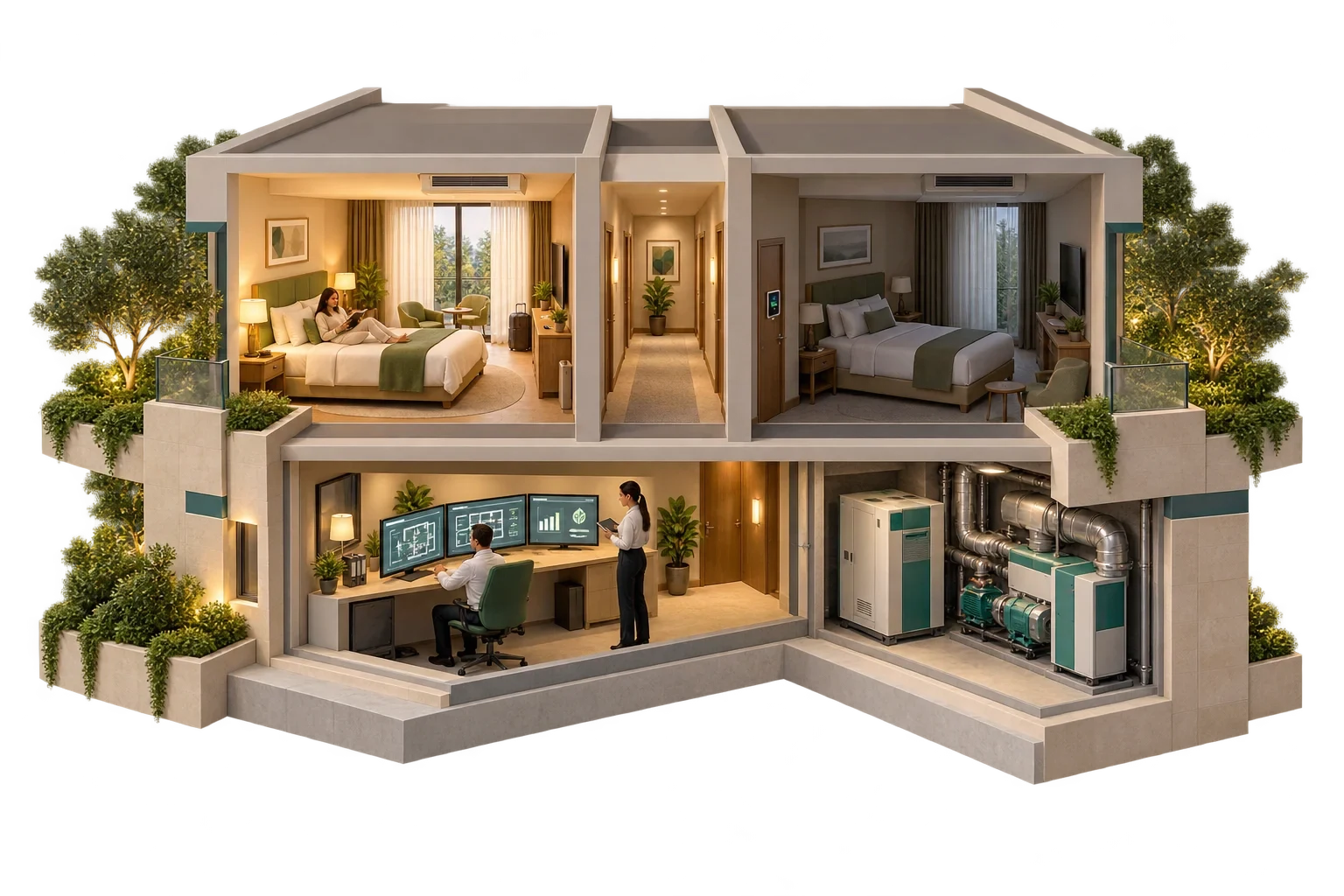
A hotel room that looks empty to the building management system may contain a sleeping guest, and a room sold an hour ago must be comfortable by the time its guest reaches the door. Any hotel energy plan has to work around those two facts.
Within those limits there is often room for improvement. The approach is to match building services to actual need, room by room and space by space, and to make comfort an explicit acceptance criterion that is measured, never assumed. In our view the larger operational opportunities in many hotels lie in operating sequences, unnecessary running hours and systems working against each other, and all of them can be tackled before new equipment is even considered.
Guest rooms, kitchens, laundry, meeting and event spaces, pools and spas, back-of-house and public areas each have their own demand profile, so a single building-wide setback rule will be wrong for most of them. The starting point is the operating pattern: occupancy by room and floor, event bookings, kitchen and laundry hours, set against plant operation from the BMS.
The faults that the US Federal Energy Management Program's O&M Best Practices Guide (Release 3.0) finds in existing buildings apply to hotels as much as anywhere: plant running when nobody needs it, drifting set points, systems fighting each other and overrides never released.
Guest complaints and manual overrides should be recorded as signals. A room that is "always too warm" may have a faulty valve; a corridor that is too cold may be fighting a heating system set too high next door. Fixing the cause often improves comfort and cuts energy at the same time. Logging complaints by room and linking them to equipment records makes the patterns visible.
Guest-room control linked to booking status is valuable, but it is also the most sensitive area. A room must never be cold for an arriving guest or unsuitable for a sleeping one, so the logic needs designing with front-office and housekeeping teams, with clear fallbacks when signals conflict. The back of house and public areas are often the quicker win, because they rarely face a guest directly:
| Area | Common waste | Comfort or service check |
|---|---|---|
| Kitchens | Extract and make-up air at full speed outside cooking periods | Capture of cooking fumes during service; kitchen team sign-off |
| Laundry | Ventilation and hot water running beyond shift hours | Shift patterns and early starts |
| Meeting and event spaces | Conditioned on a fixed timetable regardless of bookings | Room ready before delegates arrive; late finishes |
| Lobby and corridors | Heating and cooling fighting each other near entrances | Temperature at reception and lift lobbies |
| Plant rooms and stores | Conditioning that serves no one | Equipment temperature limits |
A well-meant manual change can undo a saving as surely as a faulty valve. That is why an operating policy has to be in place before the tuning starts.
The policy starts with overrides. It names who may override a schedule or set point and for how long; each override is logged with a reason and expires automatically. Department heads sign off the operating window and comfort limits for their own spaces, as in the table below. Engineering alone changes the BMS, and records and reviews each change, while operations reports problems through one route instead of adjusting controls locally. Temporary arrangements for an event or a heatwave carry an end date and a named owner.
| Area | Signs off operating window | Engineering checks |
|---|---|---|
| Kitchens | Executive chef | Extract capture during service; make-up air balance |
| Meeting and event spaces | Events manager | Pre-start time; late-finish procedure |
| Guest rooms | Front office and housekeeping | Arrival and unsold-room set points; fallbacks when signals conflict |
| Spa and pool | Spa manager | Humidity and water temperature limits |
Energy should be tracked alongside comfort complaints, recovery times and staff interventions, because a measure that saves energy but generates calls to reception has not succeeded. Savings should be measured as the IPMVP describes, against a baseline with suitable adjustments for changed conditions such as occupancy and weather, since a busier month will use more energy whatever the controls do.
A first area that rarely faces guests, such as the kitchen ventilation or the conference floor, keeps the risk low while the method is proved. Agree its operating window with the department head, and only then touch the controls. Pagin Consulting reviews controls and operating data area by area, and builds the energy plan around the hotel's service promise.
This article connects to our work on Sustainability.
We can discuss operational systems and energy opportunities.
Contact Pagin Consulting