
Operations & Productivity
Which facilities management tasks can be automated?
Four tests for deciding which facilities tasks to automate, support with better information or leave manual.
Use occupancy data to change how cleaning is planned, while keeping a hygiene baseline and respecting privacy.
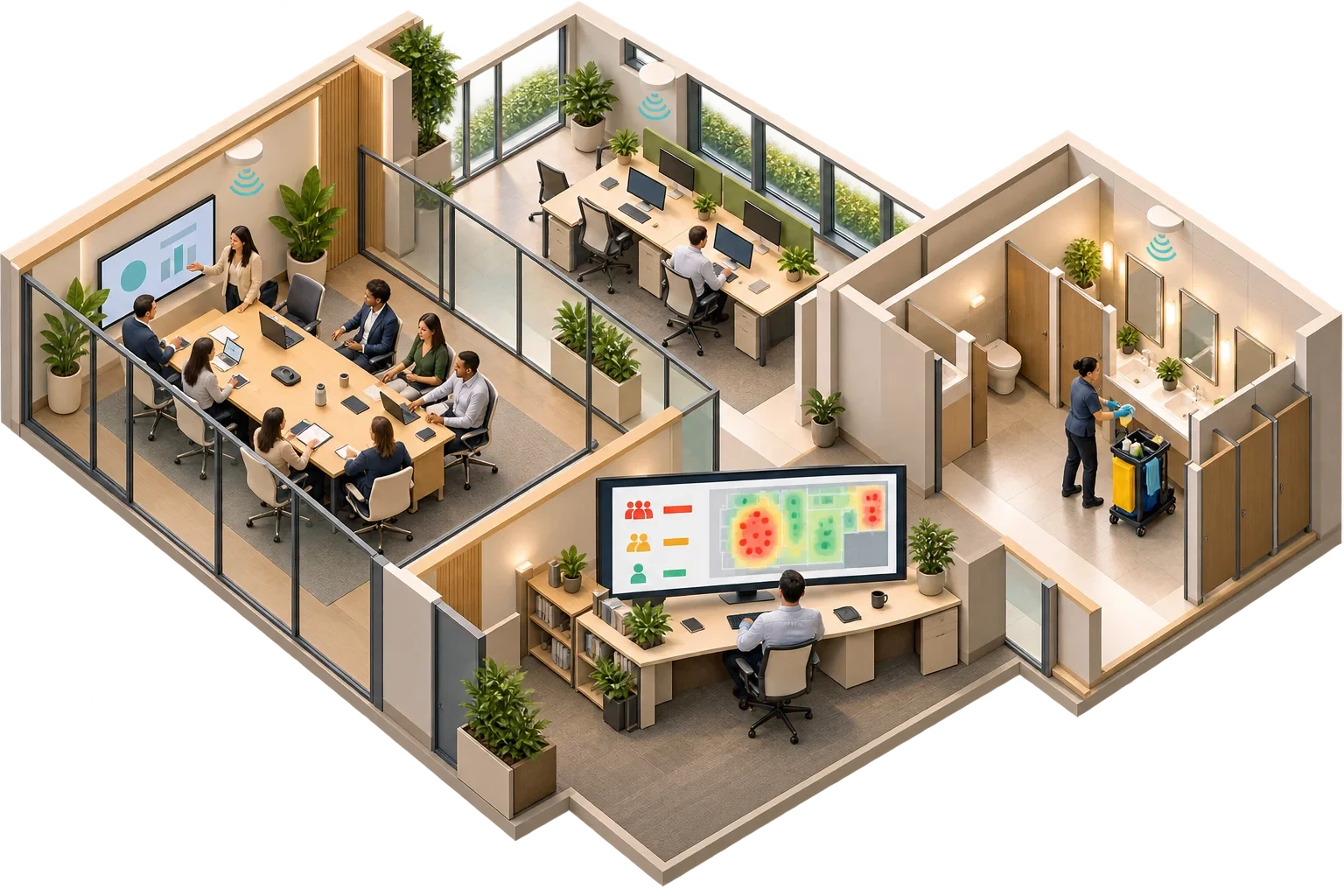
On a Friday in a hybrid office, a cleaning team may spend the evening wiping desks nobody sat at, while on Tuesday the washrooms on the busiest floor fall behind by mid-morning. Occupancy data fixes that mismatch by showing which spaces were actually used, how heavily and when. Cleaning effort can then follow demand: busy washrooms serviced more often, unused meeting rooms and desks skipped, and staff sent where they are needed.
The aim is better service where it matters and less effort where it does not, which is not the same as an automatic cost reduction. Making it work means keeping a fixed baseline for hygiene-critical and statutory tasks, moving only suitable spaces to demand-based cleaning, using aggregated data that does not track individuals, and changing the cleaning contract so that the new way of working is paid for and measured.
A traditional cleaning specification lists tasks and frequencies: every desk wiped daily, every meeting room cleaned twice a day, washrooms checked hourly. Where use varies from day to day, that guarantees cleaning empty rooms while busy areas fall behind. Demand-based cleaning keeps the task list but changes what sets it off. Work happens when usage passes an agreed threshold, at agreed intervals for spaces in use, and at a reduced or minimum frequency for those that are not.
Scroll horizontally to read the full table.
| Data source | What it tells you | Typical use | Points to check |
|---|---|---|---|
| Door or entry counters | Number of entries to a washroom, kitchen or floor | Servicing washrooms and kitchens by visits | Counting accuracy; placement at the right doors |
| Desk or room occupancy sensors | Whether a desk or room was used, and for how long | Cleaning only used desks and rooms | Battery maintenance; coverage; sensor privacy design |
| Room booking systems | Which rooms were booked and released | Room resets after bookings; skipping unbooked rooms | Bookings do not equal use; no-shows and unbooked use |
| Access control events | Floor or zone use by time | Planning daily effort by floor | Use aggregated counts only; purpose and retention agreed |
| Network connection counts | Approximate density by area | Broad zone-level planning | Approximate; personal data considerations |
| Consumable sensors | Soap, paper or bin levels | Replenishment on demand | Reliability; integration with task app |
A simple count combined with a booking feed is often enough for a first phase. Each extra data source adds cost and complexity, so add one only when a gap appears.
Demand-based cleaning should never mean that a space goes uncleaned because a sensor reported it unused. A fixed baseline stays in place for hygiene-critical areas such as kitchens, washrooms and clinical or food-preparation spaces, at frequencies set by the operator's risk assessment and the applicable rules. It also covers statutory or contractual tasks that must happen at set intervals, and periodic deep cleaning that does not depend on recent use. Any space whose sensor has failed or whose data is missing should fall back to the baseline, never to "no cleaning required".
Occupancy data can become personal data if it identifies, or can be linked to, individuals; desk sensors in an office with assigned seating are the obvious case. In the EU, the GDPR's principles of purpose limitation and data minimisation point towards collecting only what the cleaning purpose needs, which usually means counts and used-or-unused status by space, not identities. The purpose, retention period and who can see the data should be agreed with your data protection adviser. It also helps to explain the system to occupants: people accept a washroom counter far more readily than an unexplained sensor under their desk.
The same care applies to the cleaning staff. Task apps that record completion times can slide into monitoring individual performance. Decide in advance what is recorded, why and how it will be used, and involve the cleaning contractor and its staff in that decision.
Cleaning contracts are commonly priced on fixed frequencies and hours, and a demand-based service sits awkwardly on that basis. How the commercial model should change is a matter for the client's FM procurement lead or adviser, but the data design throws up questions they will need to answer before the system goes live:
The occupancy data, the triggers and the integration can be designed to support any of those answers, but they cannot settle them.
What you can reasonably expect is better-targeted effort and faster response in busy areas. Whether total cleaning cost falls depends on the contract model, on how much of the old rota was spent on unused space, and on whether released hours are removed or redeployed. Reducing hours is a commercial decision between owner and contractor, and the business case should keep it separate from improvements in service quality. Certification schemes have started to take notice, too: WiredScore's SmartScore scorecard for hotels lists cleaning orchestration under operational excellence. That shows market interest; it does not prove every building will benefit.
Lay a month of the current rota against booking or badge data for the same weeks. The gap between the two shows how much of the case is real, and it costs nothing to find out. Pagin Consulting's part is the occupancy data itself: what to collect, how to sense it and how it reaches the task system, with the contract questions left to your FM procurement lead.
This article connects to our work on Our services.
We can discuss how this subject fits the project brief.
Contact Pagin Consulting