
Operations & Productivity
How can smart buildings reduce facilities management costs?
Which facilities management cost lines smart building capabilities can change, and how to build and measure the cost case.
Automate tasks that are frequent, rule-based and already captured digitally, and keep a person checking the consequences.
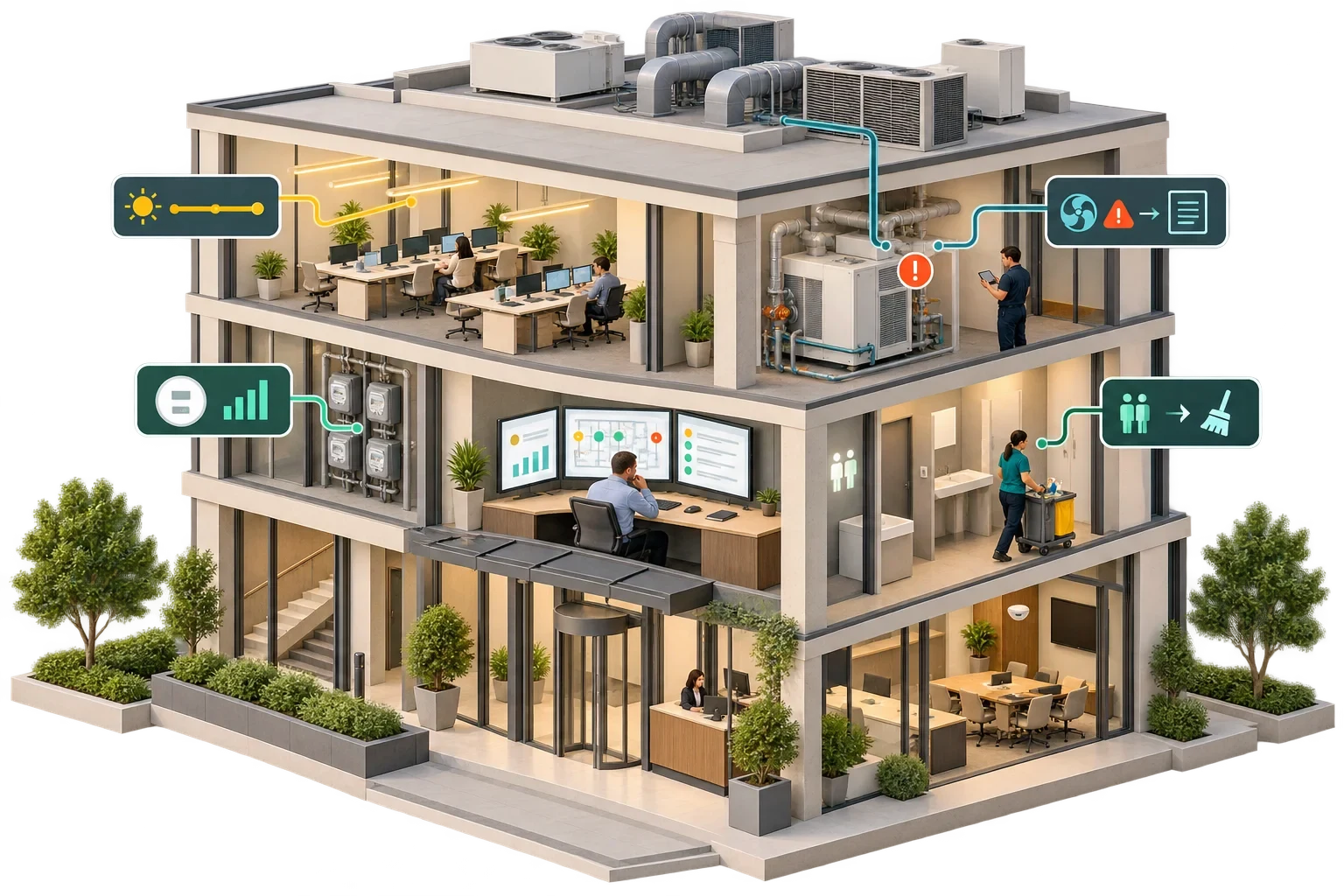
The best candidates for automation in facilities management are tasks that are frequent, follow a rule and depend on information already captured digitally. Collecting meter and equipment readings, routing alarms, generating planned maintenance work orders, compiling routine reports, scheduling services against booked or measured use and updating records when work is finished all fit that description. Tasks that need physical intervention, professional judgement or statutory competence are different: automation can support them, but it cannot take them over. Before automating anything, put four questions to it. Is the rule clear? Is the data good enough? What happens if the automation is wrong? And who checks it?
| Category | Examples | Typical role of automation |
|---|---|---|
| Data collection | Meter readings, run hours, temperatures, equipment status | Fully automated, with checks for missing or implausible values |
| Notification and routing | Sending an alarm to the right person or contractor; escalating if unacknowledged | Largely automated, using agreed rules and rotas |
| Work-order administration | Creating planned maintenance orders by calendar or run time; creating reactive orders from qualifying alarms | Automated creation, with human review of priority and exceptions |
| Reporting | Monthly consumption, service-level performance, open work orders | Automated compilation; a person interprets and acts |
| Scheduling | Allocating cleaning or room preparation by actual use; booking contractor visits | Partly automated; a supervisor adjusts for constraints |
| Diagnosis | Identifying likely causes of a fault from trends | Decision support; an engineer confirms |
| Physical work | Repairs, replacement, cleaning, inspections | Not automated; can be better targeted and documented |
| Compliance judgement | Statutory inspections, safety sign-off, risk assessments | Not automated; competent persons remain responsible |
Much of this capability may already be on site. The US Department of Energy's Operations and Maintenance Best Practices Guide describes computerised maintenance management systems as automating most of the logistical functions of maintenance: work-order generation and tracking, scheduled maintenance, history, documentation and parts inventory. An organisation may well own such a system and use only part of it, so the first check before buying new automation is whether the existing systems have been configured to do what they already can.
| Area | Candidates |
|---|---|
| Engineering and maintenance | Run hours captured automatically, so that servicing follows actual use where the manufacturer's requirements allow; qualifying alarms creating work orders; closure prompts asking the engineer to confirm a fault has cleared; equipment changes written back to the asset register |
| Energy and utilities | Meters read and validated automatically, with alerts for consumption outside expected patterns, such as water use overnight |
| Soft services | Cleaning and replenishment triggered by measured or booked use; meeting rooms reset once bookings end or rooms are released |
| Administration | Service-level reports compiled from work-order data; reminders for contract renewals, warranties and compliance dates |
Statutory and safety work is the clearest case. Automation can schedule inspections and remind people of them, but responsibility for inspection and certification stays with competent persons under the applicable rules. No automated workflow should be able to mark a safety-critical item complete without a human confirmation step.
Plant control is another. Automatically changing how equipment operates, as opposed to raising a task for someone, is a control decision. It belongs within the building's controls design and commissioning, with defined limits and overrides.
Automation that relies on occupancy or access data may also involve personal data. In the EU, the GDPR requires such data to be collected for specified purposes, limited to what is necessary and kept no longer than needed, so aggregated information should be used wherever it is sufficient, and the purpose and retention period agreed with your data protection adviser.
The safest sequence begins with tasks where the data already exists, the rule is simple and mistakes are cheap, such as data collection and reporting. Work-order automation with human review comes next, and only after that automation that schedules people or influences plant. Each step should be measured for time spent, errors, exceptions and whether users trust the output. When people start bypassing an automation, the rule or the data needs attention.
Score your recurring facilities tasks against the four questions with the people who do the work in the room, and the shortlist is often shorter than expected. That is no bad thing. An automation nobody owns soon becomes a chore of its own, and the cheapest wins may well sit in systems the building already has.
This article connects to our work on Our services.
We can discuss how this subject fits the project brief.
Contact Pagin Consulting