
Data Centres & AI Infrastructure
What is the difference between N, N+1 and 2N redundancy?
What N, N+1 and 2N redundancy mean, why the labels can mislead and how to trace the redundancy actually provided.
Data Centres & AI Infrastructure
Choose an availability level from the consequence of interruption, then check what has actually been certified.
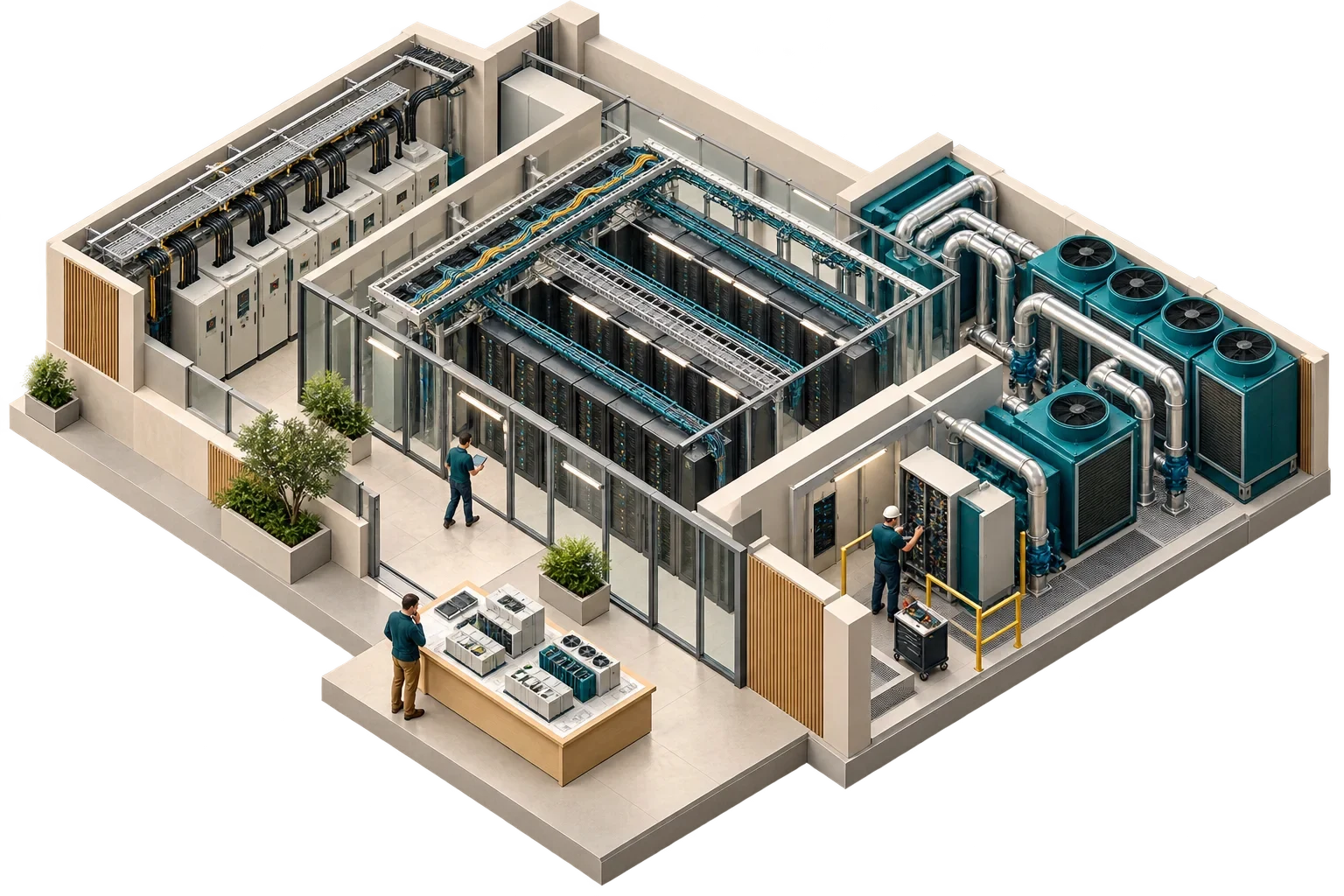
The Tier levels, defined by the Uptime Institute, describe how a data centre's infrastructure is designed to cope with maintenance and failure. Tier I provides basic capacity. Tier II adds redundant capacity components. Tier III is concurrently maintainable, meaning every capacity component and distribution path can be taken out for planned maintenance or replacement without affecting operations. Tier IV is fault tolerant: an individual equipment failure or distribution-path interruption does not affect operations.
Two cautions belong in any conversation about Tiers. A Tier describes a design topology and its operation, not a guaranteed uptime percentage. And a drawing that resembles a Tier III arrangement is not the same thing as a Tier III certified facility.
Scroll horizontally to read the full table.
| Tier | Uptime Institute description | What it means in practice | What it does not give you |
|---|---|---|---|
| I | Basic Capacity | No redundancy: a capacity or distribution failure affects the site | Maintenance or repair without a site-wide shutdown |
| II | Redundant Capacity Components | Spare capacity components, such as an extra UPS module or chiller | Maintenance without a site-wide shutdown, or ride-through of a distribution failure |
| III | Concurrently Maintainable | Every capacity component and distribution path can be maintained without interrupting operations | Immunity to equipment failure or operator error |
| IV | Fault Tolerant | An individual equipment failure or path interruption does not affect operations; also concurrently maintainable | Freedom from the need for disciplined operation |
For many owners the decisive step is from Tier II to Tier III. Concurrent maintainability takes more than spare equipment; the distribution paths have to be arranged so that each part can be isolated while another carries the load. The further step to Tier IV adds tolerance of any individual equipment failure or path interruption, and with it more cost and complexity.
The Uptime Institute certifies against its Tier Standards in stages. Tier Certification of Design Documents confirms that the design meets the intended Tier objective. Tier Certification of Constructed Facility confirms that the facility was built as designed and can meet the performance requirements, which matters because construction changes and value engineering can erode the design intent unseen. Tier Certification of Operational Sustainability then assesses how the facility is run, because even a well-designed facility can fail through poor operation.
A facility described as "Tier III design" or "built to Tier III principles" without certification may well be well engineered, but the wording is the supplier's own assessment. The right questions are what was certified, by whom, at which stage and when.
Two other frameworks turn up in specifications and colocation contracts. ANSI/TIA-942, from the Telecommunications Industry Association, specifies requirements for data centre telecommunications infrastructure and for the wider site, architectural, electrical, mechanical, safety and security provisions, with four rating levels and its own certification programme; the current revision is TIA-942-C. EN 50600, the European standard series for data centre facilities and infrastructures, uses availability classes.
Neither is interchangeable with the Uptime Tiers, even where the levels sound alike. Equipment manufacturers sometimes reference all three in their site-preparation guides, asking for the third level of any one of them and then adding power-redundancy requirements of their own.
Higher is not automatically better. The starting point is the cost of downtime for the workloads in the facility, including recovery effort and reputational damage. Maintenance comes next: if planned shutdowns are unacceptable, concurrent maintainability is the minimum. Application resilience can change the answer, because some organisations achieve resilience by running workloads across several sites, which can justify a lower Tier at each one. Every step up adds capital cost, plant, space and operating demands, so budget and complexity weigh in too, and customers or regulators may have contractual expectations of their own.
The step that matters comes earlier than either a design standard or a provider: translating your organisation's tolerance for downtime into an explicit availability requirement, stating which failures and which maintenance activities the IT must survive. The Tier is then what it should be: a means of meeting that requirement.
This article connects to our work on Our services.
We can discuss how this subject fits the project brief.
Contact Pagin Consulting