
Data Centres & AI Infrastructure
What are the main infrastructure requirements for a data centre?
The seven things a data centre needs to work and the business decisions on load, growth and downtime that must come first.
Data Centres & AI Infrastructure
Map each workload to the hosting model that suits it, and write down who is responsible for what.
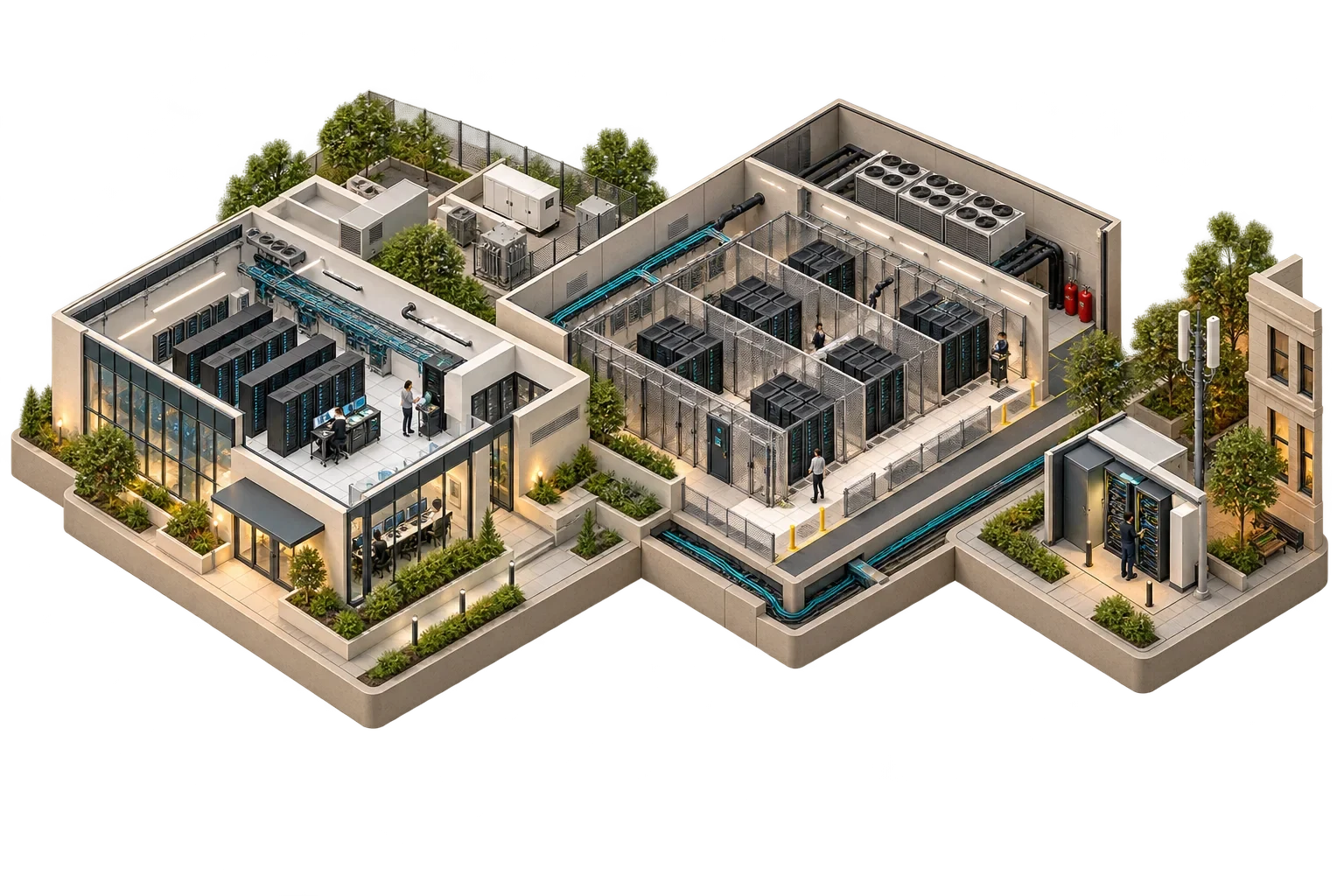
Two questions separate them: who owns and operates what, and where the facility sits. An enterprise data centre is owned or controlled by the organisation that uses it, which runs both the facility and the IT. A colocation data centre is operated by a provider that rents space, power, cooling and network access to customers, who install and manage their own IT equipment.
An edge data centre is a small facility, often a room, container or cabinet, placed close to where data is created or used (a building, campus, factory or telecoms site) so that processing stays local. Public cloud sits alongside all three as a fourth option: computing delivered as a service, with the provider responsible for everything below the customer's applications and data.
Many organisations end up using a mix. The decision that matters is which workloads belong where, and what each choice commits you to.
Scroll horizontally to read the full table.
| Responsibility | Enterprise (on-premises) | Colocation | Edge | Public cloud |
|---|---|---|---|---|
| Building, power, cooling | Organisation | Provider | Organisation or host site | Provider |
| Physical security | Organisation | Provider (to the cage or rack) | Often shared with host building | Provider |
| IT hardware | Organisation | Customer | Organisation | Provider |
| Operating systems and applications | Organisation | Customer | Organisation | Shared, depending on service |
| Capacity growth | Organisation must build | Contract for more space and power | Limited by small footprint | Purchased on demand |
| Typical strengths | Full control, data location certainty | Professional facility without owning it, carrier choice | Low latency, local resilience, reduced data transfer | Speed, scale, no facility to run |
The US Department of Energy's 2024 data centre design guide puts the trade-off plainly: building and operating an on-premises facility is expensive and needs expert staff, while cloud and colocation can lower first cost and may lower operating cost. The advantages are especially significant compared with small on-premises rooms that lack round-the-clock expertise, adequate redundancy and efficient design.
An enterprise facility makes sense when an organisation needs full control of its infrastructure, has workloads with special requirements, or operates at a scale where owning the facility is economic. The price of control is owning every responsibility: the grid connection, redundancy, maintenance, staffing, security and, in the EU, annual energy-performance reporting once the installed IT power demand reaches 500 kW.
Many so-called enterprise data centres are really small server rooms in office buildings. These often have the weakest resilience and efficiency in the whole estate, and they are frequent candidates for consolidation.
Colocation buys access to a professionally operated facility, usually with better resilience and more carrier choice than an organisation could justify on its own, while the customer continues to own and manage its IT. The critical work lies in the contract, which should cover:
Edge facilities exist because some processing is better done close to its source: when latency matters, when local operation must carry on without a wide-area link, or when sending all the raw data to a central site would be costly. In buildings, the edge is often nothing grander than the comms room that hosts local servers for security, building management and tenant systems.
Because edge sites are numerous and small, their challenge is consistency. They need standard designs, remote monitoring, secure remote management, physical protection in non-specialist buildings and a maintenance model that does not depend on someone visiting each site.
The decision is best made one workload at a time, with five questions:
The useful result, whoever draws it, is one page showing where each workload lives and why, revisited whenever a contract or a lease comes up for renewal. Pagin Consulting prepares maps of this kind, together with the requirements for each facility type.
This article connects to our work on Our services.
We can discuss how this subject fits the project brief.
Contact Pagin Consulting