
Data Centres & AI Infrastructure
How do you plan data centre power and cooling capacity?
How to plan data centre power and cooling from a realistic IT load profile, through the electrical and cooling chain.
Data Centres & AI Infrastructure
Fix IT load, growth and tolerable downtime before any infrastructure is designed.
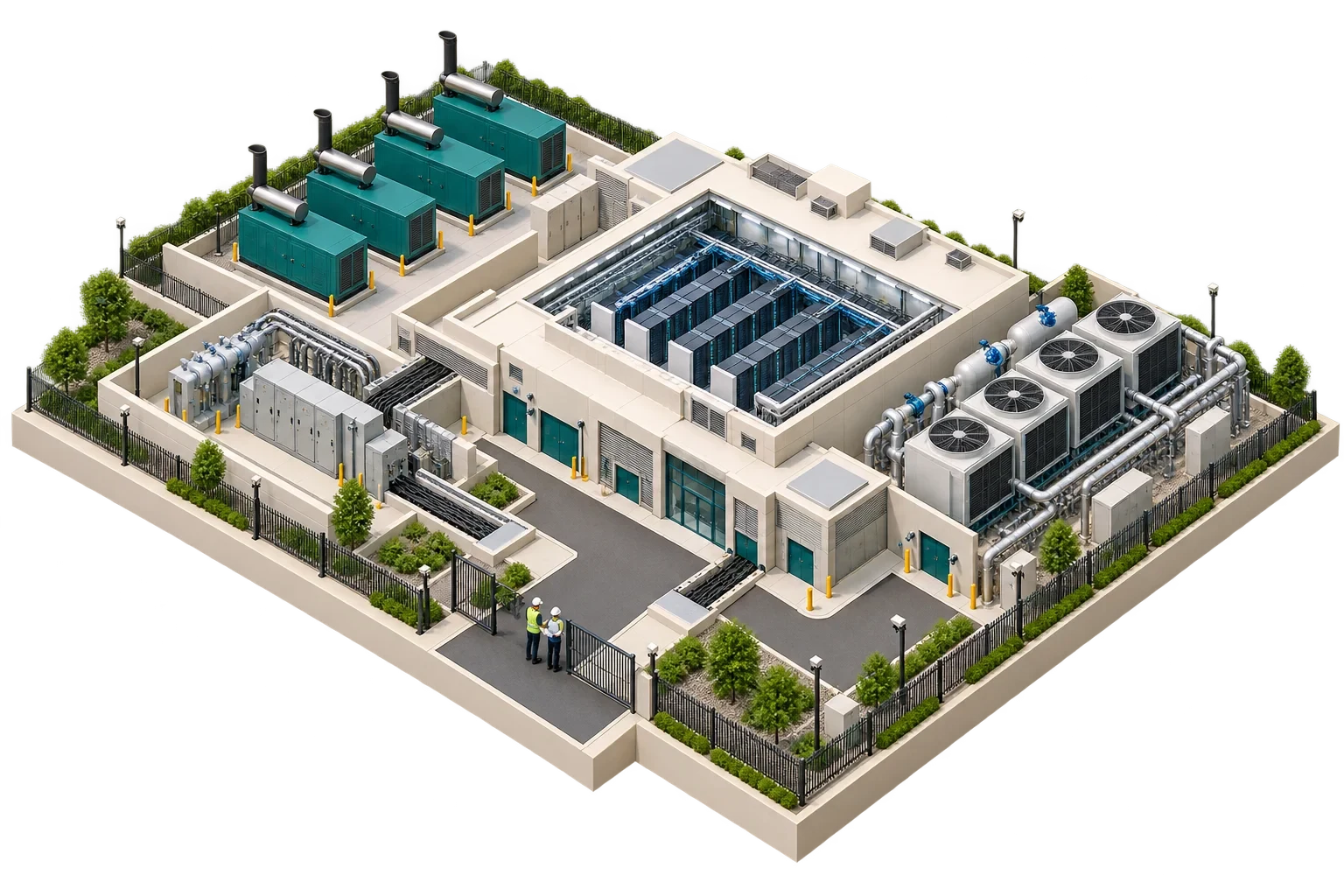
Listing what a data centre needs is the easy part: reliable power, cooling matched to the heat the IT equipment produces, a building and floor that can carry the load, diverse network connectivity, fire protection, physical security, and the monitoring and operating processes that keep all of it running. The hard part is that each requirement depends on the others, and all of them rest on a business decision that precedes the design. How much IT load is needed, how quickly will it grow, and how much downtime can the organisation tolerate?
Those three parameters, capacity, growth and availability, should be fixed before design starts, and every infrastructure choice tested against them.
IT load and density set the scale. How many kilowatts of IT equipment, and at what density per rack? A room for conventional servers and storage is a different building from one for high-density AI systems.
Growth and phasing determine how that capacity arrives. Building everything at once ties up capital and runs plant inefficiently at low load; building too little can make later expansion disruptive. The design needs to know how much is required on day one and how demand is expected to grow.
Availability decides how much resilience to buy. The question is which failures and maintenance activities the facility must survive without interrupting IT. The answer drives redundancy and topology, and frameworks such as the Uptime Institute Tiers, ANSI/TIA-942 ratings or EN 50600 availability classes provide a common language for it. Uptime's Tier III, for example, means every capacity component and distribution path can be taken out for planned maintenance without affecting operations; Tier IV adds tolerance of any single equipment failure.
| System | What it includes | Key design questions |
|---|---|---|
| Power | Utility connection, transformers, switchgear, UPS, batteries, generators, fuel, distribution to racks | Capacity available from the grid and when; redundancy; maintenance without shutdown |
| Cooling | Chillers or dry coolers, pumps, computer-room air handlers, economisers, liquid-cooling loops where used | Heat load and density; supply temperatures; water use; resilience |
| Building and space | Structure, floor loading, ceiling height, delivery routes, white space, plant space | Weight of racks and equipment; future expansion; access for large deliveries |
| Connectivity | Diverse building entries, meet-me rooms, cabling, carrier access | Number of carriers; physically separate routes; cross-connect arrangements |
| Fire protection | Detection, suppression, compartmentation | Suppression type for the space; interaction with cooling and power shutdown |
| Physical security | Perimeter, access control, CCTV, mantraps, visitor processes | Who has access to which space; audit trails |
| Monitoring and operations | Building management, electrical power monitoring, infrastructure management software, procedures, staffing | Who sees what, who responds, and how maintenance is planned |
Grid capacity is frequently the factor that determines where, and when, a data centre can be built, so what the network operator can supply, and on what timetable, needs confirming early. Within the facility, the design must deliver the IT load through UPS and distribution with the redundancy the availability target demands, and allow components to be maintained without interrupting supply. Equipment manufacturers may add requirements of their own, such as how many of a server's power supplies must stay energised, so the site-preparation guide for each type of equipment to be installed belongs among the design inputs.
Every unit of electrical energy delivered to IT equipment becomes heat that has to be removed. The US Department of Energy's 2024 best-practice guide for energy-efficient data centre design reproduces ASHRAE's thermal guidelines, in which the recommended server inlet range for air-cooled equipment is 18 to 27 °C. It stresses that facilities should be designed and operated to that recommended range. The wider allowable envelopes describe only what equipment has been tested to tolerate.
Before adding plant, get the airflow right: separate hot and cold air, seal the gaps and manage the aisles. At higher densities, liquid cooling moves heat into a fluid at or near the chip, which the same guide notes can serve higher heat densities and be more efficient than air cooling.
Where the business needs it, the building should have at least two physically separate entry routes for telecommunications and access to more than one carrier, with physical diversity checked along the actual route. Physical security should be layered from the site perimeter down to individual cages or racks, with access granted by role and logged.
Efficiency has become a regulatory matter, no longer only a cost one. In the EU, the Energy Efficiency Directive requires data centres with an installed IT power demand of at least 500 kW to report their energy performance each year to a European database. The Commission is also preparing minimum performance standards for data centres; it opened a public consultation in September 2026, running to 14 December, and plans a legislative proposal in 2027. Owners should confirm which obligations apply to their facility under national implementation.
Answered in writing, and settled before a designer is appointed, those questions become the brief against which every infrastructure choice is tested. Pagin Consulting contributes the ICT, monitoring and integration parts of that brief alongside the engineers who design the plant.
This article connects to our work on Our services.
We can discuss how this subject fits the project brief.
Contact Pagin Consulting