
Operations & Productivity
How can smart buildings reduce facilities management costs?
Which facilities management cost lines smart building capabilities can change, and how to build and measure the cost case.
Choose the maintenance approach per asset by criticality, failure mode and whether failure can be detected early.
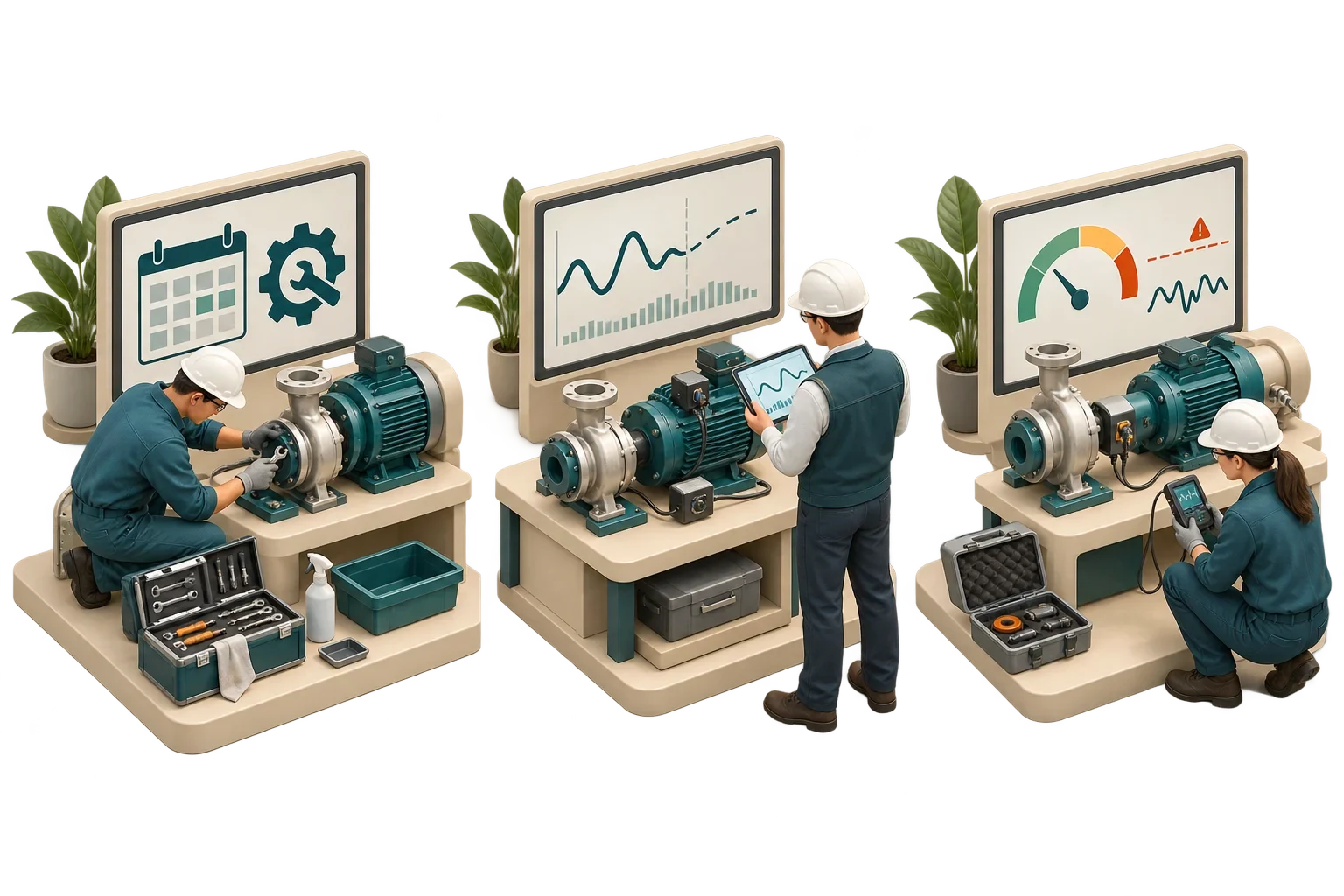
The difference lies in what triggers the work. Preventive maintenance follows a fixed schedule, based on calendar time or running hours, whatever state the equipment is in. Condition-based maintenance happens when a measured condition, such as vibration, temperature or pressure drop, crosses an agreed limit. Predictive maintenance goes a step further and uses trends in condition data to estimate when a failure is likely, so the work can be planned before the limit is reached. In everyday use the terms overlap, and some guidance treats condition-based and predictive as the same thing.
The more useful question is not which approach to adopt for the whole building but which suits each asset. That depends on how critical the asset is, how it fails and whether the failure can be seen coming.
Scroll horizontally to read the full table.
| Approach | Trigger for work | Strengths | Limitations | Typical building examples |
|---|---|---|---|---|
| Reactive (run to failure) | Equipment has failed | No planned cost; sensible for cheap, non-critical items | Unplanned downtime, overtime, possible secondary damage | Some light fittings, small non-critical fans |
| Preventive | Calendar or run-time interval | Simple to plan and contract; meets manufacturer and statutory schedules | Some work is done when not needed; failures between intervals still occur | Filter changes, statutory inspections, belt checks |
| Condition-based | Measured condition reaches a limit | Work done when evidence shows it is needed | Needs suitable measurement and a defined limit | Filter pressure drop, motor temperature, refrigerant pressures |
| Predictive | Forecast of future condition or failure from trends | Lead time to plan work and parts | Needs good historical data, analysis and validation | Vibration trends on large fans or pumps; chiller performance trends |
The US Department of Energy's Operations and Maintenance Best Practices Guide (Release 3.0, 2010) describes four maintenance programmes: reactive, preventive, predictive and reliability-centred. It defines preventive maintenance as actions on a time- or run-based schedule that detect, preclude or mitigate degradation. Predictive maintenance, in its description, uses measurements that detect the onset of degradation so that causes can be addressed before significant deterioration; maintenance is then timed by the equipment's actual condition. In one of its summaries it labels predictive maintenance as condition-based maintenance.
Some suppliers and practitioners now draw a finer line: condition-based means acting on a present measurement against a threshold, while predictive means forecasting future condition from trends, often with statistical or machine-learning models. Neither usage is wrong. What matters is that a contract or specification says exactly which it means. A tender that asks for "predictive maintenance" should also name the assets in scope, the measurements used, how predictions are produced and validated, and what happens once a prediction is made.
The FEMP guide describes reliability-centred maintenance (RCM) as a process for deciding the maintenance requirements of each asset in its operating context. RCM starts from the recognition that equipment is not equally important and that resources are limited, and it accepts that some cheap, low-consequence items are best left to run to failure.
For a building owner, the value of RCM thinking is that it turns a vague strategic choice into concrete questions about each asset class. It begins with consequence: what the asset does and what happens if it fails. A chilled-water pump serving a data room matters more than an extract fan in a store cupboard. How it fails comes next, because gradual wear, such as bearing degradation or filter loading, can often be detected, while sudden failures, such as some electronic faults, often cannot. Condition-based or predictive maintenance only makes sense where the failure can be detected early enough to act on. Even then, it has to beat the alternatives over the asset's life once sensors, data platforms, analysis and the time to review results are counted alongside the maintenance visits. None of this displaces what is required regardless: manufacturer warranty conditions and statutory inspections continue whatever the strategy.
ISO 17359:2018, the current edition, gives general guidelines for setting up a condition monitoring programme for machines, and is useful background when large fans, pumps or chillers are in scope.
The supply fans are critical to comfort and fail gradually, through their bearings and belts. Vibration and motor current monitoring with alert thresholds gives them a condition-based regime, and trending over time may later support predictions, while belt and filter checks stay on a preventive schedule. The chiller is critical and complex, so the manufacturer's service schedule remains, but its performance data, such as approach temperatures and any slow loss of efficiency, is reviewed monthly to catch developing problems between visits. The light fittings are low-consequence and their failure is obvious, so they are replaced when they fail, with stock held.
The building ends up with a mixture of approaches. That is the intended result, not a compromise.
Building management systems and connected sensors already capture much of the data condition-based maintenance needs: run hours, temperatures, pressures, valve and damper positions and alarms. What is often missing is the connection between that data and the maintenance process: thresholds that create tasks, trends reviewed by someone with the authority to act, and work-order history recorded against the same asset identifiers as the sensor data. Without that link, the condition data stays in the BMS and maintenance carries on by the calendar.
Prediction asks for more still: enough history of both normal operation and actual faults to train and test a model. A building can have plenty of sensor history and very little reliable fault history, which is why better maintenance records are often the real first step towards prediction.
Moving from fixed schedules to condition-based work changes what contractors are paid for. A contract that pays per planned visit gives little incentive to reduce visits; one that pays for availability or outcomes does. The commercial model should therefore be decided alongside the technical one, with statutory and warranty-required tasks kept clearly apart from those that can become condition-based.
Sort your assets by criticality and failure mode, beginning with the classes whose failure would hurt most; the result shows where condition monitoring is worth paying for and where a calendar or a spare on the shelf is enough. The remaining questions are practical ones: how condition data reaches the maintenance system, and whether the maintenance contract rewards anyone for acting on it.
This article connects to our work on Our services.
We can discuss how this subject fits the project brief.
Contact Pagin Consulting