
Data Centres & AI Infrastructure
What is the difference between N, N+1 and 2N redundancy?
What N, N+1 and 2N redundancy mean, why the labels can mislead and how to trace the redundancy actually provided.
Data Centres & AI Infrastructure
Size power and cooling from the approved configuration at the failure state, not from typical draw.
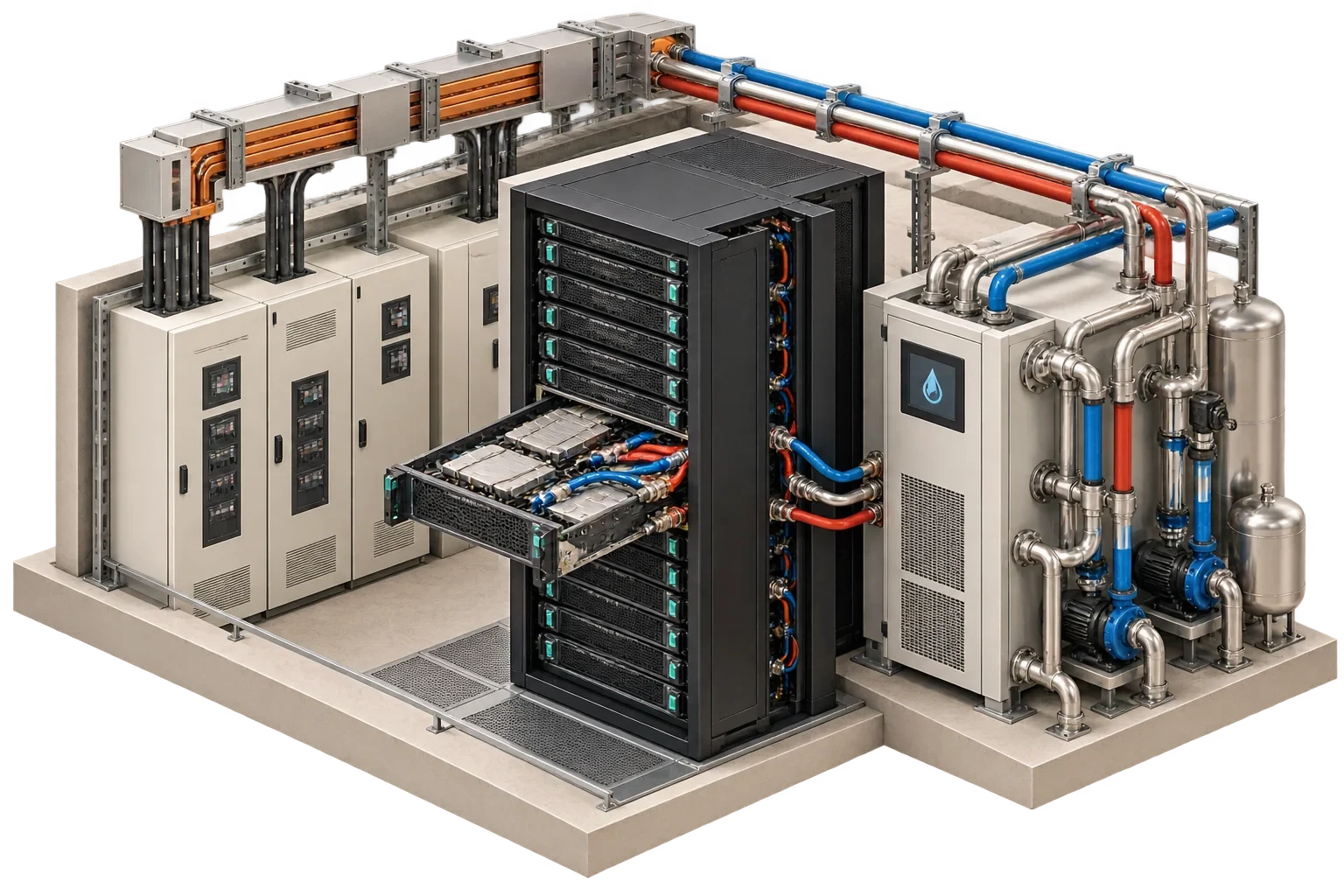
"GPU-ready" is not a specification. GPU servers need exactly what their manufacturer's approved configuration specifies (power per system, supply arrangement, connector and circuit types, airflow or liquid connections and environmental limits), delivered at the rack positions where they will actually stand. The inputs that matter are an equipment schedule and the current product documentation, traced through the whole electrical and cooling path.
NVIDIA's published design guide for its DGX H100 systems serves here as one worked example, chosen because it is unusually detailed; citing it implies no recommendation. Its figures apply to that product generation only; other servers, and later NVIDIA products, have different requirements.
For every server type, and for the network and storage equipment that comes with it, the schedule should record:
The DGX H100 guide, for instance, gives 10.2 kW maximum per system, a weight of about 130 kg, air cooling and a typical density of four systems per rack. It explicitly does not recommend more than four systems per rack, for thermal reasons.
The DGX H100 guide tabulates how common supply arrangements support its racks under a three-circuit N+1 scheme in which no circuit carries more than half the load:
| Supply | Circuit capacity | Systems per rack | Peak demand per circuit | Unused at peak |
|---|---|---|---|---|
| 230 V single-phase, 63 A | 13.7 kW | 2 | 10.2 kW | 3.5 kW |
| 400 V three-phase, 32 A | 21 kW | 4 | 20.4 kW | 0.6 kW |
| 415 V three-phase, 32 A | 21.8 kW | 4 | 20.4 kW | 1.4 kW |
Four systems at 10.2 kW make 40.8 kW per rack; if one circuit fails and each of the two remaining circuits carries half, that is 20.4 kW per circuit. The guide names 415 V, 32 A, three-phase N+1 as the preferred arrangement for high-density deployments. The method is what transfers to other equipment: size each circuit for the load it must carry when another has failed or is under maintenance, and check the server's own power-supply rules.
The check should not stop at the rack. Floor distribution, the upstream UPS and switchboards, and the generator all need assessing at the same failure state.
All electrical power becomes heat. NVIDIA warns that because each circuit in its N+1 scheme carries only half the rack load, cooling capacity has to be aligned with the full load carried by two circuits, not with the capacity of one. It is an easy mistake for designers used to 2N schemes, where one feed equals the full load.
Before reaching for more drastic measures, the guide stresses getting air management right: hot and cold aisle orientation, containment, blanking panels in empty rack spaces and brush grommets on cable openings. Inlet temperature belongs in the same conversation: warmer inlet air saves chiller energy but makes server fans work harder, as the US Department of Energy's design guide notes, so agree the inlet range with the cooling designer before fixing the power budget.
The lesson generalises. Density is a trade between floor space, stranded power and cooling delivery, and it should be resolved on a layout drawing before the equipment is ordered.
A layout is ready for approval when each rack's equipment schedule comes from current manufacturer documentation, circuit sizing and upstream capacity have both been checked at the failure and maintenance state, the cooling available at those rack positions has been compared against full load, and floor loading, access and network cable lengths have been confirmed.
For a GPU deployment you are about to procure, the document to ask the supplier for is the site-preparation guide of the exact configuration. Fill in the schedule above from it, and have your electrical and mechanical engineers check it while the order can still change.
This article connects to our work on Our services.
We can discuss how this subject fits the project brief.
Contact Pagin Consulting