
Data Centres & AI Infrastructure
What power and cooling infrastructure do GPU servers need?
How to size circuits, upstream capacity and cooling for GPU servers from the manufacturer's configuration, at the failure state.
Data Centres & AI Infrastructure
Decide on liquid cooling from what the equipment requires and what air can remove, not from a universal threshold.
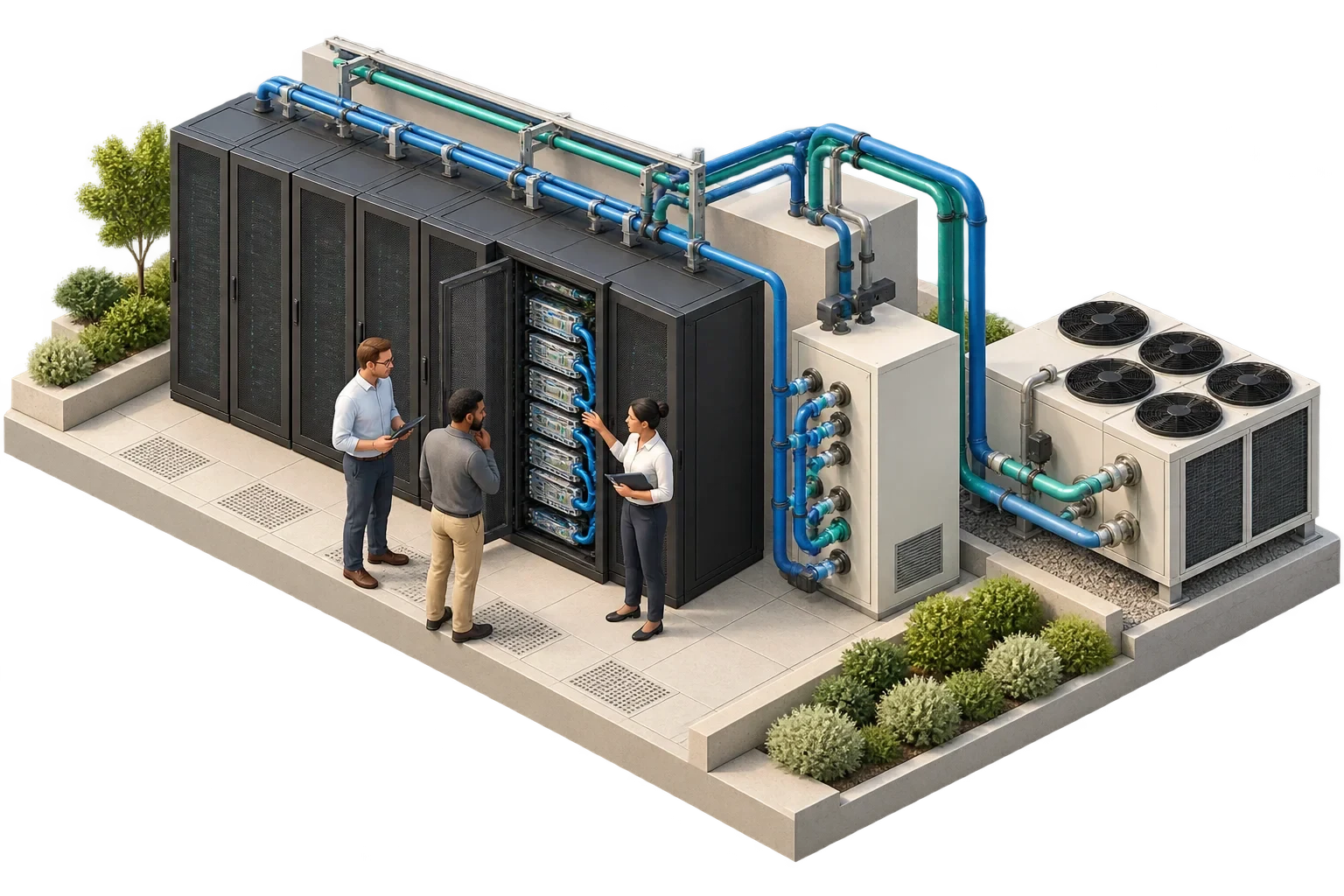
Liquid cooling is a question about specific equipment in a specific room; no universal rack density settles it. An AI data centre needs it when the equipment being bought requires it, or when a proper assessment shows that air cannot remove the heat at the rack positions available, or can only do so with unacceptable penalties in energy, space or noise.
What has changed is the direction of travel. ASHRAE's data centre committee, TC 9.9, warned in a 2021 white paper that rising chip power is making high-temperature air and water cooling harder to sustain, and recommended that any future data centre include the capability to add liquid cooling. The US Department of Energy's 2024 design guide draws on that paper, and observes that high-performance computing sites adopted direct liquid cooling early because of their rack densities. It also notes that ASHRAE has introduced an air-cooling class, H1, for high-density equipment, and advises operators to consider direct liquid cooling for high-density servers.
Some accelerated systems are designed for air cooling. Others are offered only with liquid cooling, or in both variants. The exact model and configuration matter: its supported cooling method, the inlet temperatures or liquid supply conditions it requires, and whether the next generation you might buy will be the same. A cooling strategy chosen for today's server can be wrong for its replacement.
A facility may have ample cooling in total and still be unable to deliver it to a handful of dense racks. Short of converting to liquid, the usual air-side measures (containment, blanking panels, sealing cable openings, spacing racks) may solve a moderate problem. If they do not, liquid becomes the realistic option.
The DOE guide groups liquid cooling into three classes.
| Approach | How it works | Typical implications |
|---|---|---|
| Rear-door or close-coupled heat exchangers | A water coil at the rack (rear door, in-row or overhead) captures heat from the air close to the source | Works with standard air-cooled servers; liquid reaches the rack, not the server |
| Cold plates | Liquid flows through plates on the processors and other hot components, usually via a coolant distribution unit (CDU) | Server must be designed for it; some heat still goes to air |
| Immersion | Servers are submerged in a non-conductive fluid, single-phase or two-phase | Different racks, handling and maintenance procedures |
The guide treats cold plates and immersion as direct liquid cooling. Some solutions are hybrid, with part of the heat still removed by air; others capture practically all of it, which the guide describes as the most energy-efficient.
The CDU is the interface between the facility water loop and the IT liquid loop, supplying liquid at the temperature, pressure and chemistry the equipment needs. ASHRAE's water classes, renamed in 2021 (W17, W27, W32, W40, W45 and W+), state the upper supply temperature in degrees Celsius. Higher classes make it easier to use economisers or dry coolers, saving energy and water.
The DOE guide explains why liquid can be more efficient: water carries heat far better than air, warmer supply temperatures allow more economiser hours, and fan power falls. That describes what liquid cooling can do; the saving at your own site has yet to be measured. Whether it lowers operating cost depends on the climate, the existing plant, tariffs and the maintenance regime, and the capital cost of the conversion has to be weighed against it.
Once liquid cooling is chosen, the design has to cover the equipment interface, CDUs, facility connections, water treatment, isolation valves, leak detection, drainage and alarms, and explain how each part is maintained without shutting down live equipment. The mechanical engineers and the IT team need to agree who responds to a leak alarm, and how. Operating staff should have procedures, spares and training by the time the first rack is filled.
The monitoring side, meaning leak detection, CDU alarms and their integration with the BMS, is easily left until last. It belongs in the first design review, alongside the choice of cooling method itself.
This article connects to our work on Our services.
We can discuss how this subject fits the project brief.
Contact Pagin Consulting