
Data Centres & AI Infrastructure
How do you plan data centre power and cooling capacity?
How to plan data centre power and cooling from a realistic IT load profile, through the electrical and cooling chain.
Data Centres & AI Infrastructure
Allocate functions and the authoritative source for each piece of information before buying any application.
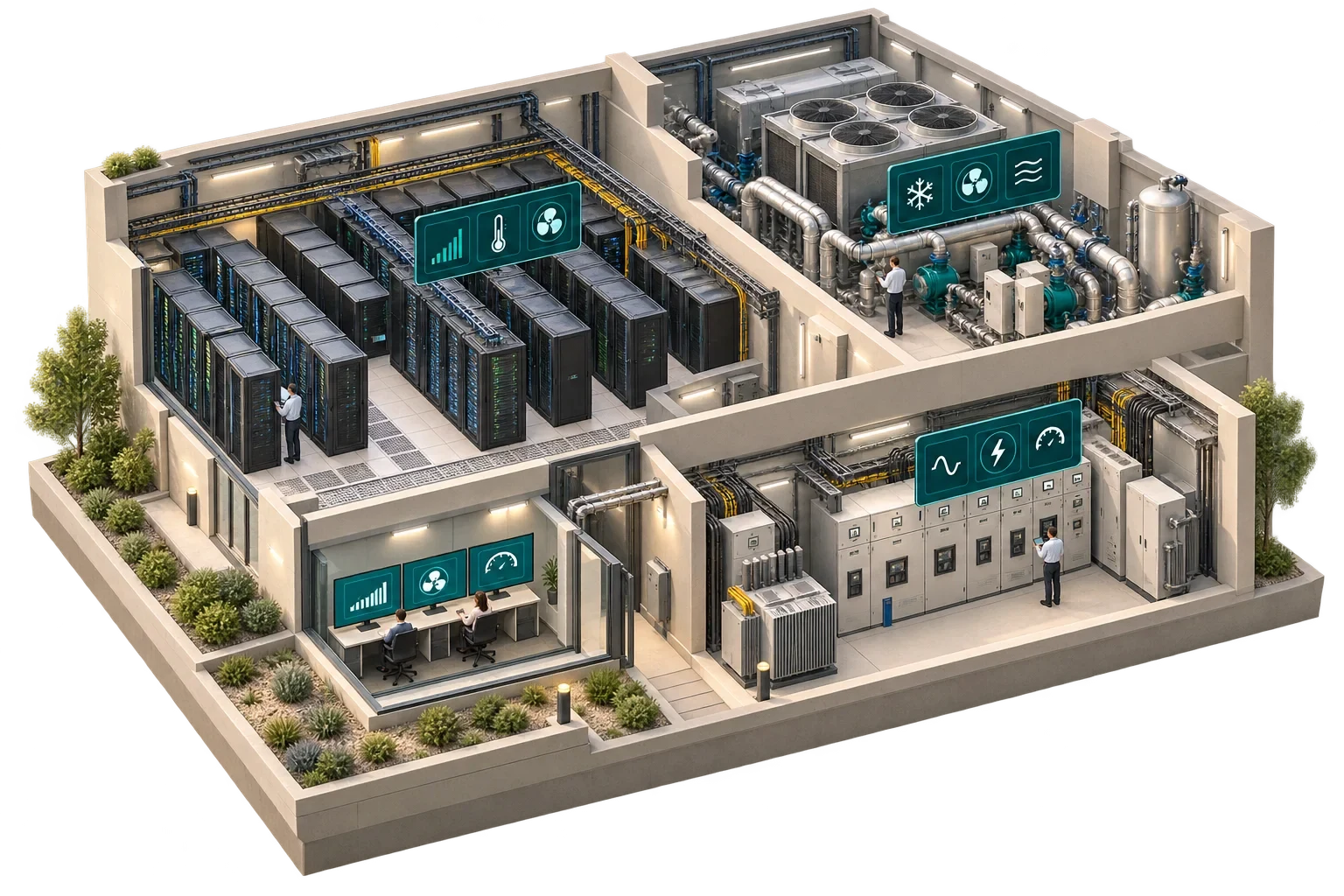
Ask a data centre's systems whether there is room for one more rack and you may get three different answers, because three different kinds of system are looking at the question from three angles.
DCIM (data centre infrastructure management) treats the IT space as an inventory and capacity problem: racks, devices, power and network connections, space, and the relationships between them. It answers "where is it, what is it connected to, and how much room is left?" The BMS (building management system) monitors and controls building services such as chillers, air handlers, computer-room air units, pumps, leak detection and lighting, and answers "are the mechanical systems running as intended, and how do we control them?"
The EPMS (electrical power monitoring system) concentrates on the electrical system: metering, power quality, breaker status, switching events and alarms from switchgear, UPS and generators, often with high-resolution event recording. Its question is "what happened on the electrical network, and when?"
In practice the boundaries blur, and products sold under each name vary considerably. Some DCIM tools include environmental and power monitoring; some BMS platforms present rack-level dashboards. That is why the decision should begin with tasks and data ownership, leaving product categories until later.
For each important piece of information, one system should be authoritative: the place where it is maintained and from which the others copy.
| Information | Usually authoritative in | Used by |
|---|---|---|
| Rack and device inventory, connections | DCIM | BMS, EPMS (for context) |
| Mechanical plant status and control | BMS | DCIM (cooling capacity view) |
| Electrical events and power quality | EPMS | DCIM (power capacity), BMS (alarms) |
| Energy metering for PUE | EPMS or a dedicated metering system | DCIM, reporting |
The table is a common starting point, and a site may well depart from it. What matters is that the choice is explicit and written into the integration design.
Wherever information is copied, the interface should carry the asset identifier, the timestamp and the quality of the value with it. A temperature copied into a dashboard without its sensor identity or time can make an investigation harder, not easier.
The US Department of Energy's data centre design guide stresses that energy management depends on sufficient metering of adequate accuracy. Its example is telling: a pair of temperature sensors with an accuracy of about ±0.8 °C (±1.5 °F) provides no value for determining chilled-water temperature difference when the operating difference can be as low as about 2.8 °C (5 °F). The guide also recommends true-RMS three-phase power meters, continuous trending, archiving at least one year of data to obtain annual totals, and an open-protocol control system so that sensors can be added later.
So whichever system presents the data, the questions are the same: which device takes the measurement, how accurate is it and how is it calibrated? Three systems displaying one poor measurement are no better than one.
If the rack schedule in DCIM, the electrical hierarchy in EPMS and the cooling associations in the BMS disagree, operators end up making decisions on inconsistent information. The integration design has to say where each record is maintained and how changes propagate.
Alarms need the same discipline. A single UPS event can arrive through EPMS, BMS and DCIM simultaneously. Someone has to decide which system raises the alarm and to whom, which one holds the event record, and how the others display it without setting off parallel escalations.
The most revealing procurement step is to write three to five representative tasks, such as approving a rack, investigating a cooling alarm, reconstructing an electrical event or producing an annual PUE report, and ask suppliers to demonstrate them across the proposed interfaces. The integration should then be specified properly: protocols, identifiers, the authoritative source for each data item and alarm routing. Metering accuracy and calibration deserve a specification of their own, separate from the software. And before contract, it should be clear who will maintain the asset records after handover, and how.
The function allocation and interface schedule are best settled before product selection, and given to every DCIM, BMS and electrical monitoring bidder alike. Pagin Consulting prepares both on a Vendor Agnostic basis.
This article connects to our work on Our services.
We can discuss how this subject fits the project brief.
Contact Pagin Consulting