
Cybersecurity & Resilience
How do smart visitor management systems work?
How smart visitor management works from invitation to exit, and how to handle data, temporary access and failures.
Decide which integrations are worth having and which system has authority to unlock, especially in an emergency.
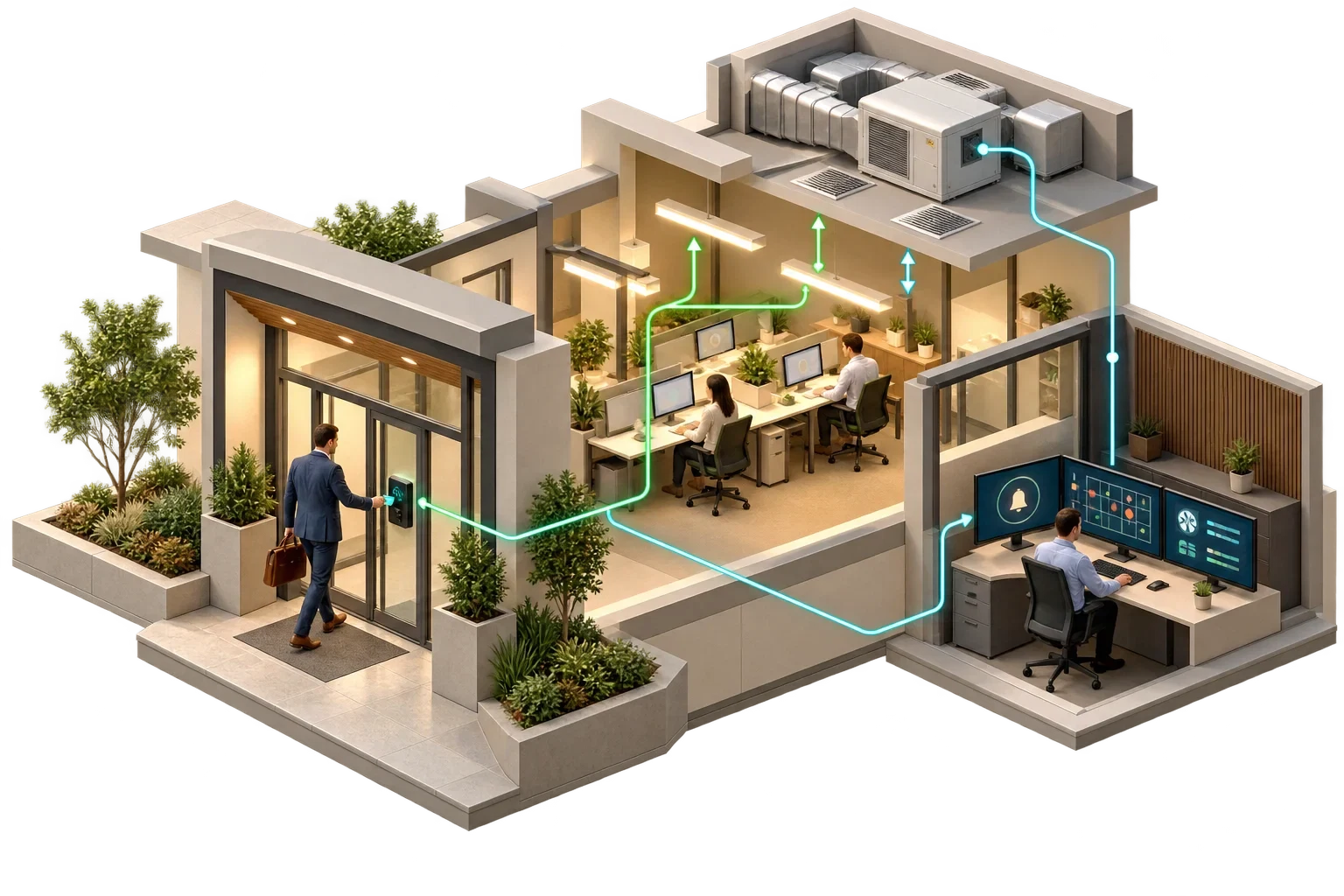
Access control can share identity, events and door states with a long list of other systems: HR and identity directories for joiners and leavers, visitor management, lifts, video surveillance, intruder detection, the building management system for occupancy-based operation, hotel property management for guest keys, and the fire alarm system for door release. The benefit is less manual administration and better-informed operation. The risk is that a weakness in any connected system becomes a way to open doors. Every integration therefore needs three things written down: what data flows, in which direction, and, above all, which system has the authority to unlock a door or change someone's access.
NIST's guide to OT security (SP 800-82) classes physical access control systems as operational technology, alongside building automation. NIST describes the basic chain: a reader captures a credential, a door controller validates it, the access control server decides, the controller releases the lock and every attempt is logged. Each integration attaches to some part of that chain, and precision about which part matters, because reading an event log carries a very different risk from being able to issue a credential or command a door.
| Integration | What it typically does | Key decision |
|---|---|---|
| HR or identity directory | Creates, changes and removes cardholders automatically | Which system is authoritative for identity, and how fast are leavers revoked? |
| Visitor management | Issues temporary credentials to registered visitors | Who approves, how is validity limited, and how is the credential recovered? |
| Lifts | Restricts floors by credential, or calls a lift to the permitted floor | Does the lift system receive a decision or make its own? |
| Video surveillance | Links door events to camera views and recordings | Which events trigger what, and who may view the result? |
| Intruder detection | Arms or disarms areas based on access events | Can a valid card disarm an area, and under what conditions? |
| Building management | Uses entry events as one occupancy signal for lighting or HVAC | Is access data used only in aggregate, and what happens if the feed stops? |
| Hotel property management | Encodes guest room keys or mobile keys on check-in | Which system controls validity dates and room changes? |
| Fire alarm | Releases specified doors on alarm in line with the fire strategy | Defined by the fire engineer; the integration must fail in the required safe state |
The central design question is authority, and in a well-designed arrangement it is divided cleanly. The access control system decides who may open a door; other systems may request or supply information, but they should not bypass its rules. The identity source decides who exists: if HR is authoritative, access rights follow HR records, and manual changes in the access system become controlled exceptions. And the fire strategy decides how doors behave in an emergency. The fire alarm interface, and how doors on escape routes respond to an alarm or a loss of power, are life-safety matters determined by the appointed fire engineer and the applicable regulations. The integration designer implements them, and the smart building brief must not override them.
Write commands are where integrations most often go wrong. A building management system that can "unlock all doors" for a convenience scenario, or a visitor app that can create permanent credentials, has become part of the security system by the back door, without ever being designed or protected as one.
Between readers and controllers, the Open Supervised Device Protocol (OSDP), published internationally as IEC 60839-11-5:2020, specifies communication between access control units and peripheral devices such as readers. The Security Industry Association, which maintains OSDP, describes it as an alternative to the legacy Wiegand interface, with supervision of the reader connection and, from Version 2, Secure Channel encryption. For new installations we generally recommend specifying OSDP with Secure Channel enabled, confirming that each proposed reader and controller supports it, and checking at commissioning that it is actually switched on, not left at a default.
For interoperability between suppliers, ONVIF Profile C covers door control, site information and event management for electronic access control, and Profile A covers the configuration of credentials, schedules and access rules. Conformance can make integration between different suppliers' products more predictable. As with any profile, check which features are mandatory and which are conditional, and test the functions your project needs.
Hotels have their own reference point. HTNG (Hospitality Technology Next Generation), the industry's technology association, has been part of the American Hotel & Lodging Association since 2021 and develops open specifications for hotel system integration, including categories for door lock and property management systems. Where your suppliers support them, cite them in the specification.
None of these standards replaces a project test of the actual integration under normal, abnormal and failure conditions.
Access events record where identifiable people went and when. In the EU, the principles in Article 5 of the GDPR apply, including purpose limitation, data minimisation and storage limitation. Before access events are used for a new purpose, such as occupancy analytics, ask whether aggregated or anonymised counts would be enough, and agree retention periods with your data protection adviser. Biometric data processed to identify people uniquely falls into the special categories of Article 9, which may be processed only under specific conditions, so whether to use biometric readers is a decision for your data protection specialists.
Beside each integration on the shortlist belong two answers: what it is allowed to control, and what happens when it fails. Pagin Consulting's part is to coordinate those requirements between the security, lift, fire and building-systems designers, each of whom keeps responsibility for their own discipline.
This article connects to our work on Our services.
We can discuss how this subject fits the project brief.
Contact Pagin Consulting