
Strategy, Costs & Procurement
What does a smart building consultant do?
What a smart building consultant does at each project stage, which deliverables to expect and where the role stops.
Fix requirements and spatial allowances early; choose products late.
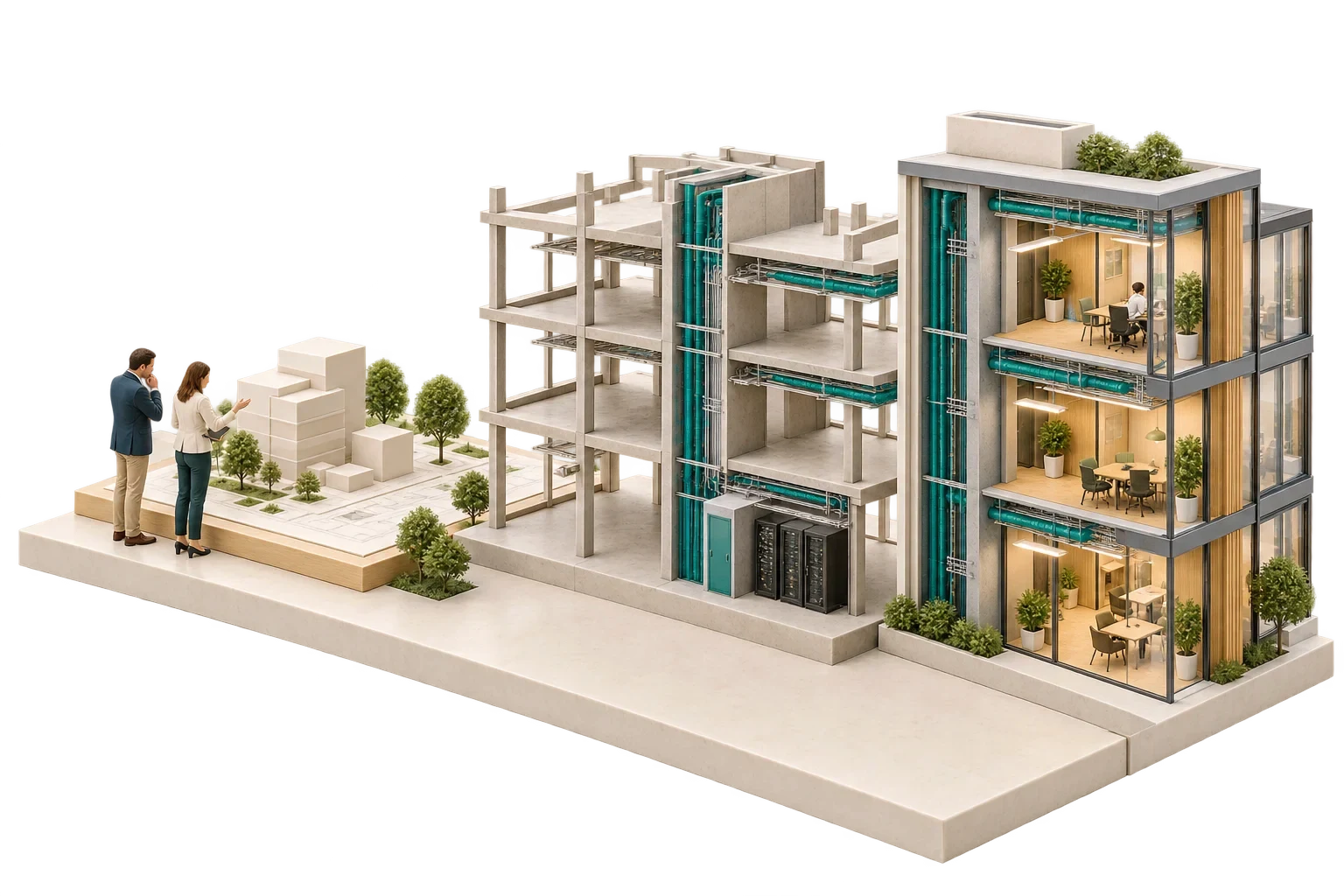
Earlier than most projects manage, and later than most suppliers would like. Smart building design should start at the briefing stage, before concept design, with the decisions that shape the building itself: what the technology must achieve, which users and operators it serves, what information is needed at handover, and how much space, power and network capacity to allow. Detailed product choices belong much later, because technology changes faster than buildings get built.
The stages below are those of the RIBA Plan of Work, the UK's standard project framework. Other countries and many clients use their own stage models with different names and numbers, but the same sequence of briefing, concept, coordinated design, technical design, construction and handover applies, so the advice transfers. Start early on requirements and spatial allowances; start late on products.
The RIBA Smart Building Overlay to the Plan of Work, published in 2024, reports consistent industry feedback that smart building designers are brought in too late. By the time they arrive, the brief is fixed, the cost plan includes neither the technology nor the specialist fees, and the spatial design makes no allowance for the equipment rooms, risers, containment and power the systems will need. The overlay also notes that smart building technology does not just affect mechanical and electrical services; it can shape spatial, functional and aesthetic elements of the design.
The symptoms are familiar. Telecoms and equipment rooms turn out too small, badly placed or uncooled. Ceiling and riser coordination is finished without the containment or device positions the systems require. Systems are specified in separate packages with nobody responsible for integration. Information requirements are set too late for contractors to price structured asset data, and the operators meet the systems for the first time at handover.
| RIBA stage | Smart building decisions | What to leave open |
|---|---|---|
| 0 Strategic Definition | Whether smart capabilities support the business case; whether specialist support is needed | Technologies |
| 1 Preparation and Briefing | Appoint the specialist; agree outcomes, user groups, Information Requirements and a high-level budget including fees | Systems and products |
| 2 Concept Design | Approve the smart building strategy: use cases, priorities, architecture, data and security principles | Product selection |
| 3 Spatial Coordination | Confirm preferred technologies and scope for costing; coordinate space, power and containment; decide whether a master systems integrator is needed; design freeze | Specific products and versions |
| 4 Technical Design | Complete specifications; prequalify products; make final hardware and software selections | — |
| 5 Manufacturing and Construction | Factory and site testing; asset tagging and structured information | — |
| 6 Handover | Training, user acceptance, credentials and documentation | — |
| 7 Use | Tuning, post-occupancy evaluation | — |
The sequence follows the RIBA overlay, which describes spatial coordination (Stage 3) as an ideal point for a smart building design freeze, and technical design (Stage 4) as the final opportunity to make hardware and software choices so that detailed design, coordination and procurement can follow. The RIBA Plan of Work 2020 itself makes setting the Information Requirements a core task of preparation and briefing (Stage 1): that is when you decide what asset information contractors must deliver at handover.
The overlay points out that major projects can take more than five years from design to occupation, so technology chosen at conception may be obsolete by installation, and it advises making final selections at the latest practicable time. Early engagement and late selection are reconciled by distinguishing what is expensive to change from what changes quickly.
Outcomes, use cases, network architecture principles, spatial allowances, spare capacity, integration responsibility, data and security principles and information requirements are all costly to revisit once the design moves on, so they should be fixed early. Specific devices, software platforms and versions move quickly, and should be chosen against performance specifications once the design is coordinated. Performance-based specifications make this possible: they describe what a system must do and how it will be tested, leaving the supplier to propose current products that meet the requirement.
The RIBA Plan of Work notes that the procurement route affects when building systems are designed and by whom. Under design and build, design responsibility passes to the contractor, which makes the early stages more important, not less. The requirements, interfaces and testing obligations in the employer's requirements are what the contractor will price and be held to, so they have to be clear. The RIBA overlay suggests that on design and build projects the smart building specialist may stay on in a review role, checking contractor submissions against those requirements.
The RIBA Plan for Use strategy is the RIBA's interpretation of the Soft Landings framework from BSRIA and the Usable Buildings Trust. It brings future operators into the project from the start and commits the team to aftercare after handover. For a smart building, that means the facilities team helps write the requirements during briefing, sees the systems in testing and is trained before the building opens.
Refurbishments work the same way, except that the first step is a survey of what already exists: controllers, networks, documentation and data quality. The right moment to involve a smart building specialist is while the refurbishment scope and budget are being set. Once the mechanical and electrical packages are out to tender, much of the opportunity has gone.
During briefing or concept design there is still time to set the outcomes, information requirements and spatial allowances that keep later technology choices open. If the project is further along, the useful first step is to establish what can still be changed and what each change would cost.
This article connects to our work on Our services.
We can discuss how this subject fits the project brief.
Contact Pagin Consulting