
Strategy, Costs & Procurement
How do you calculate the ROI of a smart building investment?
How to appraise a smart building investment with NPV, savings-to-investment ratio and discounted payback, with a worked example.
Build the cost from defined capital and recurring lines over an agreed period, not from a headline price per square metre.
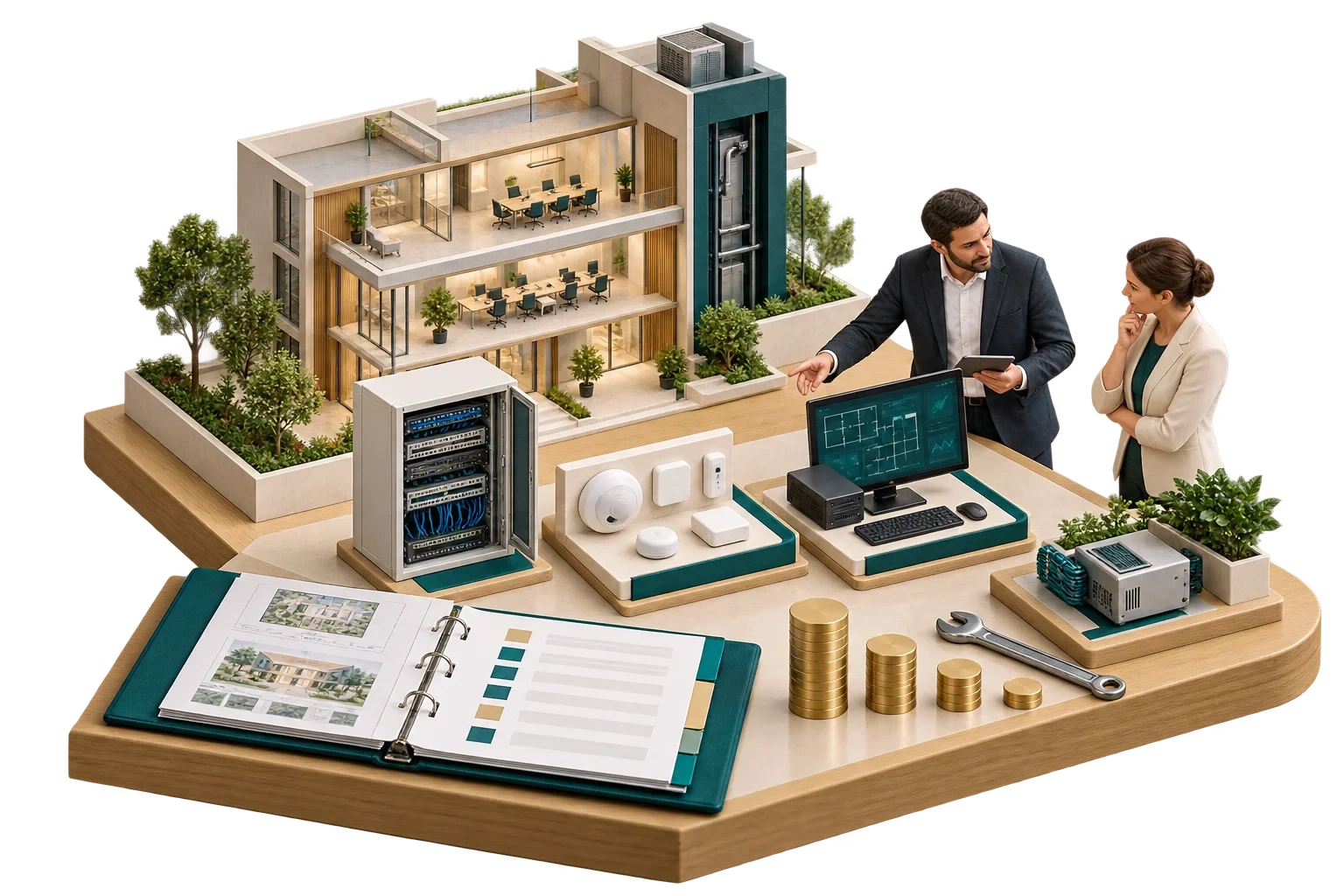
"What does a smart building cost per square metre?" is the question owners often ask first, and the one most likely to lead them astray. There is no reliable single price, because "smart building" describes a set of capabilities, not a product. What a project costs depends on which capabilities you need, how much of the infrastructure already exists, how many systems must be integrated and what has to be supported after handover.
A more useful question has three parts: what are the cost lines, which of them apply to my building, and what will I pay over the life of the system? The way to answer it is a cost model built line by line, with capital and recurring costs kept apart and every option compared over the same period.
Figures quoted per square metre or per room are rarely comparable. One may include the network and the building management system (BMS); another may cover nothing more than an analytics subscription. Some include design, commissioning and training, others leave them out. And much of what people call a smart building is already in the mechanical and electrical budget, in the form of controls, metering and access control, so the extra cost of making it "smart" can be small or large depending on how well those systems are specified. A number becomes comparable only once its scope is defined.
A more honest picture comes from breaking the scope into the lines below.
| Cost line | What it covers | Capital or recurring |
|---|---|---|
| Strategy, design and specialist advice | Requirements, use cases, architecture, specifications, tender support, design reviews | Capital |
| Network and IT infrastructure | Cabling, switches, wireless, servers or edge devices, cabinets, power and cooling for IT | Capital, with periodic refresh |
| Field devices | Sensors, meters, actuators, controllers beyond the base specification | Capital |
| Integration | Interfaces between systems, data mapping, naming and tagging, middleware or platform configuration | Capital, plus change costs |
| Software and platform | Licences or subscriptions for building operating systems, analytics, apps, maintenance systems | Often recurring |
| Cybersecurity | Segmentation, secure remote access, hardening, monitoring, assessments | Capital and recurring |
| Testing and commissioning | Factory and site testing, integrated systems testing, user acceptance | Capital |
| Handover and training | Asset information, documentation, operator training | Capital |
| Support and maintenance | Software support, updates, service contracts, help desk | Recurring |
| Connectivity | Internet and mobile data services for cloud platforms and devices | Recurring |
| Internal effort | Owner and operator staff time to manage the system and act on its outputs | Recurring, often unbudgeted |
| Lifecycle replacement | Replacing devices, gateways and servers as they reach end of support | Periodic |
Not every project carries every line. A retrofit that reuses an existing BMS and network may consist mainly of integration, software and commissioning. A new building may carry most of them, though some will already sit in other budgets.
Scope is the first driver: every additional use case, and every additional system to integrate, adds design, configuration and testing effort. The starting point comes next. Existing controllers, networks and meters can sometimes be reused, but only if their documentation and data are reliable, and inconsistent point names or missing asset data are a common source of unplanned integration work.
Openness matters as much as size. Open, documented protocols and interfaces reduce integration effort and the risk of paying the original supplier for every future change. Security effort, by contrast, scales with the system's exposure and criticality rather than with floor area. The procurement route shapes the outcome too: design and build transfers design responsibility to the contractor, which affects how well the smart building scope is defined and priced. Finally there is the support model, which depends on whether the owner, the contractor, a master systems integrator or a software provider looks after the system once the building is handed over.
The professional guidance points the same way. The RIBA Smart Building Overlay to the Plan of Work says that a high-level budget should be agreed at Stage 1 (Preparation and Briefing), covering specialist fees as well as the technology, and that clients should think in terms of total expenditure: capital plus operating cost. ISO 15686-5, the international standard on life-cycle costing for buildings (the 2017 edition, confirmed as current in 2024), frames such analysis over an agreed period. And the US National Institute of Standards and Technology's life-cycle costing handbook for federal energy projects explains why payback alone misleads: it ignores all costs and savings after the payback date, so alternatives should be compared over the same study period.
For smart building systems the point has real weight, because the recurring lines can be large. Software subscriptions, support and device replacement often run for as long as the building operates, while the hardware may need replacing well before the building's main services do.
A dependable estimate is built in a particular order, and it begins with the use cases and outcomes, because a cost estimate without a scope is a guess. Each use case then maps to the systems, devices and integrations it needs, some of which will already sit in the base budget. Only after that is each cost line estimated, capital and recurring separately, over a stated period of analysis.
When suppliers are involved, ask them to price against the same structured scope and to state their exclusions, assumptions and recurring costs explicitly. Review the estimate at each design stage, and in a retrofit keep a contingency for integration with existing systems. Only once costs and expected benefits are defined over the same period is it meaningful to compare them.
The first exercise needs no adviser. Take your two most recent quotations, map every line to the structure above and list what each one leaves out. The omissions may explain more of the price gap than the prices themselves. Pagin Consulting builds full cost models the same way, line by line and without generic price benchmarks.
This article connects to our work on Our services.
We can discuss the scope and the investment priorities.
Contact Pagin Consulting