
Smart Buildings
How do you design an ICT network for a smart building?
How to design a smart building ICT network from the services it carries, including zones and operational ownership.
Settle design responsibility between electrical and ICT teams before tendering a PoE installation.
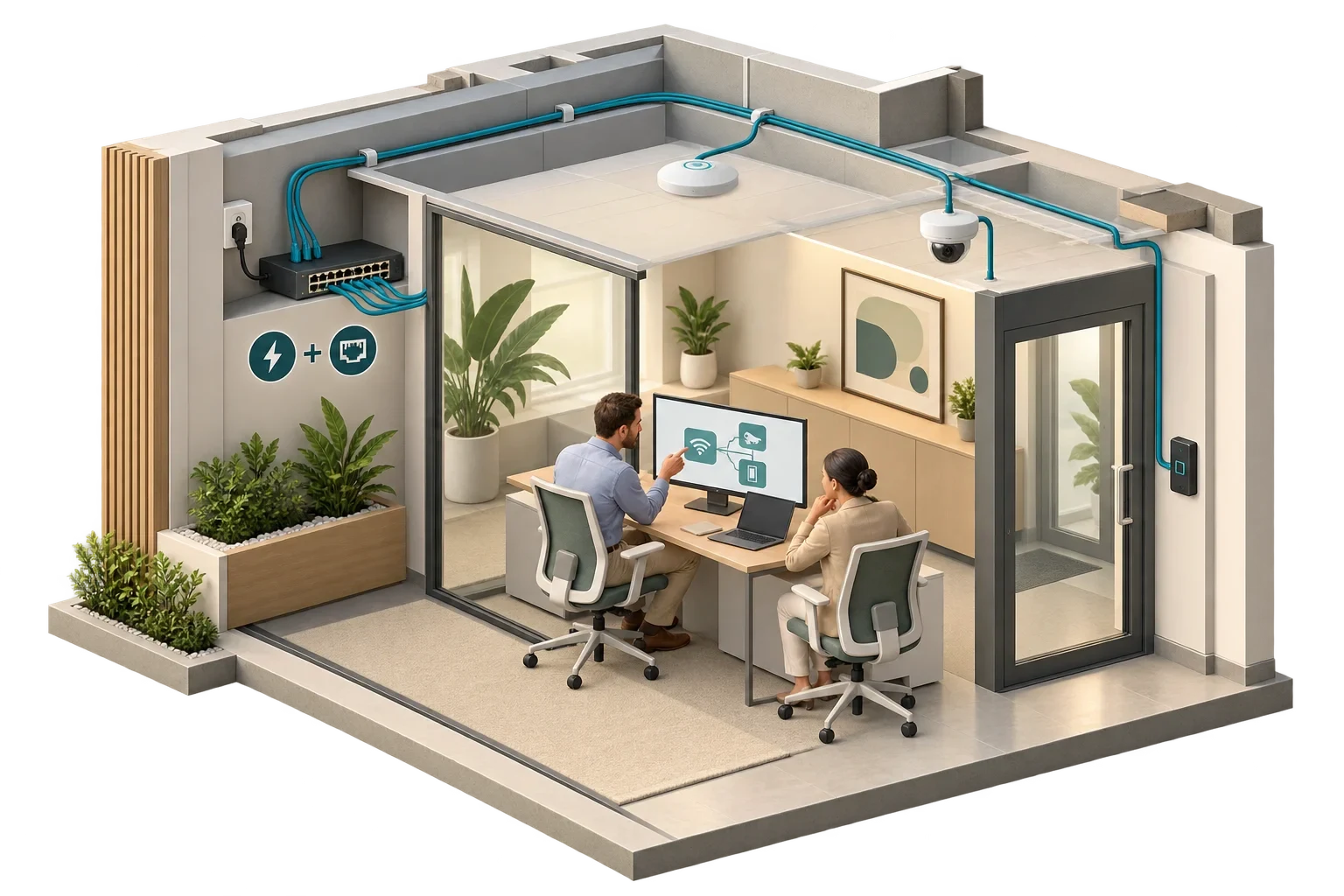
Power over Ethernet (PoE) carries electrical power and data to a device over the same twisted-pair Ethernet cable. The switch, or a separate injector, acts as the power source, and the connected device draws its power from the cable, with no need for a local socket. That device might be a wireless access point, a camera, a telephone, an access-control reader, a display, a sensor or an LED luminaire driver. Power is negotiated between the two ends, so only compatible devices receive it.
Building owners like PoE because it removes local power supplies, simplifies installation and lets devices be monitored and restarted remotely. It is also a design decision with consequences for switch sizing, cabling, cabinet power and resilience, and it belongs in the electrical and network design. It will not sort itself out once the switches are ordered.
PoE is defined in the IEEE 802.3 family of Ethernet standards. Early versions delivered power over two of the four pairs in a cable. The IEEE 802.3bt amendment (2018) extended standardised PoE to all four pairs and extended the power classification exchanged between switch and device, enabling higher power and more meaningful power management. IEEE now lists 802.3bt as superseded. Its content has been consolidated into the base standard, whose current edition, IEEE 802.3-2022, covers Power over Ethernet in Clause 145, so specifications should cite that edition, not the amendment.
The practical consequence is that devices and switch ports are specified by type and class. A ceiling-mounted camera with heaters, a multi-radio access point and a simple sensor need very different amounts of power. A specification should therefore state the standard, type and class each endpoint needs, taken from the manufacturer's documentation. "PoE" or "PoE+" on its own is too vague a label to price or test.
| Application | Why PoE helps | What to check |
|---|---|---|
| Wireless access points | Ceiling locations without sockets | Power class of multi-radio models |
| IP cameras | Remote locations, central backup power | Heaters, pan-tilt-zoom and infrared increase demand |
| Access control readers and door controllers | Central power and monitoring | Lock power may need a separate supply; fire-safety release requirements |
| IP telephones and intercoms | Desk and wall installation | Port density |
| Room displays and panels | Clean installation | Display size and brightness |
| Sensors and small controllers | Fewer power supplies | Whether wireless or field-bus is simpler |
| LED lighting | Individual control and data per luminaire | Lighting design, cable runs and switch density; electrical design responsibility |
Lighting is the application that changes the scale. PoE lighting can turn a lighting installation into a large network of powered endpoints. That can work well, but it moves lighting power from distribution boards to network cabinets, which changes the electrical, cooling and maintenance design, and it should be a deliberate joint decision by the electrical and ICT designers.
A switch has a per-port limit and a total PoE budget, and a 48-port switch may not be able to power 48 high-class devices at once. The budget should be calculated with every device at its maximum allocated power, leaving a documented margin.
Cable category, conductor size, run length and bundling all affect performance when power is carried, and larger bundles carrying power can run warmer. The cabling manufacturer's guidance should be followed, together with ISO/IEC TS 29125, the international technical specification on using generic building cabling for remote powering, and the installed cable tested.
Power delivered to endpoints is drawn through the switch, so network cabinets carry a larger and more critical electrical load, and the switch's own losses add heat. Supply capacity, protection and ventilation need coordinating with the electrical designer.
Centralising power makes backup easier, since one uninterruptible power supply in a cabinet can keep many cameras and readers running, but it also concentrates dependency. If a service must continue through a power interruption, the whole chain needs verifying: endpoint, switch, uplink, core and upstream supply. Separate circuits give no independence if they share the same upstream equipment.
PoE ports can be monitored and power-cycled remotely, which helps with fault recovery, but it also means switch configuration and access control now matter to building operation. Someone has to be named as the administrator of the switches.
Settle the boundary between the electrical and ICT teams before tender, in a single responsibility table both designers sign; it is where PoE projects are most exposed, particularly with PoE lighting or any large installation. Pagin Consulting, sitting on neither side, agrees that boundary and then checks the power budgets and continuity design against it.
This article connects to our work on Our services.
We can discuss how this subject fits the project brief.
Contact Pagin Consulting