
Energy & Sustainability
How does occupancy-based HVAC control work?
How occupancy-based HVAC control works, which signals to use, how to treat CO2 and how to design fallbacks.
Match lighting strategies to how each space is used, and commission them with the people who use it.
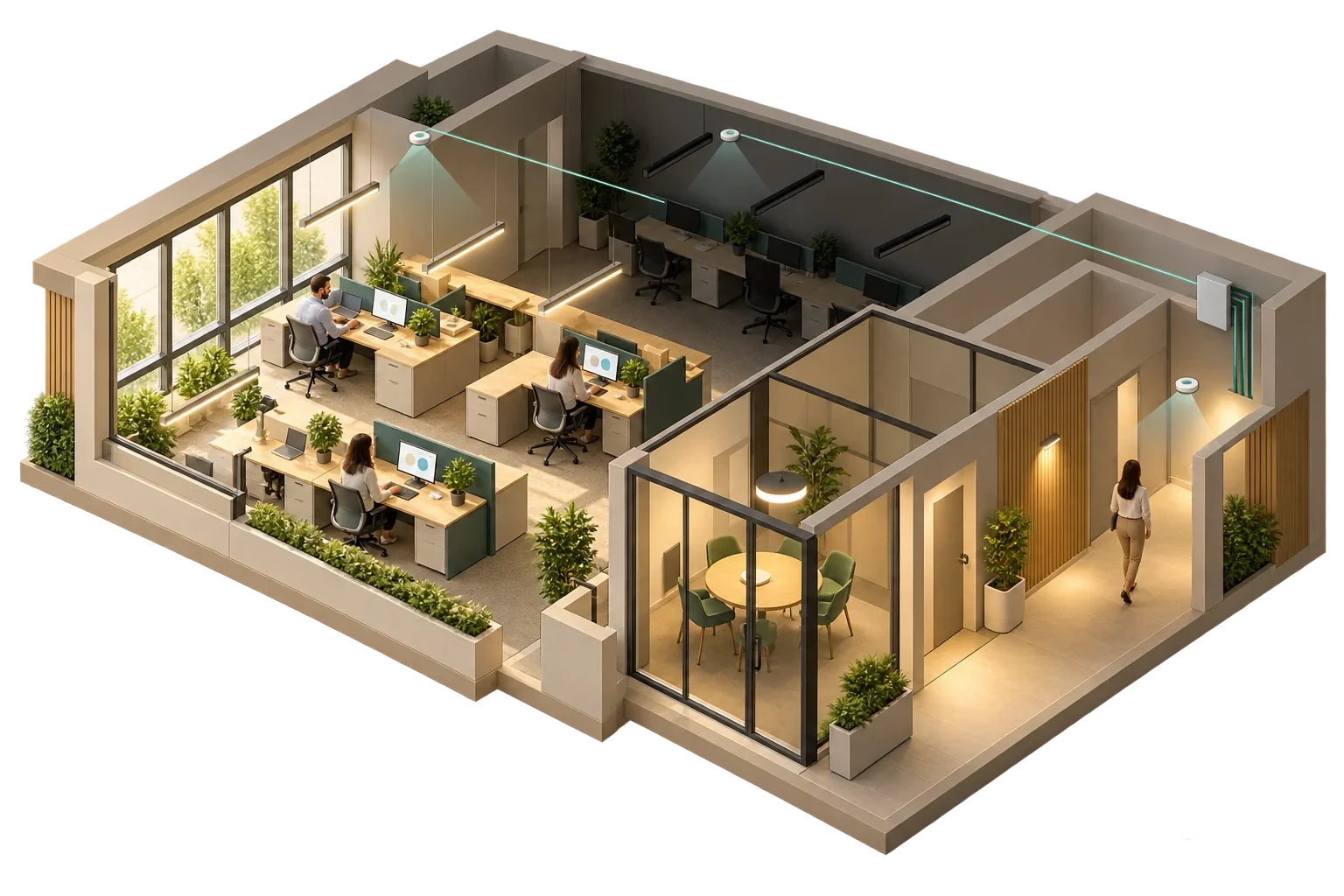
Smart lighting saves electricity in two ways: it shortens the hours that lights are on, and it reduces how much light they produce when they are. It does this by switching or dimming according to schedules, presence and available daylight, so the savings depend on how a space is actually used. They also depend on the people in it. If the controls are inconvenient, occupants disable them, tape over sensors or lobby for permanent overrides, and the savings disappear. A lighting control design has to work for the energy budget and for the person sitting under the luminaire.
| Strategy | Works well for | Watch out for |
|---|---|---|
| Time scheduling | Predictable operating periods; common areas | Late working; holidays; exceptions |
| Presence detection (switch on and off automatically) | Intermittently used spaces: toilets, stores, corridors | Lights turning off on still occupants |
| Absence detection (manual on, automatic off) | Offices and meeting rooms with daylight | Users must be able to find the switch |
| Daylight-responsive dimming | Perimeter zones and spaces under rooflights | Zoning and sensor placement |
| Task tuning (setting maximum output to what is needed) | Over-lit spaces after LED retrofit | Agreeing target levels with users |
The strategies work best in combination. The US Federal Energy Management Program's lighting checklist sums up the principles: use controls to cut hours of operation and to match light levels to tasks; locate and commission occupancy sensors carefully, because both are critical to correct operation; and select and calibrate controls with care so that occupants accept them. For daylit offices and task areas it recommends continuous dimming with photocell sensors, with lighting circuits laid out to follow daylight patterns.
Zoning is where those principles succeed or fail. A single sensor covering a large or irregular area will leave some people undetected, while too many small zones make the system hard to understand and maintain. Daylight zones should follow how far daylight actually reaches into the floor, whatever the ceiling grid suggests.
Sensor coverage should be tested with people seated and working, not with someone walking briskly through an empty office, because a still occupant is exactly what a poorly placed sensor misses. Time delays, dimming response, daylight calibration and local controls all need checking, and occupants need a simple, comprehensible way to adjust lighting within agreed limits.
Emergency lighting and other life-safety functions should keep their own design, testing and maintenance arrangements, coordinated with the appropriate specialists. Putting normal and emergency lighting on one control platform is fine; letting it blur who is responsible for each is not.
Networked lighting controls can feed occupancy data to other systems, such as HVAC or space-utilisation reporting. Lighting is also one of the domains rated by the EU's Smart Readiness Indicator, which assesses what the controls are capable of, not the savings they achieve. Whoever uses lighting occupancy data needs to understand what it means, and how reliable it is: presence in a zone is not a headcount.
Book a review of operating hours, override patterns and occupant feedback for three months after occupation, and a second at the first change of season. A control strategy that suited September can irritate people by December, and only the second review will show it.
This article connects to our work on Sustainability.
We can discuss how this subject fits the project brief.
Contact Pagin Consulting