
Energy & Sustainability
How can smart lighting reduce energy consumption?
How smart lighting reduces energy use through schedules, occupancy and daylight control, and how to keep savings persistent.
Decide what each space does when the occupancy signal is missing or wrong before committing to the strategy.
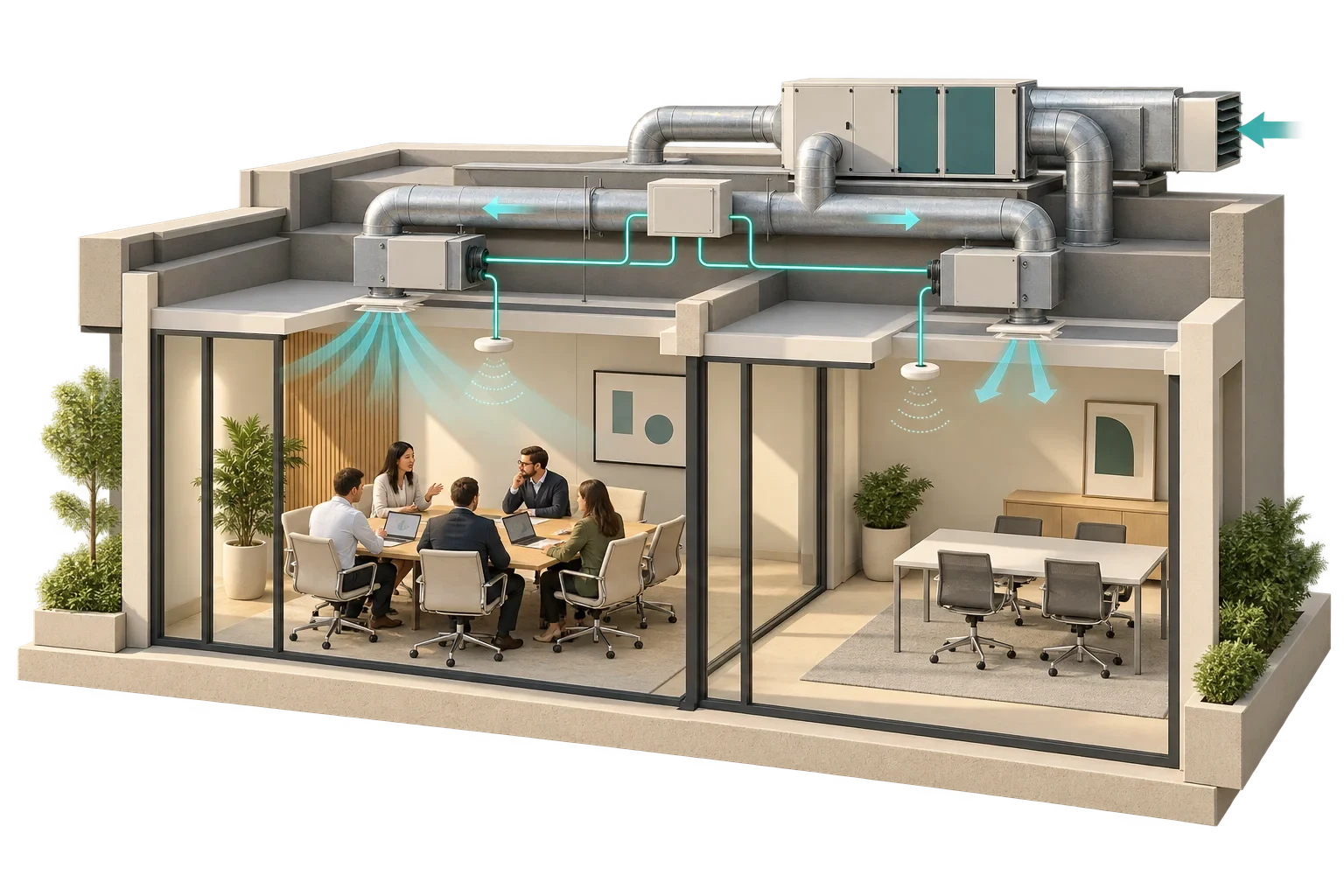
Occupancy-based HVAC control adjusts heating, cooling and ventilation according to whether a space is in use, when it will be, or how many people are in it. The energy saving comes from not conditioning empty spaces at full output. Buying the sensor, however, is the easy part. The result depends on the control response: what the system does with the signal, how quickly it recovers, and what happens when the signal is wrong. Ventilation, comfort, humidity and equipment constraints apply whether or not anyone is detected.
| Signal | What it tells you | Typical weakness |
|---|---|---|
| Time schedule | When a space is expected to be used | Wrong whenever use changes |
| Room booking | Intent to use a space | No-shows; unbooked use |
| Presence sensor (e.g. passive infrared) | Someone is moving in view now | Misses still occupants; coverage gaps |
| People counter | How many have entered and left | Counting errors accumulate |
| CO₂ concentration | Indicator of occupant-generated CO₂ and ventilation | Lags occupancy; sensor accuracy and location |
No single signal is reliable everywhere, so the art lies in combining them according to the space and the cost of getting it wrong. A booking can trigger preparation; presence can confirm use or release an unused booking; CO₂ can modulate ventilation once people are present.
Demand-controlled ventilation using CO₂ is an established technique; a 2023 addendum to ASHRAE Standard 62.1 added CO₂ differentials for use with it. ASHRAE's position document on indoor carbon dioxide, approved by its board in February 2025, adds two cautions that matter for control. Demand-controlled ventilation sequences are often more complex than simple on/off thresholds, particularly where occupancy varies and with multiple-zone and recirculating systems. And Standard 62.1 does not set an indoor CO₂ limit, despite a widespread belief that it sets 1,000 ppm.
The practical consequence is that a CO₂-based sequence still needs a minimum ventilation rate for pollutants that people do not produce, sensors placed where they represent the breathing zone, and a calibration routine.
A good specification describes behaviour in each mode, typically occupied, standby and unoccupied. It sets how long after the last detection a space moves to standby and then to unoccupied, how far set points and airflow move in each mode, and how quickly the space must recover when people return. It also says what happens when the sensor or network fails, and the safe answer is usually to revert to the occupied schedule, not to switch off.
Rapid switching is the other trap. A room that cycles between modes every few minutes when signals fluctuate wastes energy and annoys the people in it.
Commissioning should test with people sitting still, not just someone walking through the room. Recovery times, sensor coverage and the way occupants can request comfort or override within limits all need confirming, and trends should be reviewed after occupation, because use patterns rarely match the design brief.
Settle one question before committing to occupancy-based control: what should each space do when the occupancy signal is missing or wrong? The answer shapes the sensors, the operating modes and the acceptance tests.
This article connects to our work on Sustainability.
We can discuss how this subject fits the project brief.
Contact Pagin Consulting