
Data Centres & AI Infrastructure
How do you design structured cabling for a data centre?
How to design data centre cabling from the network architecture to pathways, with clear design responsibilities and tender requirements.
Data Centres & AI Infrastructure
Define the traffic each workload creates before choosing a fabric, and accept on useful performance.
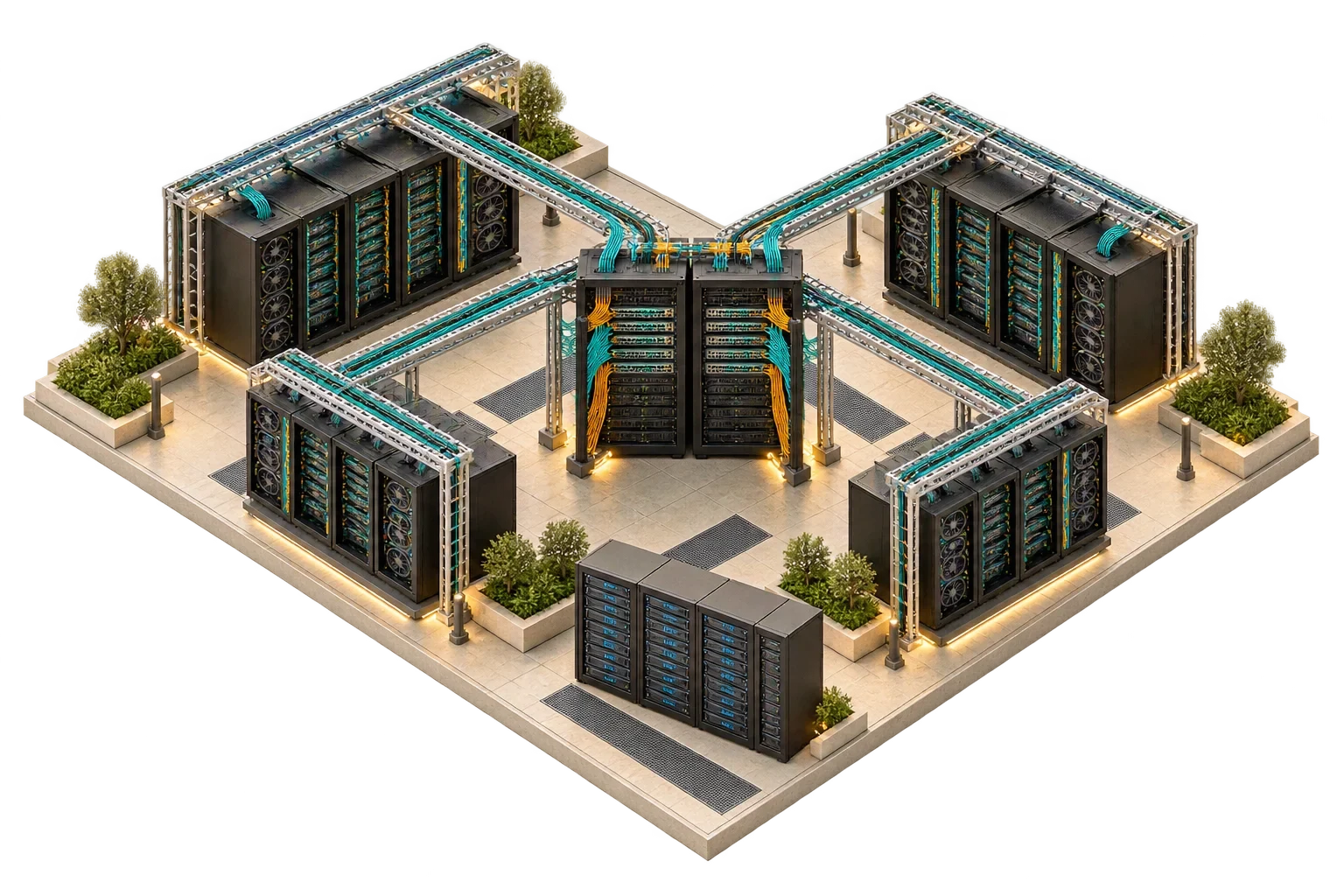
Expensive accelerators are only as fast as the network that feeds them, and what that network must look like depends on the workload. Training a model across many servers needs a dedicated, very fast, low-latency network between them, because the servers spend much of their time exchanging results. Running a trained model to answer requests, known as inference, is often much closer to ordinary data-centre networking. Preparing data needs high throughput to storage. Working out which of these you are doing, and the traffic each creates, is the starting point; the choice of technology follows from it.
Nor does a high link speed on a datasheet prove that the complete system will perform. Topology, congestion behaviour, storage throughput and physical layout all play their part.
One published reference design, NVIDIA's DGX SuperPOD architecture for the DGX H100 generation, uses four separate networks. Other vendors' designs differ in detail, but the division of labour is instructive.
| Network | Purpose in the reference design |
|---|---|
| Compute fabric | Server-to-server traffic for distributed jobs; InfiniBand, rail-optimised, full fat-tree topology |
| Storage fabric | Access to shared storage over its own InfiniBand fabric; per-server I/O must exceed 40 GB/s |
| In-band management | Ethernet linking the cluster-management services, the home file system, and services outside the cluster such as container registries, code repositories and data sources |
| Out-of-band management | A separate Ethernet network connecting the management ports of servers, storage, network equipment and rack power distribution units |
Not every deployment needs this structure, but the separation of concerns is a model to copy. The guide explains that the out-of-band network sits on its own fabric because there is no case in which users need access to those ports. A management network that stays available when the production fabric is congested or failing is what lets operators recover the system.
NVIDIA's reference architecture recommends that if fewer servers are bought than a full scalable unit, the fabric should still be built for the full unit, leaf switches and leaf-to-spine cables included, with the unused positions left empty, so that traffic routing and performance stay consistent. Growing the network piecemeal around whatever has been purchased can create uneven performance that is hard to diagnose.
Any deviation from a supplier's validated architecture needs engineering review. Components that look interchangeable on paper may behave differently under load.
High-performance fabrics impose physical limits. Cluster designs can cap the total cable path of each fabric link, and a power constraint that forces racks to spread out can lengthen cables and affect latency. Supported link distances, transceiver types, tray capacity, patching and maintenance access therefore need fixing before rack positions are final, with space reserved for the next stage.
When a job runs slowly, the cause could be the compute fabric, storage, the servers, the software or the facility itself; a cooling constraint can throttle processors. Monitoring should let the team tell these apart, and the contract should say who investigates a problem that spans several suppliers.
Link-level test results are necessary but not sufficient. The acceptance method, agreed with the IT and application teams, should measure what the business actually cares about: job completion time or throughput on representative workloads, behaviour when a link or switch fails, and recovery time.
Write the acceptance tests before the order is placed, because a supplier that knows how the system will be judged designs for it. Pagin Consulting handles the physical side (pathways, cabling, rack positions and the management network) for whichever architecture is selected.
This article connects to our work on Our services.
We can discuss how this subject fits the project brief.
Contact Pagin Consulting