
Cybersecurity & Resilience
How do you secure a smart building against cyberattacks?
How to secure a smart building's control systems as operational technology through an owner-led programme.
Agree the boundary between IT and facilities security responsibilities in one meeting, then write it into contracts.
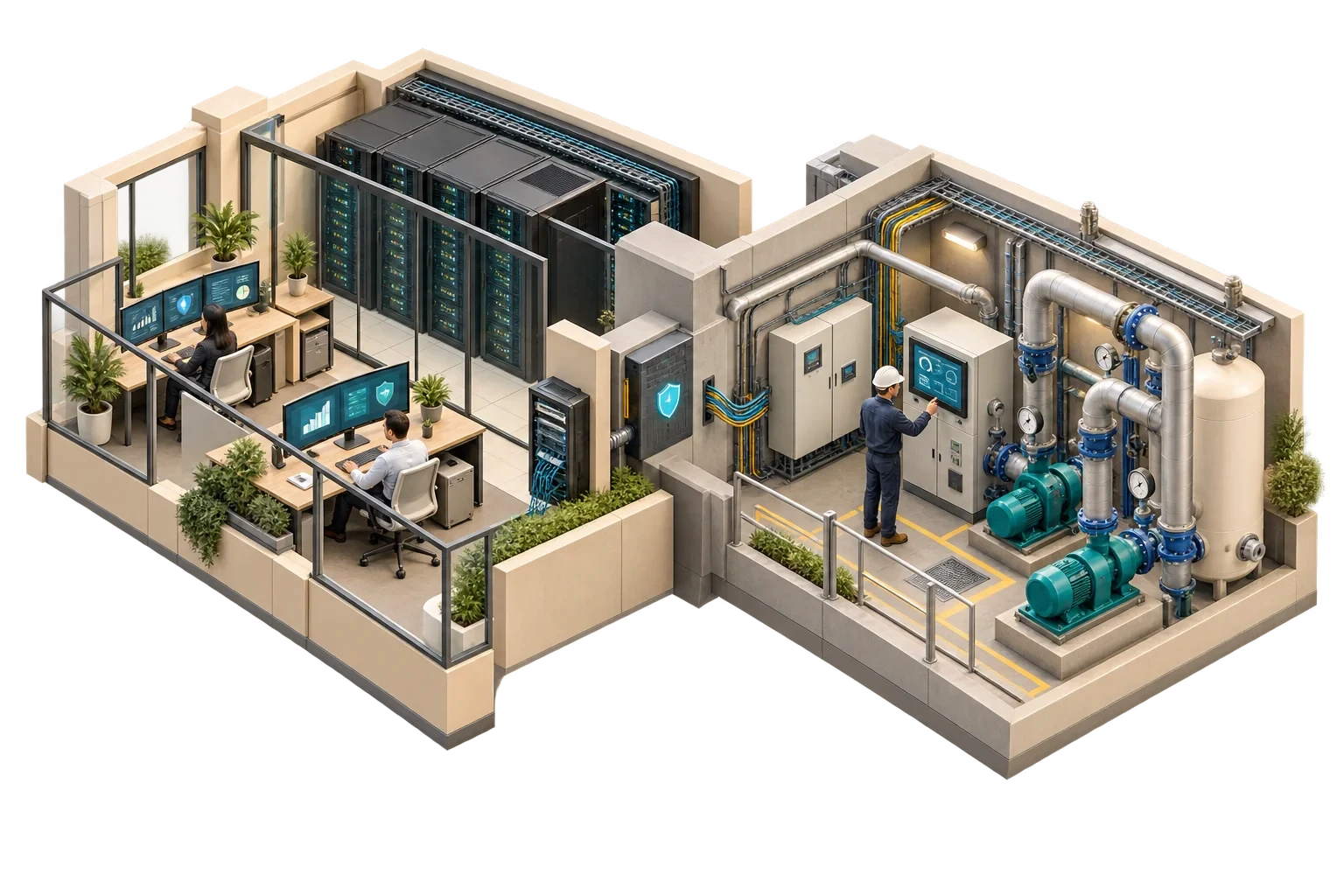
IT cybersecurity protects information systems such as email, finance and booking platforms, where the main concerns are usually the confidentiality and integrity of data. OT cybersecurity protects operational technology: the controllers, sensors and supervisory software that run physical equipment such as air handling, lighting, lifts and door access. In OT, the first concern is that the equipment keeps operating safely and predictably.
The two disciplines share many techniques, which is precisely what makes the difference dangerous to ignore. Office IT practice applied to building plant without adjustment can cause the very outage it was meant to prevent. The sensible response is to agree in writing who does what across the boundary, before an incident forces the question.
NIST's guide to OT security, SP 800-82, sets out how OT differs from conventional IT. The table summarises the points that most often matter in buildings.
| Topic | Typical IT environment | Typical building OT environment |
|---|---|---|
| Main risk | Loss, theft or alteration of data | Unsafe or unavailable physical operation |
| Availability | Planned restarts are routine | Plant may need to run continuously; outages need planning |
| Timing | Tolerates some delay | Some control functions need dependable, timely responses |
| Updates | Patches applied quickly, often automated | Updates need vendor and site testing and a planned window |
| Device resources | Modern operating systems with security features | Controllers may lack encryption, logging or strong authentication |
| Protocols | Standard enterprise protocols | Building protocols such as BACnet, Modbus or KNX, plus vendor-specific interfaces |
| Support | Many possible support providers | Support sometimes available only from one vendor or its partners |
| Lifetime | Often three to five years | NIST cites 10 to 15 years or longer |
| Who operates it | IT staff | Controls engineers, facilities teams and contractors |
NIST adds two points that should shape every decision. Security measures must not impair safety. And some third-party security software cannot be installed on OT systems without the vendor's agreement, because doing so can affect support.
Active network scanning is routine in IT. NIST cautions that the indiscriminate use of IT security practices in OT can disrupt availability and timing, particularly on resource-constrained devices. That is not an argument against assessing OT. It means agreeing the method, timing and scope with the controls engineer, testing on a sample first, and scheduling the work for a time when the plant can tolerate a problem.
The IT default is to patch quickly. In building OT, an update may change how a controller behaves or require re-commissioning, and NIST notes that OT owners often need to plan outages days or weeks ahead. The aim is still to keep systems supported; only the route differs. Each update is assessed, tested where possible and scheduled, and compensating measures are recorded when an update has to wait.
IT identity systems can usually enforce strong authentication everywhere. Many building controllers cannot. A realistic design concentrates strong authentication at the points of entry, such as remote-access gateways and engineering workstations, and uses network segmentation to limit what an attacker could reach from a weak device.
An IT response plan might isolate an infected laptop immediately. Isolating a building controller can stop the plant it runs. OT response plans therefore need operational input on which systems can be disconnected safely, what local or manual operation looks like, and who has the authority to decide.
None of this exempts OT from good practice. The differences are about priorities and methods. Both environments need an asset inventory, controlled access, supported software, monitoring, backups and tested recovery, and the NIST Cybersecurity Framework 2.0 applies to both. Its Govern, Identify, Protect, Detect, Respond and Recover functions give the board, the IT team and the facilities team a common language.
The ISA/IEC 62443 series, developed specifically for industrial automation and control systems, explicitly includes building automation in its scope. It treats security as a responsibility shared between asset owners, product suppliers, integrators and service providers, which makes it a useful reference when deciding which party owns which part of the work.
A building owner may well have an IT team that understands security and a facilities team or contractor that understands the plant. Neither can secure building OT alone. A short responsibility matrix settles the questions that otherwise fall between them:
| Area | What the matrix must settle |
|---|---|
| Network infrastructure | Who designs, configures and maintains switches, firewalls and wireless for building systems |
| Building systems | Who administers controllers, supervisory software and their accounts |
| Change approval | Who must agree before a change on either side of the boundary |
| Remote access | Who approves, enables and monitors supplier sessions |
| Monitoring | Who reviews security events from building systems, and what they escalate |
| Updates | Who assesses, tests and schedules updates for each system |
| Incidents | Who leads, who can disconnect what, and who operates the building meanwhile |
NIST recommends a cross-functional team that includes IT staff, a control engineer, a system operator, a security specialist, management and physical security, with the control system vendor or integrator consulted. In a building, several of those roles may fall to the same few people, and the team may meet only monthly. What matters is that it exists and has authority.
New buildings often run their building systems over the same physical network infrastructure as IT, separated logically. That can be sensible and economical. It also means a configuration error made for IT reasons can affect plant. If the infrastructure converges, the change process should converge with it, so that a firewall rule or switch update touching a building zone is reviewed by someone who understands the consequences.
If your IT and facilities teams have never sat down together to agree where the boundary lies, arrange that meeting before anything else, and do not end it without a responsibility matrix that names an owner for every system on both sides of the line.
This article connects to our work on Our services.
We can discuss how this subject fits the project brief.
Contact Pagin Consulting