
Strategy, Costs & Procurement
What should a smart building tender specification include?
A practical guide to specifying outcomes, interfaces, data rights, responsibilities, testing and support so smart building bids can be compared.
Base handover on integrated and failure tests witnessed against agreed scenarios, not on each contractor's own view.
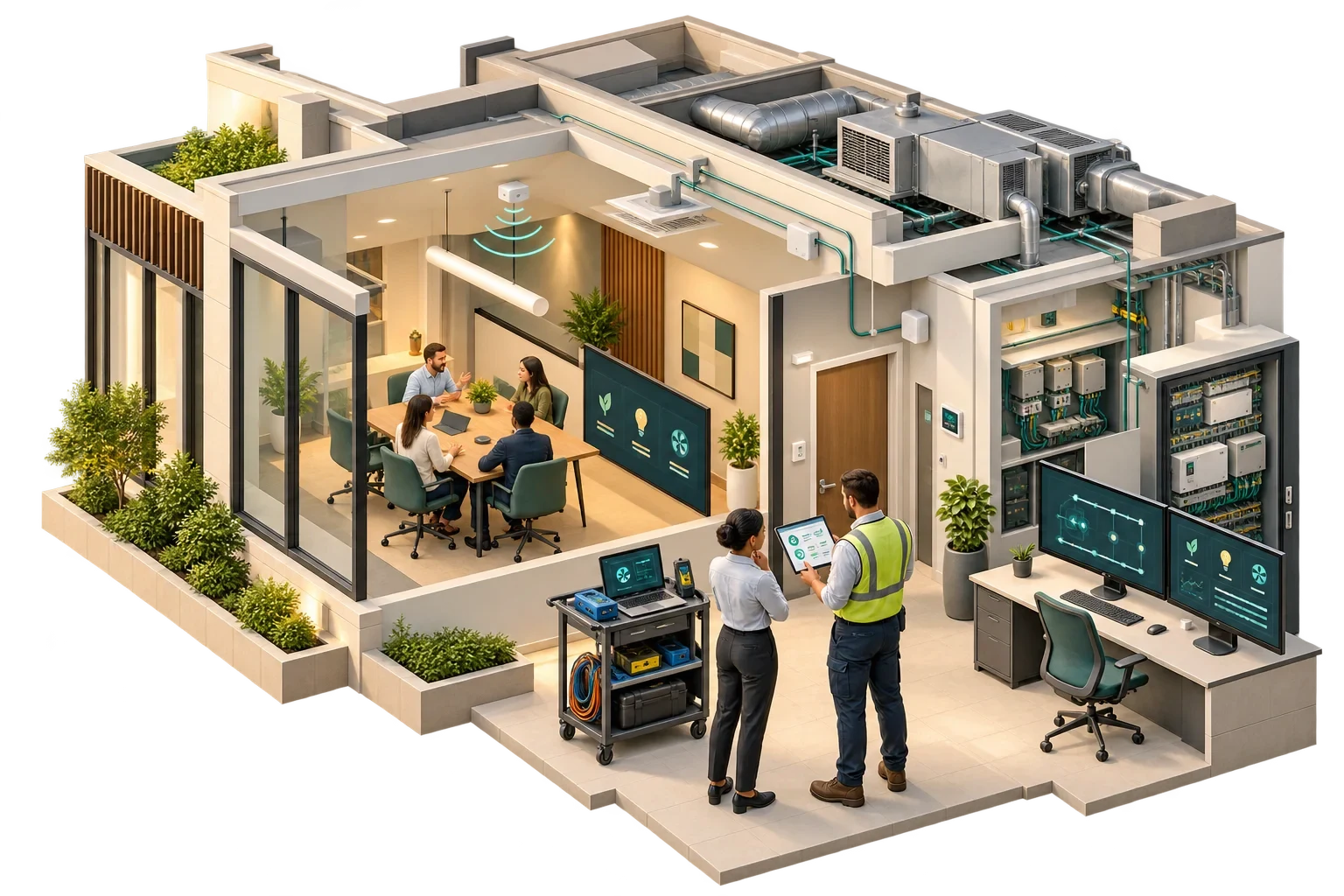
Integrated systems are tested in layers: each device and point, then each system on its own, then each interface between two systems, and finally complete end-to-end scenarios that cross several systems, including what happens when something fails. User acceptance by the people who will operate the building closes the sequence, alongside a plan for the tests that can only happen once the building is occupied or the season has changed. Commissioning is the wider quality process that sets the requirements those tests verify.
Three decisions make the difference between a building that is handed over and one that works. The integrated test scenarios should be written during design. One party should be clearly responsible for running integrated tests across packages. And handover should wait until the end-to-end scenarios and failure tests have passed.
ASHRAE Guideline 0 (2019 edition) describes the commissioning process as a quality process for verifying that a facility and its systems meet the owner's project requirements. ASHRAE/IES Standard 202, most recently issued in 2024, sets out commissioning process requirements for new buildings and new systems, and ASHRAE Standard 230-2022 covers existing buildings. Commissioning starts with documented requirements and runs through design, construction, handover and early operation. Testing is one part of it: the evidence that the requirements have been met.
With integrated systems, the weak point is rarely the testing of individual systems, which each contractor carries out for its own package. It lies between the packages, where no single contractor is responsible. ASHRAE Guideline 1.1, for instance, describes validating interfaces and possible interferences between building systems as part of HVAC&R commissioning.
Scroll horizontally to read the full table.
| Layer | What is tested | Typically run by | Typically witnessed by |
|---|---|---|---|
| Factory or desktop | Configuration, interface behaviour and security settings before site installation | Supplier or integrator | Integrator, consultant |
| Point-to-point | Each sensor, actuator and point reads or acts correctly, with the right name and location | Installing contractor | Commissioning manager, sample checks |
| System functional | Each system's sequences and alarms perform as specified | System contractor | Commissioning manager, designer |
| Interface | Each message or data exchange between two systems, against the interface schedule | Integrator, with both system contractors | Consultant, owner's IT |
| Integrated scenario | End-to-end use cases across several systems | Integrator or master systems integrator | Owner, operator, consultant |
| Failure and recovery | Behaviour on loss of power, network, server, cloud service or interface, and recovery | Integrator with all contractors | Owner, operator |
| Security acceptance | Accounts, remote access, segmentation and hardening as specified | Integrator, owner's IT or security adviser | Owner's IT |
| User acceptance | Operators and users complete their real tasks | Operators | Owner |
| Deferred and seasonal | Tests that need occupancy or different weather | Commissioning manager | Operator |
The RIBA Smart Building Overlay to the Plan of Work (2024) recommends testing smart building systems in a factory environment before site installation where appropriate, and carrying out asset tagging under factory conditions where possible, coordinated with the room naming strategy. It also recommends a user acceptance period for operational applications at handover. Factory testing is worth the effort because it finds configuration and interface faults while they are cheapest to fix.
An integrated scenario follows a use case from trigger to outcome and states the expected result at every step. A complete one sets out the trigger and starting conditions, each system involved and what it should do, the expected timing, what each user should see, and how the scenario ends, including how alarms, tasks or overrides are cleared. It also names the evidence to be recorded, whether screenshots, logs or trend data.
Each scenario then needs its failure versions. What happens if the integration server is offline, the network link to one floor is down or a cloud service is unavailable? The answer should match the agreed degraded mode for each system.
Life-safety interfaces, such as fire alarm signals to ventilation or access control, are a special case. They are tested under the fire strategy and the relevant regulations, with the fire engineer and the approving authority, and integrated testing should include them only in the way those parties agree, without changing them.
Integrated tests often fail for avoidable reasons, the commonest being that they started too soon. Entry criteria prevent this: point-to-point and system tests complete and signed off, network and security configuration in place, interface tests passed and test data available. Starting before those conditions are met wastes everyone's time and hides the root cause of defects.
Defects need a single log across all packages, each with an owner, a severity and a retest date. For a defect at an interface, both parties are recorded and one is agreed to lead the fix. Every fix is retested, along with any earlier tests it could affect.
Some things can only be tested in use: heating in winter, cooling in summer, occupancy-based control with real occupants. These deferred tests should be listed at handover with dates and responsibilities. Monitoring-based or continuous commissioning can carry verification on into operation, but it does not replace completing the integrated tests before handover.
Scenarios, failure tests, entry criteria and the defect process belong in the specification, not the commissioning plan. They are used at the end, but they are design-stage work, and no contractor can be held to a test that was never in its contract.
This article connects to our work on Our services.
We can discuss how this subject fits the project brief.
Contact Pagin Consulting