
Data Integration & Ontologies
What is Brick Schema and why is it used in smart buildings?
What Brick Schema is, why owners use it, what it does not do and how to keep a Brick model maintained.
Choose an ontology approach by the questions you need answered, and fund its maintenance.
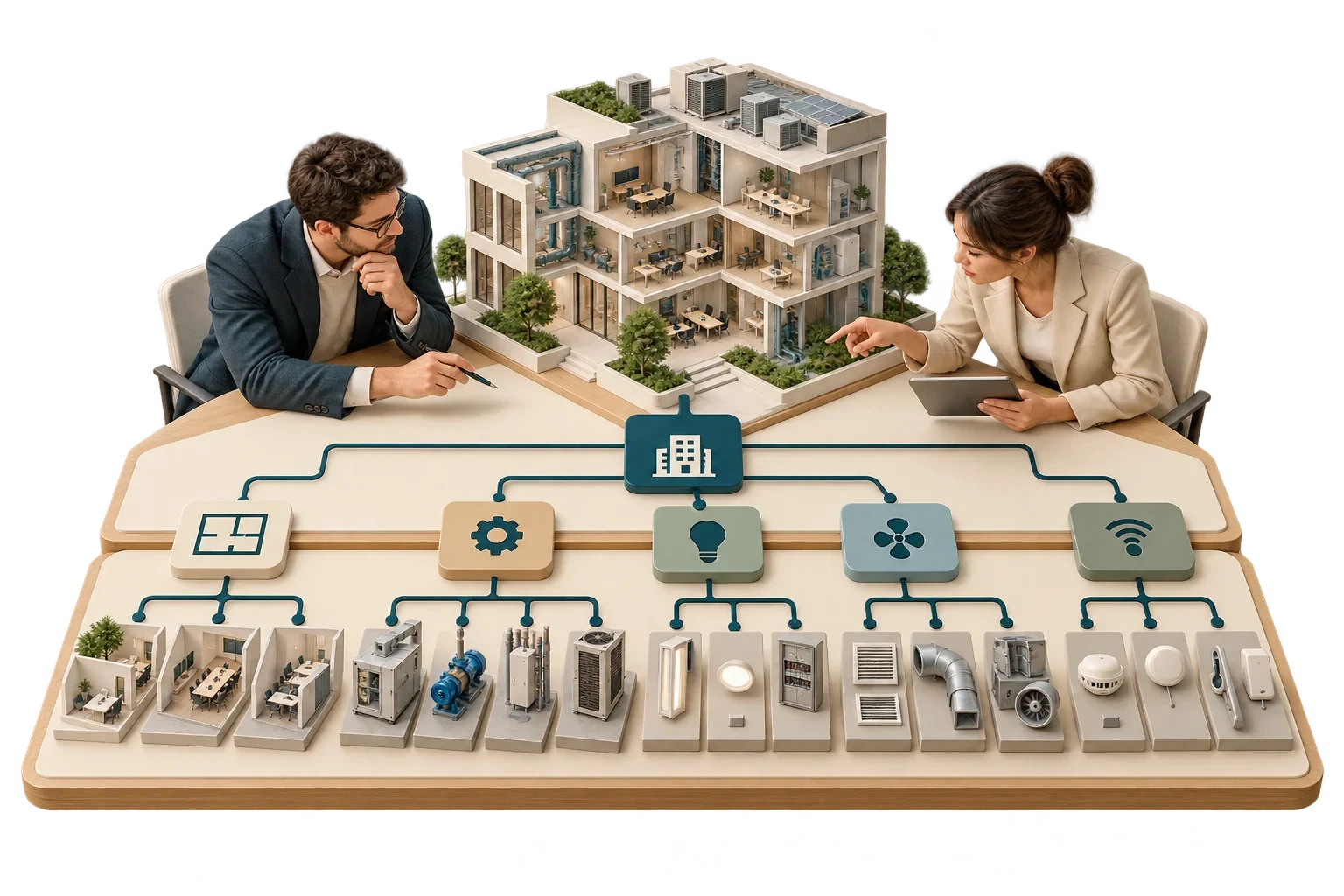
A building ontology is a formal, shared definition of the kinds of things that exist in a building, such as equipment, systems, spaces, sensors and meters, and of the ways they can be related. It lets software record that an item is a pump, that it is part of a heating system, that it serves a particular set of spaces, and that a given sensor measures its outlet temperature. A list of point names and values cannot carry that context reliably; an ontology can.
The word comes from philosophy, but in practice an ontology is a carefully defined vocabulary plus rules about how its terms connect. Project Haystack's documentation shows the progression in a single model, from formally defined tag names up to an ontology of relationships between them.
Without them, every application has to be taught each building's naming conventions by hand. With them, an application can ask a question once, say "find every air-handling unit and its supply-air temperature sensor", and get an answer in any building modelled the same way. That is the foundation for portfolio analytics, for reusable fault detection and for applications that can move from one building to another.
Several open building ontologies are in use, each with a different emphasis:
| Ontology | Emphasis |
|---|---|
| Brick | Equipment, points, spaces and their relationships, as an RDF graph |
| Project Haystack | Tags with formal definitions, taxonomy and ontology for equipment and points |
| RealEstateCore | Real-estate concepts: buildings, spaces, organisations, and their data; distributed together with Brick since Brick 1.4.0 |
| Google Digital Buildings | Entity types with defined data fields, plus configuration and validation tooling |
| SAREF and its extensions | ETSI reference ontology for smart applications, with domain extensions such as SAREF4CITY |
| ASHRAE 223P | Proposed ASHRAE standard semantic model, not yet final (its second public review ran from April to June 2026), with community open-source tooling published as open223 |
They overlap, and some are converging. The choice is usually driven by the tools, suppliers and skills available, and by the questions the owner needs answered.
ETSI's SAREF principles describe the aim of a shared reference model: different semantic assets keep their own terminology but relate through common semantics, so that one set of mappings to the reference replaces a dedicated mapping between every pair. That is a genuine benefit. It still requires the mappings to be made, though, and the underlying information to be right. If nobody knows which unit serves which floor, the ontology has nothing correct to record.
The model should be shaped by the decisions it must support, with the vocabulary and level of detail following from them. Maintenance planning, energy analysis and space management need overlapping but different relationships, and modelling every conceivable detail on day one consumes budget without improving the first decision.
Established vocabularies should be used wherever they fit. Where an extension is unavoidable, it should be documented, kept small and accompanied by a plan to migrate if the shared ontology later covers the same concept. Recording the versions used means another team can still interpret the model in five years' time.
Changes need an approver, too. Renaming a room, replacing a controller or splitting a tenancy may require several relationships to change as well as a label.
An ontology is only as useful as the context someone is prepared to maintain. Choose the approach and name the person responsible for keeping it current in the same decision.
This article connects to our work on Our services.
We can discuss how this subject fits the project brief.
Contact Pagin Consulting